a16z
Oct 28, 2026

a16z’s Ben Horowitz says the agent era could turn every employee into a manager

Ben Horowitz and Michael McGuiness argue that AI agents are set to reshape how companies operate, with Databricks serving as their main example. Their core claim is that once agents can query business data, take action, and track outcomes inside a shared enterprise system, companies will need fewer layers devoted mainly to passing information up and down the chain. In that setup, frontline workers gain more direct access to context and decision-making, while management stops being concentrated in a narrow class of professional managers. The piece traces that argument through Databricks’ product evolution from Spark to Lakehouse and then Lakebase, before introducing what CEO Ali Ghodsi calls a System of Record for Agents, or SORA. The authors say an agent-ready enterprise system must answer four questions on a continuous basis: what is true, what that information means, what actions are allowed, and whether those actions worked. They also argue that a company’s long-term edge in the AI era will depend less on access to the latest model and more on whether it can retain its own business ontology, permissions, feedback loops, and decision history inside systems it controls. Their broader conclusion is that AI may not make everyone a software engineer. Over time, it may push more people into work that looks managerial: defining goals, assigning tasks, reviewing outputs, and updating processes.


1530
a16z’s Ben Horowitz says the agent era could turn every employee into a manager
Databricks
Oct 27, 2026

Databricks annualized revenue tops $7 billion with 80% growth

Databricks, an AI infrastructure company, has surpassed $7 billion in annualized revenue, with year-over-year growth reaching 80%, according to Techub, citing Crypto Briefing. The figures point to continued momentum at the company as it scales its business at a rapid pace. The report also said Databricks’ strong growth and elevated valuation reflect rising market confidence in AI infrastructure and sustained demand for the sector. The update adds to signs that investor and customer interest in AI-related infrastructure remains strong as companies continue to spend on the tools and platforms that support artificial intelligence workloads.

490
Databricks annualized revenue tops $7 billion with 80% growth
SpaceX
Oct 22, 2026

SpaceX launches Super Intelligence partner network with Nvidia and others

SpaceX has launched its SpaceX Super Intelligence, or SI, partner network, according to ChainCatcher. The partners named in the brief update are Nvidia, Apollo, Databricks, and Bain Capital. No additional details were provided in the source about the structure of the network, the scope of the collaboration, or any timeline tied to the initiative. The item was published as a 7x24 news flash, and the report only states that the partner network has been introduced and identifies the organizations involved.

670
SpaceX launches Super Intelligence partner network with Nvidia and others
AWS
Oct 3, 2026

AWS, Cloudflare and Databricks move to adopt decision models after Jev

After Jev’s release, AWS, Cloudflare and Databricks have each rolled out products or platform features tied to decision models, pointing to faster adoption of the architecture in AI tooling. AWS introduced the open-source Strands Decider 2B, built on Qwen3.5-2B with its text generation module removed and replaced by a dedicated answer-selection component, then fine-tuned with LoRA. In AWS’s tests, median latency for a single decision was about 115 ms on an RTX 3090, while full training took roughly 11 hours. Cloudflare released two open-source models, Clef and Clef-flash, adapted from Qwen3.8-27B and Qwen3.5-9B. In Cloudflare’s tests on Jev’s official benchmark set, the Clef series outperformed Jev in three of four task categories, and Clef-flash posted 38.8 ms median latency versus 524.1 ms for Jev. Databricks, meanwhile, integrated the capability into its platform through ai_decide, which can be called from SQL or a REST API for classification, scoring and agent routing, with direct compatibility for the TypeSafe AI API.

1820
AWS, Cloudflare and Databricks move to adopt decision models after Jev
a16z
Aug 19, 2026

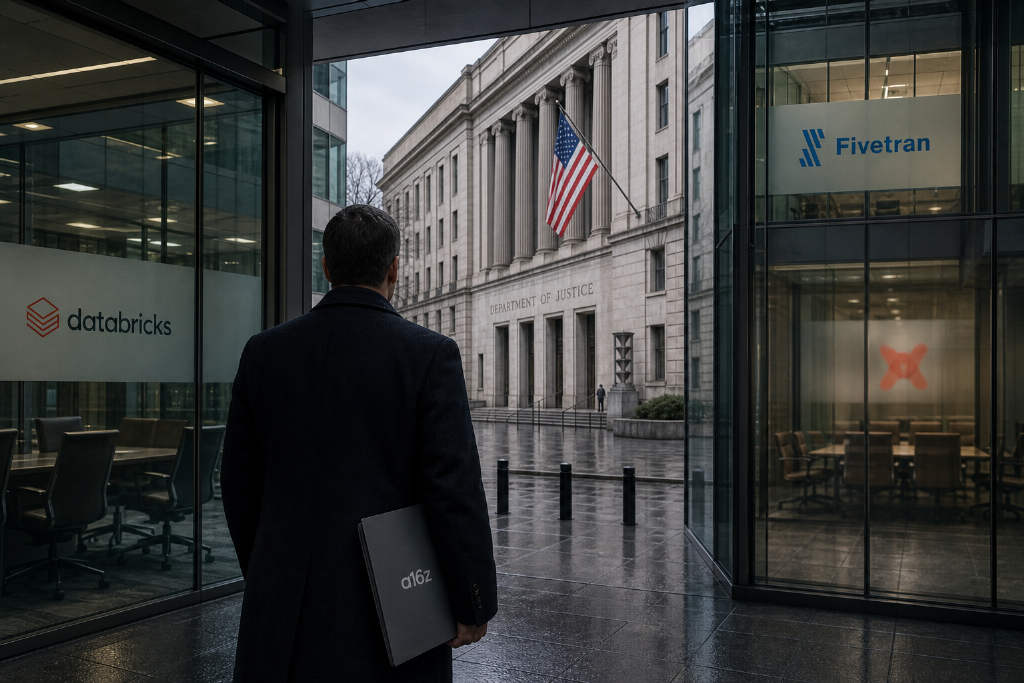
DOJ probes a16z over board seats at rivals Databricks and Fivetran

The U.S. Department of Justice is investigating Andreessen Horowitz, better known as a16z, over whether its partners improperly hold board seats at two competing AI data companies, according to Bloomberg. The case centers on Ben Horowitz serving on the board of Databricks and Martin Casado serving on the board of Fivetran, both of which are backed by the venture firm. The issue touches a rarely used 1914 law aimed at “interlocking directorates,” a rule the DOJ used repeatedly during the Biden administration to push directors off the boards of competing companies. People familiar with the matter said the probe has been underway for nearly a year and began around the same time the DOJ reviewed Fivetran’s acquisition of dbt Labs, a deal announced in October last year and approved without conditions after months of review. The department has not decided how to resolve the matter and may ultimately take no action. The investigation carries weight because a16z manages $90 billion as of January and has become one of the most influential venture firms in AI, with investments spanning Databricks, Cursor, ElevenLabs, SpaceX, and OpenAI. The case could test how antitrust rules apply when different partners from the same venture firm sit on the boards of rival portfolio companies.

2040
DOJ probes a16z over board seats at rivals Databricks and Fivetran
Policy Regulation
Aug 18, 2026

DOJ Opens Antitrust Probe Into a16z Over Board Seats at Rival AI Companies

The U.S. Department of Justice is investigating Andreessen Horowitz, better known as a16z, over whether its partners improperly held board seats at competing AI and data companies, according to Bloomberg, citing people familiar with the matter. The probe centers on Databricks Inc. and Fivetran Inc., two a16z-backed companies that both sell enterprise tools for collecting, organizing, and analyzing large volumes of data. Ben Horowitz sits on Databricks’ board, while partner Martin Casado serves on Fivetran’s board. People familiar with the matter said the investigation has been running for nearly a year and had not been previously reported. Casado also previously served on the board of dbt labs, a related company that Fivetran acquired in June. The DOJ reviewed that deal for months after it was announced in October last year and cleared it without conditions, though the broader inquiry continued. The case draws extra attention because of a16z’s ties to the White House and its role in AI policy debates. Bloomberg said DOJ has not decided what action, if any, it will take. The investigation also revives scrutiny of “interlocking directorates” under a little-used 1914 law that bars overlapping board roles at direct competitors.

1980
DOJ Opens Antitrust Probe Into a16z Over Board Seats at Rival AI Companies
a16z
Aug 18, 2026

a16z Breaks Down the AI Compute Trade: Revenue Is Surging, but Capex and Profitability Still Cloud the Picture

Andreessen Horowitz’s New Media team used its latest Charts of the Week to examine the AI infrastructure trade through a wider lens than headline demand growth. Moses Sternstein focused on neocloud companies such as CoreWeave, Nebius, and Applied Digital, arguing that the market’s question is no longer whether AI needs more compute, but whether providers can turn that demand into durable cash flow. The piece says many neocloud players entered the AI cycle with an advantage built during the crypto mining era: power access, data center capacity, cooling systems, and experience running dense compute loads. That legacy helped them scale revenue quickly, with CoreWeave reaching $2.6 billion in revenue in about 25 quarters versus 40 quarters for AWS after launch. Still, investors have not rewarded growth evenly. Over the past year, CoreWeave shares were down about 16%, while Nebius stayed closer to prior highs, highlighting concerns over capital intensity, depreciation, and rising interest expense. Sternstein also argues that AI is reshaping software unevenly rather than destroying SaaS across the board. Atlassian’s cloud revenue rose 31% year over year, and customers using its AI assistant Rovo were spending at nearly twice the growth rate of non-Rovo users. Databricks, meanwhile, said its Smart Router can cut average task costs by more than 30% by matching tasks with different model tiers. The article closes with data on widening enterprise AI spend gaps and diverging hiring patterns at OpenAI and Anthropic.

2930
a16z Breaks Down the AI Compute Trade: Revenue Is Surging, but Capex and Profitability Still Cloud the Picture
Total 11 items
Go topage