Ethereum
Nov 11, 2026

Vitalik Challenges ETH Burn-Based Valuation as Ethereum Shifts Toward Store-of-Value Case

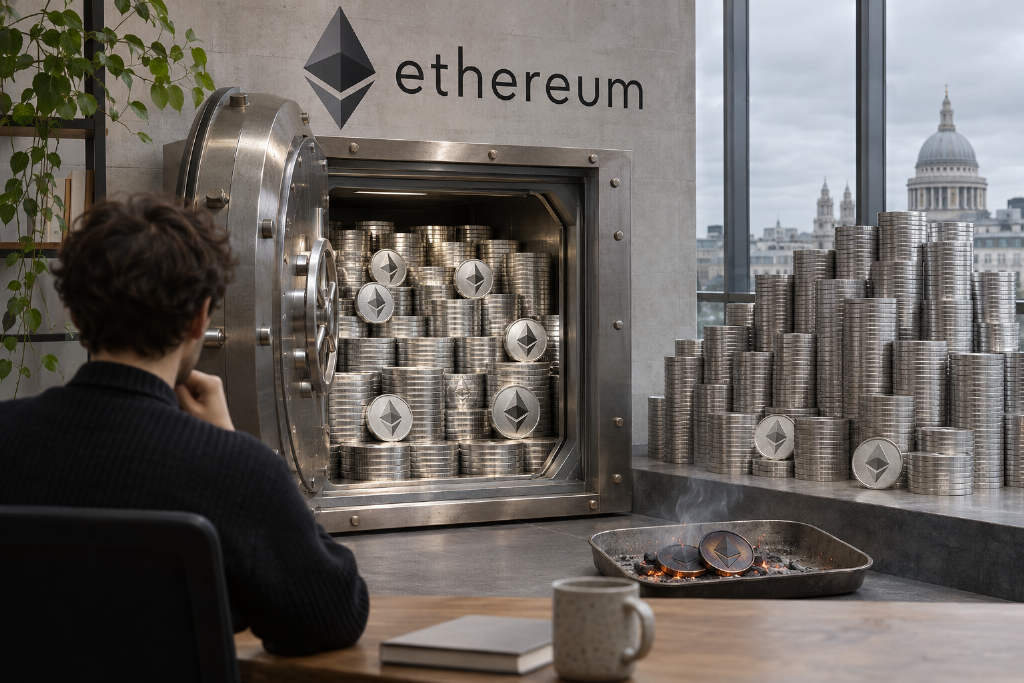
Vitalik Buterin has revisited the source of ETH’s value, arguing that transaction-fee burning should not be treated as a dependable valuation floor. Ethereum’s long-running “Ultrasound Money” narrative linked network activity, higher gas fees and ETH burns with lower inflation or even deflation. But Buterin noted that a large share of historical fee revenue came from speculative activity inside crypto markets, which can fade during downturns. He still supports keeping EIP-1559, while saying Ethereum should not regret a future in which burns remain below 10% of new issuance. Data cited in the discussion shows that ETH burns over the past 30 days offset only about 3.2% of new issuance. In 2022, Ethereum burned about 1.48 million ETH worth roughly $3.6 billion. By Nov. 8, 2026, cumulative burns for the year were about 19,200 ETH, worth around $43 million. Annualized to roughly $50 million and discounted at 4%, that would imply a theoretical valuation of about $1.25 billion, compared with an ETH market capitalization of about $270 billion. The gap of more than 200 times highlights the limits of burn-based models. Buterin instead emphasized decentralization, censorship resistance, open-source development, privacy and security as parts of Ethereum’s longer-term value proposition.
30
Vitalik Challenges ETH Burn-Based Valuation as Ethereum Shifts Toward Store-of-Value Case
Base
Sep 15, 2026

Base to add validity transactions in Cobalt upgrade later this month

Base is set to introduce validity transactions in its upcoming Cobalt upgrade later this month, according to Jon Roethke, a senior developer advocate at Base. Roethke said the new transaction type will support conditional execution flows onchain. He described these transactions as EIP-2930 or EIP-1559 types that execute only when specific onchain conditions are met. The update is part of the Cobalt upgrade scheduled for the end of the month. No further technical details or rollout timeline beyond that were disclosed in the brief statement.

1420
Base to add validity transactions in Cobalt upgrade later this month
Ethereum
Aug 24, 2026

EIP-8363 model says Ethereum would cut staking rewards, not erase issuance

A quantitative review by IOSG researcher Mario Chow argues that EIP-8363 would not drive Ethereum issuance to zero at current staking levels, but would instead cut it roughly in half while reducing validator yields and shifting value away from staking intermediaries. The proposal would burn a growing share of validator rewards as the staking ratio rises, reaching a 100% burn at 50% of ETH supply staked. Based on the model in the report, with about 42.2 million ETH currently staked, issuance would fall 58.6% and staking APR would drop 56.4%. The report says that translates into 633,000 ETH less annual dilution, worth about $1.55 billion per year, or 0.53% of ETH market capitalization. The paper also argues that Ethereum’s fee-burn mechanism has lost most of its force. It says EIP-1559 destroyed 1.48 million ETH in 2022, but only 25,660 ETH over the past 12 months, offsetting just 2.4% of annual issuance. In the author’s reading, that leaves issuance policy as Ethereum’s last effective lever over supply. On market impact, the study says it found no detectable relationship between staking yield changes and ETH price performance over a 43-month window from January 2023 to July 2026. It does, however, say supply growth has a somewhat stronger, though still statistically insignificant, connection. The report’s final view is mildly bullish on ETH itself, negative on staking middlemen such as LST and LRT infrastructure, and skeptical that the proposal can pass governance because losses are concentrated while benefits are diffuse.

1940
EIP-8363 model says Ethereum would cut staking rewards, not erase issuance
Ethereum
Aug 4, 2026

New Ethereum EIP targets staking expansion with tapered issuance burn

A new Ethereum Improvement Proposal, called “Tapered Issuance Burn,” has been submitted to the Ethereum community with the goal of changing how ETH issuance works as staking participation rises. The proposal argues that the network’s current reward curve leaves no effective shutoff for staking incentives: even if all ETH were staked, the staking yield would still not fall below roughly 1.5%. It also says ETH staking had exceeded one-third of total supply by April 2026 and was still climbing. Under the proposed design, part of validators’ theoretical rewards would be burned in each epoch, and the burn rate would increase as the staking ratio grows. The proposal says net staking yield would gradually fall to zero once the staking ratio reaches about 50%. Its stated aims are to curb continued ETH supply expansion, reduce dilution pressure on token holders, and limit the risk of staking becoming too concentrated in custodians and staking service providers. The design says ETH issuance would peak when the staking ratio is around 20%, with annual issuance of about 0.5%, before declining to zero at 50% staking. Combined with EIP-1559 and blob fee burns, the proposal says ETH supply could enter deflation more often in the future.

2760
New Ethereum EIP targets staking expansion with tapered issuance burn
Total 21 items
Go topage