BackEIP-8198

EIP-8198

Ethereum
2026-09-19 14:31:10

Ethereum’s EIP-8198 aims to make block times configurable before cutting slots

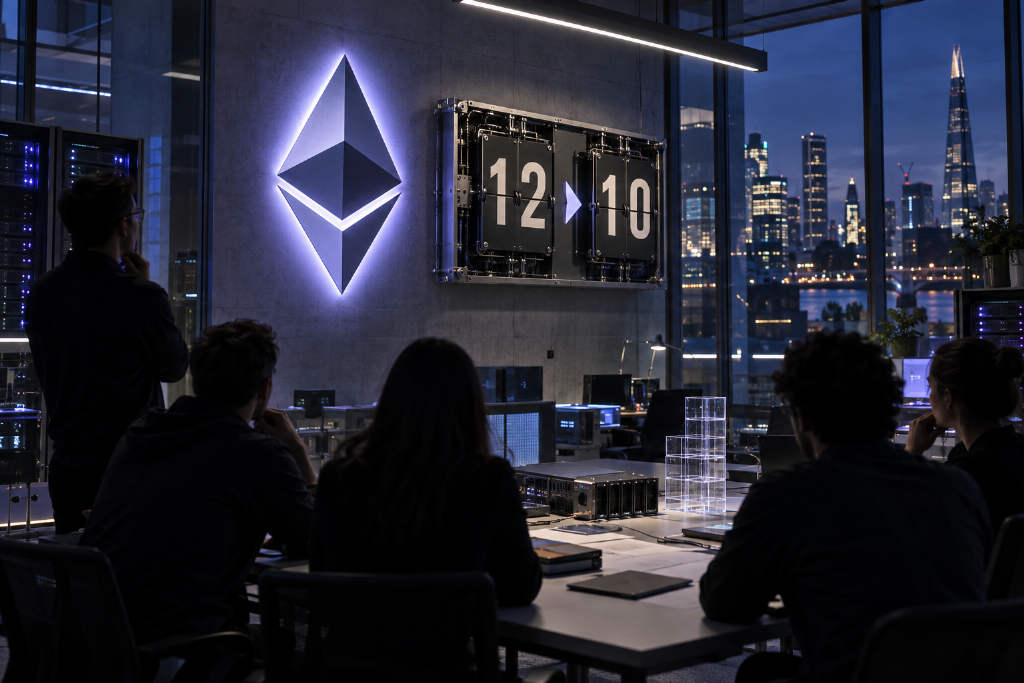
Ethlabs is pushing Ethereum Improvement Proposal 8198, known as Quick Slots, as a candidate for the Hegotá upgrade, arguing that Ethereum can move faster without giving up censorship resistance, decentralization, or credible neutrality. The proposal does not call for an immediate aggressive cut in block times. Instead, it starts with a structural change: removing the assumption across specs and clients that Ethereum blocks always arrive every 12 seconds. Once that work is in place, slot times could be shortened gradually, with 10 seconds presented as the initial step and every later reduction requiring separate testing and consensus. The case for the change, as laid out in interviews with roughly 20 DeFi founders, application builders, and infrastructure researchers, spans market structure, user experience, censorship resistance, and L2 coordination. Supporters say fresher state updates would tighten quoting windows, reduce stale pricing, improve execution conditions, and help products ranging from DEX aggregators and options venues to tokenized stocks and ETFs. Others argue that faster slots would shorten the wait for censored transactions to find another inclusion path and make Ethereum’s base layer a more responsive settlement clock for rollups. At the same time, the proposal’s backers say the tradeoff only works if decentralization is preserved. That is why current work is focused on specifications, client implementations, downstream dependency checks, and compatibility with future consensus changes rather than on rushing a hard cut in slot time.


190
Ethereum’s EIP-8198 aims to make block times configurable before cutting slots
Ethereum
2026-09-19 14:31:03

Ethereum’s EIP-8198 aims to make block times adjustable before shortening them

Ethlabs is making the case for EIP-8198, or Quick Slots, as a way to speed up Ethereum without trading away censorship resistance, decentralization, or credible neutrality. The proposal would first remove the hard-coded 12-second block assumption from clients and specifications, then let the network shorten slot times in measured steps, starting with a move from 12 seconds to 10 seconds. Supporters interviewed by Ethlabs — including DeFi founders, infrastructure builders, and researchers — argue that fresher state updates could improve DEX execution, tighten quotes, reduce risk for arbitrageurs and market makers, and make tokenized assets and cross-rollup interactions work better on Ethereum’s base layer. They also say faster slots could strengthen censorship resistance, especially when paired with FOCIL, by increasing how often censored transactions get another chance to be included. At the same time, the proposal’s backers stress that none of this is worth doing if it raises barriers for geographically distributed validators or pushes staking and block production toward better-connected data centers. Work is now focused on turning the specification into running client code, testing transition paths, auditing downstream systems that assume 12-second timing, and checking compatibility with future consensus changes such as decoupled consensus.

190
Ethereum’s EIP-8198 aims to make block times adjustable before shortening them
Ethereum
2026-09-19 05:31:03

ETH Labs lays out a faster Ethereum roadmap, tying Quick Slots, account abstraction and L1 issuance to ETH value capture

Ethereum may already be the settlement layer for tokenized finance, but ETH Labs argues that one bottleneck still stands in the way of serving global markets at scale: speed. In a recent Milk Road Crypto interview summarized by PANews, ETH Labs members Julian Ma, Derek Chiang and Binji discussed a broader “faster Ethereum” agenda that goes beyond block times and reaches into finality, bridging, interoperability and account abstraction. At the center of the discussion was Quick Slots, a proposal aimed at reducing Ethereum’s hard-coded 12-second block time to 10 seconds as an initial step in the Hegotá upgrade cycle after Glamsterdam. The team said the change should not come at the expense of decentralization or security, and argued that faster performance, if achieved without weakening Ethereum’s core properties, could make the network more attractive as the home base for tokenized assets. The interview also covered the failed push to merge Ethereum Foundation’s Frame-based account abstraction effort with Base’s EIP-8130 proposal, ETH Labs’ preference for issuing tokenized assets on Ethereum L1 rather than directly on L2s, and the role of privacy and post-quantum work in Ethereum’s longer-term roadmap. Across those topics, the speakers repeatedly linked infrastructure upgrades to higher settlement demand, more gas consumption and stronger value capture for ETH.

160
ETH Labs lays out a faster Ethereum roadmap, tying Quick Slots, account abstraction and L1 issuance to ETH value capture
Ethereum
2026-09-18 11:01:09

Ethlabs backs adding EIP-8198 to the Hegotá upgrade

Ethlabs said it had compiled input from about 20 voices across the Ethereum ecosystem and is advocating for EIP-8198 to be included in the Hegotá upgrade. The proposal sets out a two-step path rather than an immediate cut to block times. First, block time would be changed into an adjustable parameter. After that, Ethereum’s block interval would be reduced gradually from 12 seconds to 10 seconds. The update was shared through an X post linked by Foresight. No additional implementation details were provided in the source material.

200
Ethlabs backs adding EIP-8198 to the Hegotá upgrade
Ethereum
2026-09-09 09:05:57

Ethereum sets a 2029 deadline for quantum readiness, with Hegotá as the first critical test

Ethereum Foundation protocol researchers have put December 2029 on the calendar as the target for full post-quantum readiness across Ethereum’s execution, consensus, and data layers, using a conservative planning assumption that a realistic "Q-day" could arrive as early as 2030. The first major checkpoint is not a post-quantum fork itself, but Hegotá, a precursor upgrade that will determine whether the later roadmap can stay on schedule. Under the current baseline, Glamsterdam is aimed at mainnet in December 2026, followed by Hegotá and then I*, J*, K*, and L* over a compressed three-year stretch. Of Hegotá’s 62 candidate proposals, only two are ranked S-tier: EIP-7805 FOCIL, which adds validator-enforced inclusion constraints for eligible transactions, and EIP-8141 Frame Transactions, which introduces more programmable transaction validation, execution, and gas payment at the protocol level. A set of A-tier proposals would also shape account security, migration away from older cryptographic assumptions, execution proofs, and resource pricing. The broader point is timing: Hegotá is being treated as the first engineering exam in Ethereum’s race to prepare for a quantum threat that may still be years away, but cannot be addressed at the last minute.

1050
Ethereum sets a 2029 deadline for quantum readiness, with Hegotá as the first critical test
Ethereum
2026-08-16 08:00:22

Ethereum Starts Planning for Hegotá Upgrade as 66 EIPs Vie for a 2027 Hard Fork Slot

Ethereum core developers have begun planning the network’s next annual upgrade, Hegotá, with 66 Ethereum Improvement Proposals now on the candidate list, according to a post on X by Ethereum developer Toni Wahrstätter. The selection process will play out over the next several core developer meetings, where proposals will be narrowed down based on whether they can be implemented, tested on devnets, deployed to testnets, and realistically made ready for a 2027 launch. Proposals that do not make the cut for Hegotá will be pushed to the following hard fork. One item is already confirmed: FOCIL, short for Fork-Choice Enforced Inclusion Lists. Developers also see native privacy as a key area of interest. They said combining EIP-8141 for framed transactions, EIP-8250 for keyed nonces, and EIP-8272 for root references could help build privacy features that do not rely on third-party intermediaries. Scaling is another major track. Proposed changes include repricing data resources through EIP-8131 and EIP-8279, along with repricing state growth costs via EIP-8368, as preparation for raising the gas limit to 600 million in the future. Other proposals under discussion include shorter block times, issuance changes, anti-correlation penalties, EVM simplification, and early discussion around zkEVM- and post-quantum-related EIPs.

1180
Ethereum Starts Planning for Hegotá Upgrade as 66 EIPs Vie for a 2027 Hard Fork Slot
Ethereum
2026-08-05 19:54:41

Aave and ether.fi founders push back on Ethereum staking reward burn proposal

A proposal to burn a growing share of Ethereum validator rewards has triggered a sharp backlash from some of the ecosystem's best-known DeFi and staking founders, including Aave founder Stani Kulechov and ether.fi CEO Mike Silagadze. The draft, first posted on Aug. 4 ahead of the Hegotá proposal deadline, would remove the incentive to stake beyond half of all ETH by scaling up reward burns as the staking ratio rises, with the burn reaching 100% at a saturation balance of 60.25 million ETH. At current staking levels, the authors say the measure would lower net consensus yield from roughly 2.6% to 1.2%, though they propose phasing it in over 18 months. Critics argue the mechanism would hurt solo stakers, create tax complications in jurisdictions that tax rewards on receipt, and pressure liquid staking and DeFi protocols tied to staking income. Kulechov said the design could cut validator income by 48% under one scenario, while Silagadze called the process and timing "disappointing on every level." Supporters of the proposal counter that Ethereum should not keep subsidizing unlimited growth in staked ETH and say the loudest critics are those with revenue most exposed to the change. The proposal, initially referred to as EIP-8361 and later corrected to EIP-8363, is expected to come up on Thursday's All Core Devs consensus call.

1820
Aave and ether.fi founders push back on Ethereum staking reward burn proposal