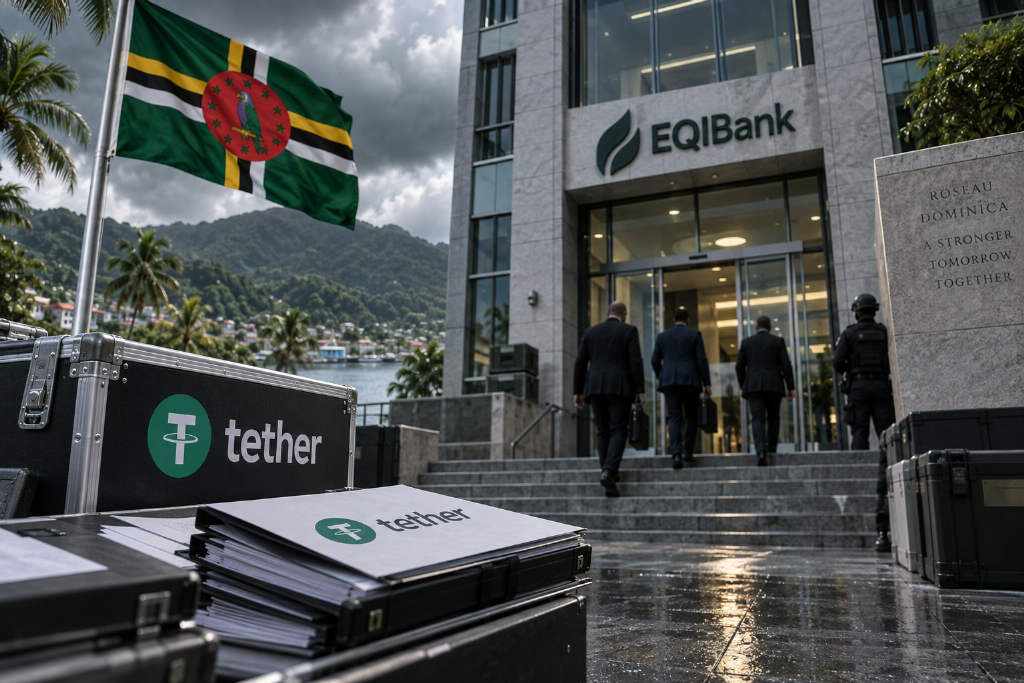
Tether2026-09-27 02:10:51Tether says partner bank EQIBank had $89 million frozen by U.S. prosecutorsTether said on Thursday that U.S. prosecutors froze $89 million tied to EQIBank, a digital bank that handled remittance flows for the company. The amount was reported to be about 80% of EQIBank’s cash holdings. Tether said its own exposure to EQIBank accounted for less than 0.034% of the group’s $18.775 billion in total assets, putting the impact on reserves at a limited level and leaving USDT’s dollar peg without a direct threat. The case, highlighted by the Financial Times and The Information, points to a less visible layer of stablecoin risk: dependence on banks, payment processors and clearing channels that sit between issuers and end users. Court filings said payment processor Capstone, which held funds in the U.S. for EQIBank and routed customer money through accounts at Wells Fargo and JPMorgan, concealed the true nature of its business from banks. Prosecutors then seized funds from those accounts and filed a civil forfeiture action. Tether said EQIBank handled wire transfers for USDT subscriptions and redemptions but did not custody the company’s main reserves. The episode also drew attention to concentration risk across crypto banking channels, as EQIBank reportedly provided services linked to transactions for Binance, Kraken and Coinbase.20
Tether2026-09-25 21:25:35US Prosecutors Seek to Keep $84.2 Million Linked to Accounts Used for Tether PaymentsThe U.S. Department of Justice is trying to retain $84.2 million that prosecutors say moved through accounts used to process payments for Tether, according to a civil forfeiture complaint filed July 15 in the Eastern District of California. The case targets Montana-based payments firm Capstone Ltd., which the government says operated as an unlicensed money transmitter in at least six states while presenting itself to banks as a standard IT services company. The complaint names Capstone owners Kotaro Shimogori and Mary Jeanne Thompson, and the FBI executed a search warrant at a Sacramento residence. Most of the funds, $79.11 million, came from a Wells Fargo Securities account in Capstone’s name, with additional amounts held at JPMorgan Chase, another Wells Fargo account, and two wallets containing USDT. Prosecutors say EQIBank, a digital bank licensed in Dominica, directed how Capstone moved the money. Tether told Reuters that EQIBank handled transfers tied to USDT purchases and redemptions, while saying it had no knowledge of the conduct alleged by the Justice Department. Capstone and EQIBank have already filed an innocent-owner defense, and claimants have 21 days to answer the complaint after a formal claim is filed in court under Supplemental Rule G.00
Tether2026-09-25 18:56:53Tether says exposure to EQIBank tied to US seizure case was limitedTether said its exposure to EQIBank, a bank named in a US civil forfeiture complaint, was small relative to the company’s overall balance sheet. The stablecoin issuer told Cointelegraph it had "no knowledge" of the conduct alleged by US authorities and said the assets it held at EQIBank accounted for just 0.034% of the group’s total assets. The case centers on Capstone, a Montana-based payments business named in a Department of Justice complaint. US prosecutors alleged the company illegally moved hundreds of millions of dollars under the direction of EQIBank. About $84 million in Capstone accounts was reportedly frozen as part of the action. The Financial Times, citing Justice Department officials, said Capstone was unlicensed and made payments to hundreds of individuals and entities on behalf of Tether and Bitfinex. Tether did not answer a question about whether the seizure could affect customers. As of Friday, USDT had a market capitalization of about $184 billion.00
Tether2026-09-25 14:53:49Tether says assets held at EQIBank made up less than 0.034% of group totalTether said assets it held at Dominica-licensed digital bank EQIBank accounted for less than 0.034% of the group’s total assets, according to a CoinDesk report. Based on Tether’s June disclosure of $187.75 billion in total group assets, the company’s exposure would be capped at roughly $64 million, though it did not disclose the exact amount. The report said EQIBank used U.S. payments processor Capstone to handle client funds, with transfers moving through accounts at Wells Fargo and JPMorgan Chase. U.S. prosecutors have seized funds tied to those Capstone accounts and filed a civil forfeiture case, alleging the processor misrepresented its business to banks. EQIBank said about $89 million had been seized, equal to around 80% of its monetary assets, a situation that could leave the bank facing liquidation risk. EQIBank previously provided banking services to Tether, including wire transfers tied to USDT purchases and redemptions. Tether said it was not aware of the Capstone-related conduct described by the U.S. Department of Justice.00
Tether2026-09-25 14:47:08Tether says EQIBank exposure is below 0.034% of group assets after U.S. asset seizureTether said its exposure to EQIBank, a Dominica-licensed bank whose assets were seized by U.S. authorities, is less than 0.034% of the group’s total assets. Based on the company’s June disclosure of $187.75 billion in total group assets, that implies a maximum exposure of roughly $64 million, though Tether did not disclose the exact figure. The company also said it had no prior knowledge of the conduct alleged by the U.S. Department of Justice against U.S. payment processor Capstone. Court documents say EQIBank held and moved client funds through Capstone, with the money kept in accounts at Wells Fargo and JPMorgan Chase. U.S. prosecutors have seized funds in those accounts and filed a civil forfeiture action, alleging that Capstone misrepresented the nature of its business to banks. EQIBank said about $89 million was seized, equal to roughly 80% of its monetary assets, and that it could face liquidation as a result. CoinDesk reported that EQIBank had previously provided banking services to Tether, including wire transfers tied to USDT purchases and redemptions. Tether’s disclosure does not indicate a direct threat to USDT reserves or its dollar peg, but it puts counterparty risk in focus for stablecoin issuers that rely on banks and payment processors for fiat access and redemptions.00