South Korea
Oct 30, 2026

South Korea says unreported virtual asset operators face up to five years in prison

South Korea’s current law allows penalties of up to five years in prison or a fine of 50 million won for operators that run virtual asset businesses without filing the required report, according to ChainCatcher. The rule also applies to overseas operators that provide services to South Korean residents, extending the reach of the country’s compliance framework beyond domestic firms. The Financial Intelligence Unit, or FIU, said unreported operators sit outside the regulatory perimeter and may be used for money laundering. In a separate enforcement-related finding, a joint investigation conducted in June by DAXA and compliant operators found that the average trading fees charged by the operators caught in the probe ranged from 1.5% to 10%. At the high end, that was about 62 times the average 0.16% fee charged by South Korea’s five major won-based exchanges. The figures highlight the gap between regulated venues and operators found outside the reporting regime, with authorities pointing to both compliance and user-cost concerns.

580
South Korea says unreported virtual asset operators face up to five years in prison
South Korea
Oct 30, 2026

South Korea’s FIU seeks access block on two unregistered virtual asset operators, DAXA refers three firms for investigation

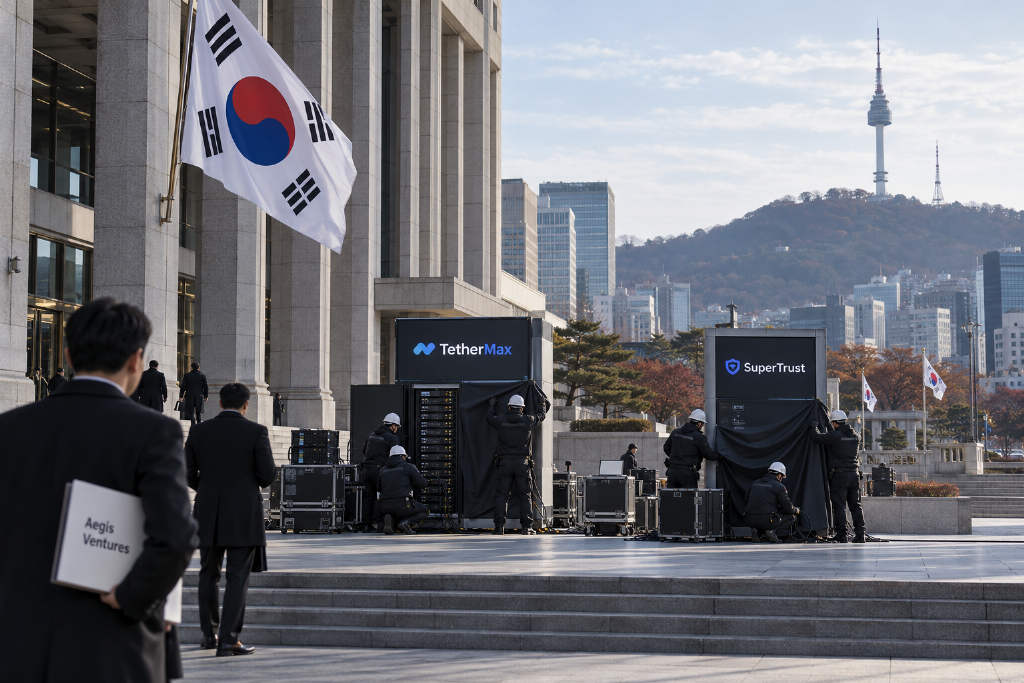
South Korea’s Financial Intelligence Unit (FIU) on Oct. 30 asked the Korea Communications Standards Commission to block domestic access to two unregistered virtual asset operators and terminate their services in the country. On the same day, the Digital Asset eXchange Alliance (DAXA) referred Aegis Ventures, TetherMax, and SuperTrust for investigation, citing suspected violations of the Act on Reporting and Using Specified Financial Transaction Information and alleged operation of virtual asset businesses without registration. FIU specifically requested access blocks for TetherMax and SuperTrust. Aegis Ventures was not included in the blocking request because it does not have an independent website or mobile application. Under the law, operating an unregistered virtual asset business can carry a penalty of up to five years in prison or a fine of 50 million won. The rule also applies to overseas operators serving South Korean residents. FIU said unregistered operators sit outside the regulatory framework and may be used for money laundering. A joint probe conducted in June by DAXA and compliant operators found that the average trading fees charged by the firms caught in the investigation ranged from 1.5% to 10%, with the highest level reaching about 62 times the 0.16% average charged by South Korea’s five largest won-based trading platforms.

580
South Korea’s FIU seeks access block on two unregistered virtual asset operators, DAXA refers three firms for investigation
Bithumb
Oct 23, 2026

Bithumb challenges South Korea FIU over 45,772 small transfers and six-month business restriction

Bithumb has taken South Korea’s Financial Intelligence Unit to court over a sanction tied to 45,772 transfers involving 18 overseas crypto operators that had not reported to Korean authorities. The first hearing was held on Oct. 22 at the Seoul Administrative Court. At the center of the dispute is whether transfers below 1 million won fall outside the mandatory scope of the Travel Rule under the Act on Reporting and Use of Certain Financial Transaction Information. Bithumb argued that all transfers at or above that threshold had already been screened out through its whitelist system, leaving zero improper outbound transfers in the legally defined range. The exchange also cited Chainalysis data in court, saying only about 2% of externally unidentifiable addresses were later confirmed by the FIU as deposit addresses of unreported overseas operators, meaning a blanket block would hit 98% of legitimate transactions. Bithumb is also contesting the proportionality and legal basis of the FIU’s six-month restriction on new customers’ external withdrawals, saying the measure goes beyond what is necessary and raises questions about the limits of administrative discretion.

850
Bithumb challenges South Korea FIU over 45,772 small transfers and six-month business restriction
Bithumb
Oct 23, 2026

Seoul court opens first hearing in Bithumb lawsuit against South Korea’s FIU

The second division of the Seoul Administrative Court held its first hearing on Oct. 22 in an administrative lawsuit between crypto exchange Bithumb and South Korea’s Financial Intelligence Unit, according to Korean media outlet Digital Asset. The FIU said Bithumb conducted 45,772 transfers with 18 unregistered virtual asset operators between Aug. 28, 2022 and Apr. 3, 2025, and imposed sanctions that included a partial business suspension barring new customers from transferring crypto assets to external platforms for six months. In court, Bithumb argued that transfers of KRW 1 million or more were subject to the Travel Rule and that unregistered operators had already been excluded from its list of selectable exchanges, leaving zero improper outbound transfers in that bracket. For transfers below KRW 1 million, the exchange said the Travel Rule did not apply at the time, there was no legal basis to require customers to provide recipient exchange information, and regulators had not clearly defined how blocking should be carried out. Bithumb also challenged the severity of the six-month measure and the FIU’s standards for identifying overseas operators.

830
Seoul court opens first hearing in Bithumb lawsuit against South Korea’s FIU
South Korea
Oct 19, 2026

South Korea’s FSS and FIU move to build joint crypto oversight framework

South Korea is moving to tighten its crypto oversight structure, according to remarks made during a parliamentary audit. Lee Jeong-jin, governor of the Financial Supervisory Service, said the country is working with the Financial Intelligence Unit to build a regulatory system for crypto assets. He referenced past internal control failures at exchanges including Bithumb. Lee said the second-phase draft of the Basic Act on Digital Assets will strengthen the regulatory framework, adding that a new supervisory structure is close to completion. The comments point to a broader effort to consolidate oversight as lawmakers continue to examine weaknesses in the current system. Lawmaker Lee Kang-il said regulatory authority over crypto assets in South Korea is currently split among the Financial Services Commission, the Financial Supervisory Service, the FIU, and the Bank of Korea. He also said related exchanges show a large number of suspected violations. The remarks highlight ongoing concern in Seoul over fragmented supervision and compliance risks in the domestic crypto market.

860
South Korea’s FSS and FIU move to build joint crypto oversight framework
European Union
Oct 18, 2026

EU and Eight Countries Sign Warsaw Convention Protocol Covering Virtual Assets and VASPs

The European Union and eight countries — Georgia, Greece, Hungary, Luxembourg, Monaco, Montenegro, San Marino, and the United Kingdom — have signed an additional protocol to the Council of Europe’s Warsaw Convention, according to Bitcoin.com News. The protocol extends the convention’s scope to virtual assets and virtual asset service providers, or VASPs, as authorities seek to address cross-border crimes involving crypto, including money laundering and terrorist financing. The measures outlined in the protocol include emergency freezing or confiscation of virtual assets without prior notice when transaction risks are present, broader powers for financial intelligence units to suspend crypto transactions suspected of money laundering, and a requirement for participating states to establish dedicated asset recovery and management offices. It also gives victims priority in reclaiming confiscated assets. Recovered funds exceeding 10,000 euros are, in principle, to be split equally among participating countries, while confiscated assets are encouraged to be directed toward social or public uses.

830
EU and Eight Countries Sign Warsaw Convention Protocol Covering Virtual Assets and VASPs
South Korea
Oct 14, 2026

South Korea Approves Website Blocks on KuCoin, MEXC and 25 Other Unregistered Crypto Platforms

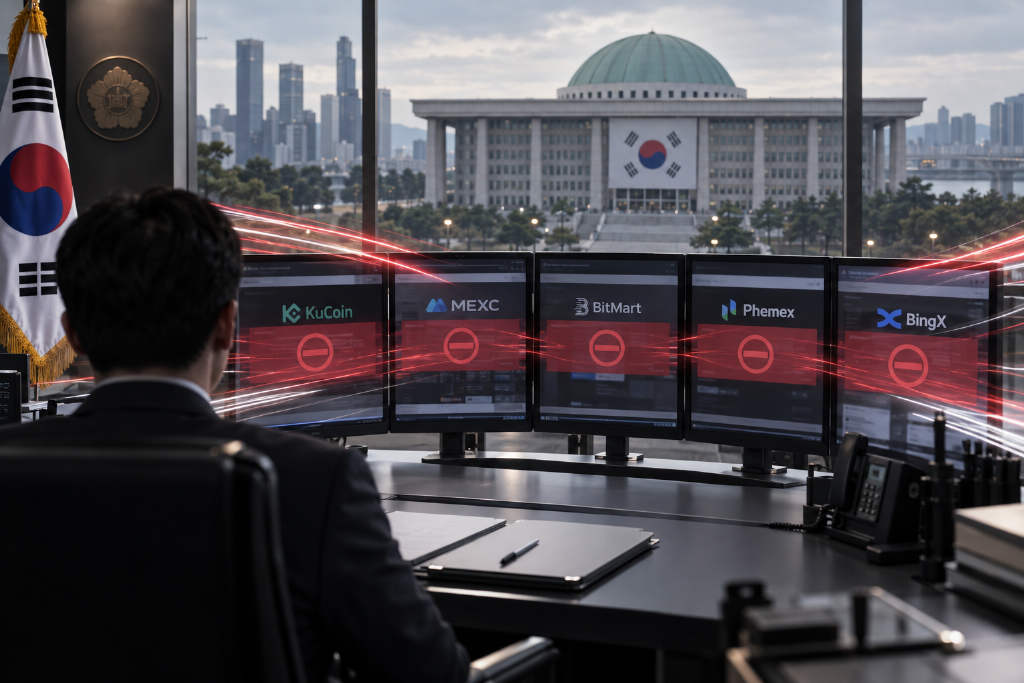
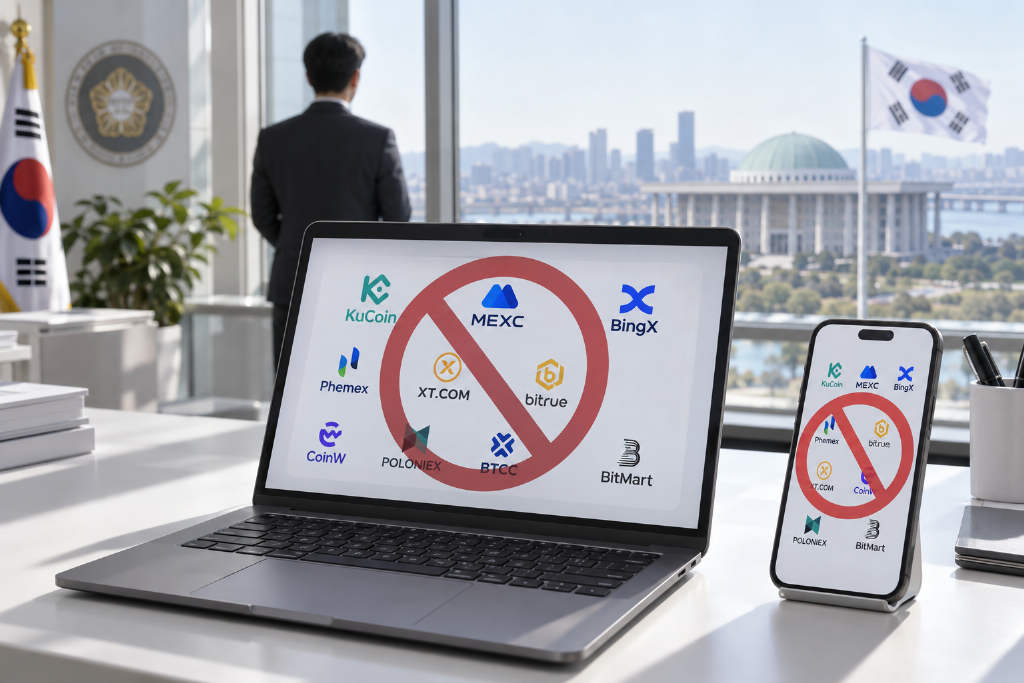
South Korea’s Financial Services Commission said on Oct. 13 that websites operated by 27 unregistered crypto platforms, including KuCoin, MEXC, BitMart, Phemex and BingX, will be blocked for users in the country. The decision marks the first time Korean authorities have extended enforcement against unregistered operators to their websites, after earlier steps such as referrals to investigators and restrictions on credit-card payments. According to the FSC, the country’s media and communications standards regulator approved block requests submitted by the Financial Intelligence Unit, which sits within the FSC, during two review sessions held on Oct. 6 and 7. Overseas-run sites will face access blocks, while Korea-based operators will face service termination. The FIU did not disclose when the measures will take effect. The regulator said it now plans to seek blocks as soon as it detects unregistered activity, without waiting for investigation results, court rulings or confirmed customer losses. It also said users of unregistered platforms should withdraw assets immediately, while warning that sharing referral links could be treated as assisting an unregistered business and may expose referrers to criminal penalties.

1250
South Korea Approves Website Blocks on KuCoin, MEXC and 25 Other Unregistered Crypto Platforms
South Korea
Oct 13, 2026

South Korea moves to block access to 27 unregistered virtual asset operator websites

South Korea is expanding restrictions on unregistered crypto operators from mobile app marketplaces to the web. According to Korean media outlet etoday, the Financial Intelligence Unit under the Financial Services Commission said the Korea Communications Standards Commission has decided to impose domestic access blocking or service termination measures on the websites of 27 virtual asset operators that were not legally reported. The list includes KuCoin, MEXC, BingX, Phemex, XT.com, Bitrue, CoinW, Poloniex, BTCC and BitMart. The move broadens the scope of enforcement beyond app-based distribution channels and into internet webpages, targeting operators that authorities say failed to complete the required reporting process.

1230
South Korea moves to block access to 27 unregistered virtual asset operator websites
Total 34 items
Go topage