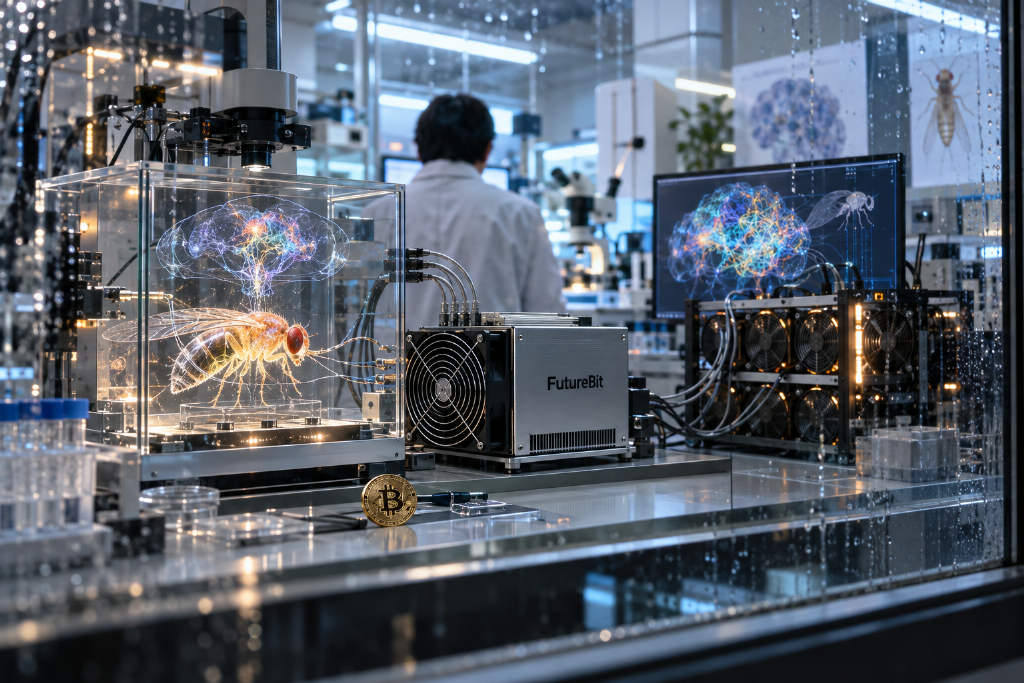
Can a Fruit Fly Brain Mine Bitcoin? FutureBit and FlyMiner Test Unusual Mining Setups
Bitcoin mining hardware has long moved toward highly specialized chips built for speed and power efficiency, but a small group of experiments is testing a very different direction. Hardware maker FutureBit said it has demonstrated a browser-based mining concept called HashFly that simulates 2,914 neural pathways from MaleCNS v1.0, a digital wiring map of an adult male fruit fly’s brain and central nerve cord. The company said it is now working to run SHA-256 across all neurons in the dataset and plans to publish the results. FutureBit argued on X that, if the idea could ever be scaled to real organic neurons, it could reach roughly 1 watt per terahash, which it described as about 10 times as efficient as the best 3-nanometer silicon ASICs. That estimate assumes a hypothetical setup where every neuron mines continuously. The current demo does not do that: it runs on standard computer hardware and operates far below Bitcoin’s real mining difficulty. Separately, a project called FlyMiner uses a larger fruit fly neural map with 139,255 neurons and 16.8 million connections to drive a conventional mining program linked to CKPool, reaching as many as 700,000 attempts per second.