Nvidia Founder Jensen Huang Loses $19 Billion in Four Days Following Personal Scandal
Nvidia founder and CEO Jensen Huang’s personal wealth fell by $19 billion over four days following a personal scandal, Techub News reported, citing Forbes.
10

Nvidia founder and CEO Jensen Huang’s personal wealth fell by $19 billion over four days following a personal scandal, Techub News reported, citing Forbes.
Corgi, a U.S. startup that uses AI to sell commercial insurance to startups, has reached a $5 billion valuation just two years after it was founded, according to Forbes. The company was started by 26-year-old CEO Nico Laqua and 23-year-old COO Emily Yuan, who studied computer science at Stanford before leaving school to build the business. Corgi focuses on products such as cyber insurance, D&O, E&O, AI liability and general liability coverage for startup clients. Forbes said the company’s annual recurring revenue has topped $100 million and that it serves thousands of startups, including Deel, Artisan and Eragon. The company has also drawn attention for operating a 24-hour coffee shop, Corgi Cafe, beneath its office, which became an unexpected customer acquisition channel. Corgi came out of Y Combinator’s Summer 2024 batch and accelerated its fundraising this year, moving from a combined seed and Series A total of about $108 million in January to a $160 million Series B in May, a $106 million B1 round three weeks later, and now a $64 million Series B extension that lifted its valuation to $5 billion.
The US Internal Revenue Service is preparing changes to its voluntary disclosure program that would cut penalties, speed up case resolution and offer more flexible payment options, according to a Friday report by Forbes. IRS Criminal Investigation Chief Jarod Koopman said the agency wants to roll out the revised program before December and aims to resolve cases within 120 days after taxpayers complete the required submission process. The planned overhaul would not create a separate disclosure track for digital assets. Instead, crypto-related tax violations would be handled through the same voluntary disclosure procedures used for other forms of tax noncompliance. Koopman also said penalties under the revised program would be substantially lower than current levels, though he did not give figures. Forbes reported that the IRS is also weighing installment agreements and offers in compromise for unpaid liabilities. The current IRS program can take a year or longer and is mainly designed for taxpayers whose willful noncompliance could expose them to criminal prosecution. Separately, lawmakers are considering a crypto-focused voluntary disclosure framework under Section 502 of the proposed Digital Asset Tax Certainty Act, which would cover past violations with defined penalties and includes taxpayers who made unintentional reporting errors.
U.S. satellite startup Xona Space Systems has completed a $250 million Series D round, according to Forbes. The financing values the company at $2.45 billion. Future Ventures led the round and invested $78.5 million. The firm was co-founded by early SpaceX investor and former board member Steve Jurvetson. The deal adds fresh capital for Xona Space Systems and marks a new valuation milestone disclosed in the report. No other financing details were provided in the source brief.
Binance founder Changpeng Zhao said in an interview with The New York Times that his lifestyle does not resemble that of a typical billionaire. The remarks came as Forbes has estimated his net worth at more than $100 billion. Zhao disputed that figure and said the real number is much lower, placing it in a range of roughly $10 billion to $30 billion. He also said that even a small fraction of that amount would be more than enough for him to live comfortably, adding that he would only need $10 million. The comments, cited by ChainCatcher, focus on Zhao’s personal view of wealth and lifestyle rather than any business development at Binance.
Binance founder Changpeng Zhao, widely known as CZ, said in an interview with The New York Times that his real net worth is much lower than outside estimates. Forbes had placed his fortune at more than $100 billion, but Zhao said the actual figure is closer to $10 billion to $30 billion. He also said his lifestyle is not like that of a typical billionaire. In the same interview, CZ added that even a small fraction of that amount would be enough for him to live very comfortably, saying he would only need $10 million. The remarks were reported by BlockBeats on Oct. 4.
Forbes reported that U.S. President Donald Trump, in an interview with Time magazine, said that 「a certain amount of inflation would also pay off debt very quickly,」 reviving debate over whether the United States could reduce its real debt burden through nominal growth and inflation. The report said federal debt has climbed past $40 trillion, more than doubling over the past decade, while interest costs have kept rising after the Federal Reserve’s rate hikes. Trump, U.S. Treasury Secretary Scott Bessent, and Elon Musk have previously pointed to technology-driven economic growth as a key way to ease debt pressure. At the same time, the market has turned back to the so-called debasement trade, where investors buy assets such as gold and Bitcoin to hedge against a decline in fiat purchasing power. Forbes, citing Bitfire Research, said the long-term case for Bitcoin as a hedge against currency debasement remains intact, though short-term price moves may still be shaped by interest-rate policy and U.S. dollar liquidity. The report also noted that PCE inflation rose 3.4% from a year earlier, above the Fed’s 2% target, while markets see about a 70% chance that the Fed will leave rates unchanged at its late-October meeting.
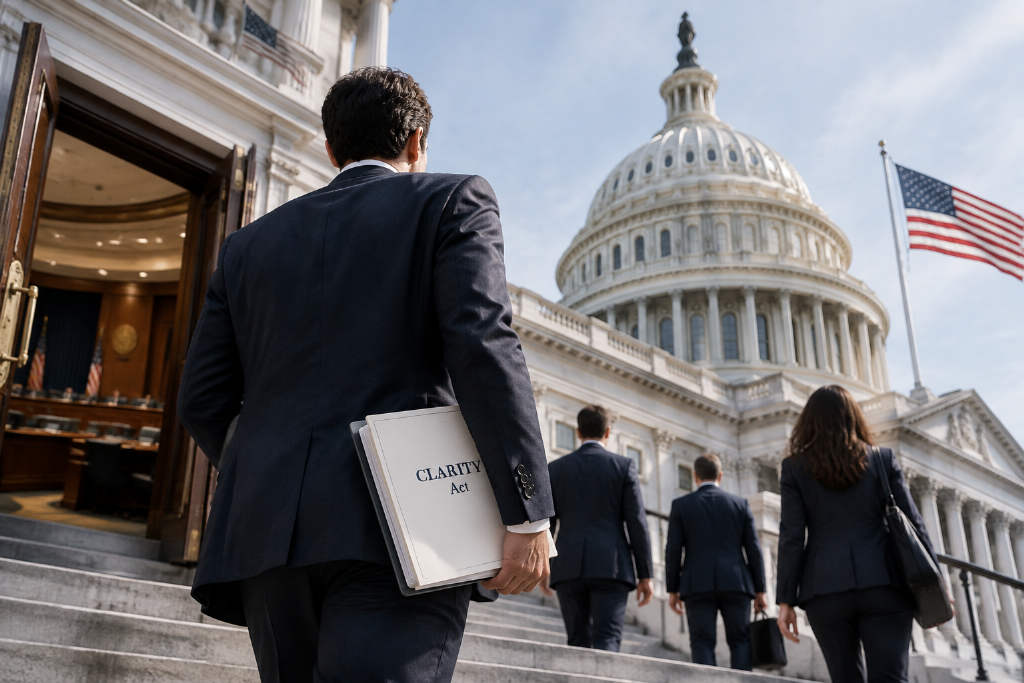
Techub News, citing Forbes, said attention has shifted to the next U.S. Congress after the CLARITY Act failed to pass the U.S. Senate. The Forbes piece looks at who may take the lead in drafting a new cryptocurrency regulatory bill in the next session. It also reviews the positions held by different lawmakers and congressional committees on the issue. The report focuses on how those stances could shape the direction of the next round of legislative work on crypto regulation.