Arthur Hayes2026-09-10 23:44:31Arthur Hayes links Japan repatriation, Fed liquidity and AI capital misallocation to crypto upsideArthur Hayes, chief investment officer of Maelstrom, said in a Sept. 8 interview on The Rollup that a reversal in Japan’s long-running overseas capital allocation, combined with stress in France’s bond market and the euro funding system, could force the Federal Reserve to accelerate dollar liquidity creation. In his view, EUR/JPY is the key short-term leading indicator to watch because it captures pressure building on both the yen and euro sides of the global funding complex. Hayes argued that Japan’s policy push to bring capital home, including potential changes tied to the Government Pension Investment Fund, may mark the unwinding of what he called the world’s largest yen carry structure. He said that if Japanese institutions are encouraged to hedge or repatriate without dumping U.S. Treasuries outright, expanded access to the Fed’s FIMA repo facility could become a critical tool. He also said the U.S. policy mix is no longer meaningfully restrictive and described the AI boom as the political narrative used to justify heavy spending. If large AI labs come under pressure because their unit economics fail to hold up, Hayes said governments may respond with more support, which would add to balance-sheet expansion and strengthen the long-term case for Bitcoin and gold. He added that Bitcoin could break its all-time high before year-end, though he expects a volatile path, and said ETH is one of Maelstrom’s larger positions for a liquidity-driven rally, alongside smaller positions in ether.fi and Ethena.1260
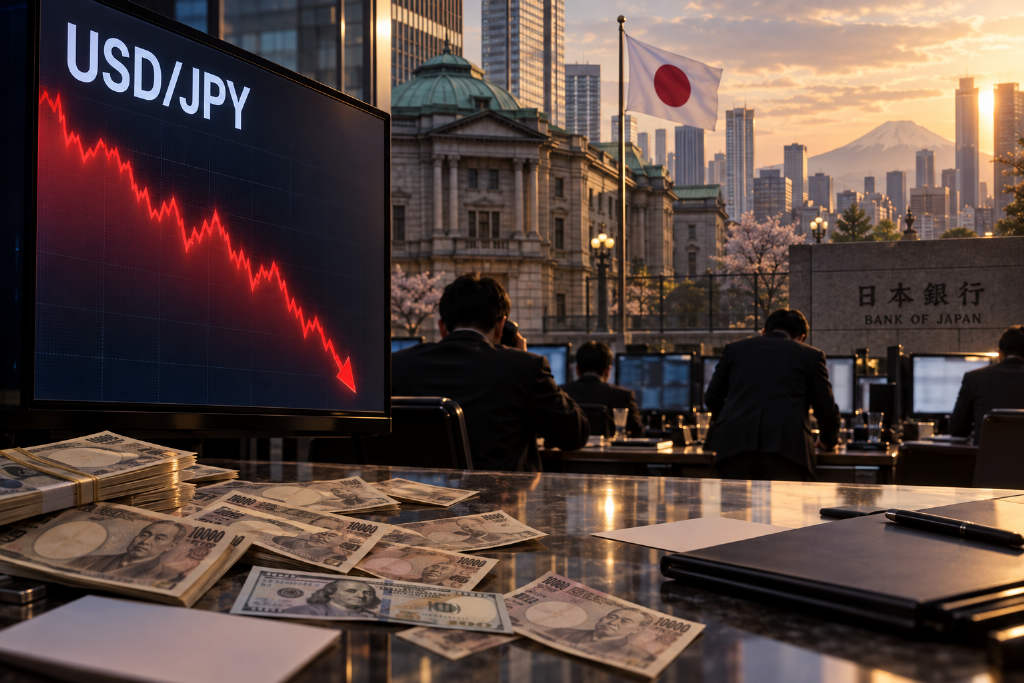
JPY2026-09-10 08:24:48USD/JPY Breaks Below 155 on a Third Test, Putting the Yen Carry Trade Thesis Under PressureUSD/JPY fell through 155 on Sept. 7 after previously holding the area twice following intervention-linked defenses, then traded below 154.50 early on Sept. 8. In the source article by Stephen Innes, the move matters less as a one-day fluctuation and more because repeated defenses had turned 155 into a crowded line in the market, with positions, conviction, and stop-loss orders built around the assumption that the floor would hold again. Once that structure gave way, the unwind itself became part of the move. The article points to several forces lining up behind the yen. U.S. Treasury Secretary Scott Bessent has taken a firmer tone on Japan’s fiscal and monetary stance, saying Japan should move away from reflation and that the Japanese government and the Bank of Japan are likely to take steps that ultimately strengthen the yen. At the same time, BOJ Governor Kazuo Ueda kept Sept. 17-18 in play for rate discussions, while board member Hajime Takata argued for flexibility on hikes. Speculation around possible portfolio changes at Japan’s Government Pension Investment Fund, which manages about JPY 300 trillion, has also returned. On the dollar side, a solid August U.S. payrolls report failed to generate much follow-through, leaving CPI as the key near-term test for the Federal Reserve.670
Goldman Sachs2026-09-10 04:16:46Goldman Sachs says a shift by Japan’s pension giant into domestic bonds could lift the yen and ripple across Asian FXGoldman Sachs said in its latest report that the yen has gained more than 4% since early September, with a more hawkish Bank of Japan and market expectations around a possible asset allocation shift by Japan’s Government Pension Investment Fund, or GPIF, prompting investors to reassess the currency’s medium-term path. The bank said that if GPIF were to move part of its portfolio from overseas assets into domestic fixed income, the yen could see a structural appreciation. Using GPIF’s roughly $2 trillion in assets under management, Goldman estimated that a 5 percentage point increase in domestic fixed-income allocation would theoretically translate into about $100 billion of USD/JPY selling. The report said that size is roughly equal to half of Japan’s annual current account surplus and could also trigger an unwind of previously built yen-funded carry trades. Goldman added that the effects could spill into broader Asian currency markets. Looking at data since 2022, the bank said the Korean won has been the most sensitive to moves in the yen, with a beta of about 0.45, followed by the Thai baht and the Malaysian ringgit. Offshore yuan and the Taiwan dollar were also cited. Goldman kept its view favoring the Taiwan dollar over the yuan in North Asia, and in South Asia it maintained a bearish stance on the Philippine peso and a constructive view on the Indian rupee versus the peso. The bank noted that a GPIF reallocation into domestic bonds remains a scenario analysis, not a formal decision.1390
Arthur Hayes2026-09-03 08:09:06Arthur Hayes says GPIF may revisit domestic and overseas allocation, calls it the start of a "money-printing party"Arthur Hayes said on Sept. 3 that Japan’s Government Pension Investment Fund, or GPIF, is considering a fresh review of how it allocates assets between domestic and overseas markets. In his view, that possible shift was also one of the reasons the euro fell by about two big figures against the Japanese yen during the day. Hayes said any change in GPIF’s portfolio mix could trigger large-scale capital reallocation. He described the potential outcome as the start of a "money-printing party." He also pointed readers to his latest article, "Atencion," for more detail on his thinking.1390
Japan2026-07-24 08:01:59Possible GPIF shift back to domestic assets puts U.S. stocks, Treasuries and the dollar in focusGlobal investors may be underestimating a risk centered on Japan rather than artificial intelligence or war. As the yen trades near multi-decade lows and domestic Japanese assets become more attractive, the market is starting to assess what could happen if Japan’s Government Pension Investment Fund, or GPIF, is pushed to increase allocations at home. With about $1.8 trillion under management and roughly $930 billion invested overseas, even a modest reallocation could ripple through Treasuries, the dollar and broader risk assets. Recent remarks from Prime Minister Sanae Takaichi and earlier comments from Finance Minister Satsuki Katayama have reinforced that possibility, even though GPIF has not announced a formal portfolio change. Analysts cited by MarketWatch and the Financial Times say a shift toward domestic bonds and other local assets could lift yen demand and channel major buying into Japanese government bonds, while pressuring U.S. yields, dollar funding conditions and risk sentiment. At the same time, any unwind of yen-funded carry trades would add another source of strain. The market has not fully priced that scenario yet. Still, signals such as the five-year USD/JPY cross-currency basis swap are beginning to draw closer attention, and investors are increasingly watching whether capital flows start to turn.650
Japanese yen2026-07-24 03:13:07Yen Near 40-Year Low Puts Japan’s Policy Tools at the Center of Short-Side PricingThe yen’s slide toward roughly a 40-year low has pushed the Japanese authorities back into focus, with USD/JPY nearing 164 in July and Finance Minister Katayama Satsuki warning that Tokyo would take “bold” steps if disorderly moves persist. For traders, the 163-165 area is no longer just a chart level. It is being treated as a policy testing zone where the market is reassessing the odds of direct yen-buying intervention, earlier Bank of Japan rate hikes, and portfolio shifts by major domestic pension money. Those expectations matter because they change the risk-reward profile of short-yen trades even before any official action is confirmed. The repricing is not about a single trigger. A weak trade-weighted yen, Brent crude near $100 on Middle East tensions, and the pass-through into import costs have sharpened inflation concerns in Japan. At the same time, monthly Ministry of Finance data currently show confirmed intervention of JPY 11.7349 trillion from April 28 to May 27 and zero from May 28 to June 26, leaving July activity unconfirmed for now. Investors are also watching whether the Government Pension Investment Fund, or GPIF, could shift more funds into domestic assets, a move some estimates cited in media reports put at tens of billions of dollars up to about $80 billion. Taken together, these factors are raising the policy premium embedded in yen shorts and narrowing the margin for error in global carry trades.1050
Japan2026-07-13 10:05:00Japan denies reports of pension portfolio shift as GPIF target allocation stays unchangedJapan has no plan at this stage to revise the target asset allocation of its national pension fund, according to Reuters, which cited sources familiar with internal government discussions. The report said authorities could still increase domestic asset investment within the current tolerance bands. The news pushed the yen and Japanese government bonds lower again, with the yen at one point weakening 0.4% to 162.36 per U.S. dollar before losses eased after additional comments from Chief Cabinet Secretary Minoru Kihara. Speaking at a Monday press conference, Kihara said the Government Pension Investment Fund, or GPIF, reviews its portfolio every year and would begin a formal adjustment process only if market conditions changed materially. Japan’s Ministry of Health, Labour and Welfare, which oversees the fund, declined to comment. Last Friday, Finance Minister Satsuki Katayama had said the government would roll out supporting measures to encourage GPIF and other pension institutions to sharply increase holdings of Japanese financial assets, prompting market bets on potentially hundreds of billions of dollars flowing into domestic markets. As of March this year, GPIF managed 293.6 trillion yen, or about $1.81 trillion, in assets.2080