
Samaya AI
1 days agoNews Editor

Samaya AI launches Sterling financial research model with lower per-query cost than Claude Fable 5.1

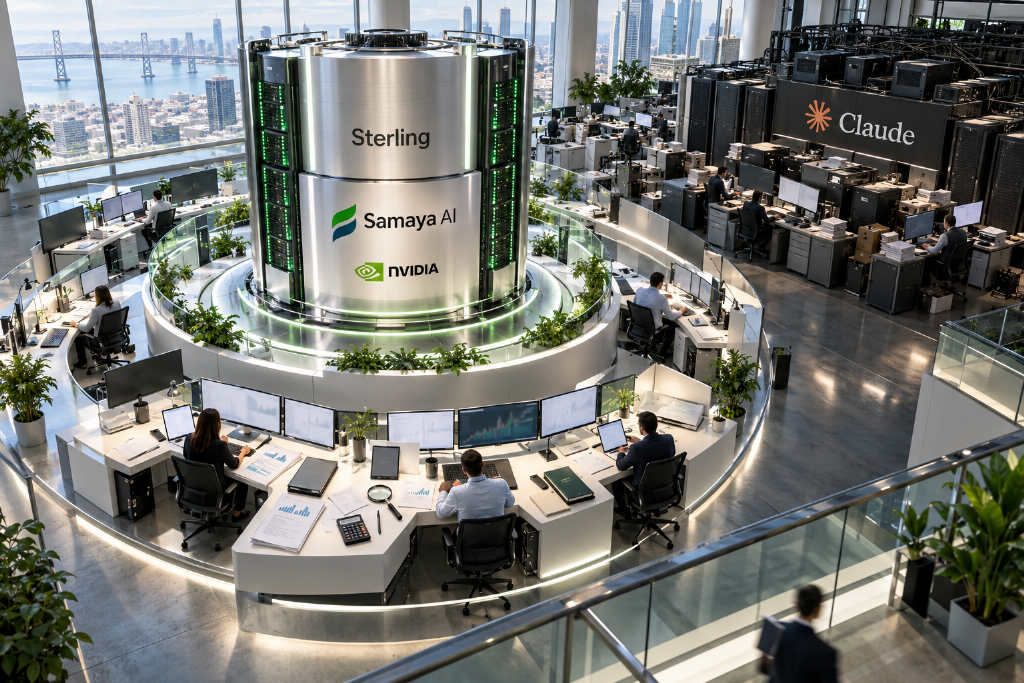
Samaya AI has introduced Samaya Sterling, a financial research agent model built on NVIDIA Nemotron 3.5 Lightning. In Samaya’s FrontierFinance benchmark, Sterling scored 58.9%, compared with 55.9% for Claude Fable 5.1. The company said the model processes each question at a cost of $0.61, versus $6.89 for Fable 5.1. Sterling is a LoRA post-trained model designed for financial research agent tasks. According to the release, it can plan research, call financial tools, gather evidence, and generate reports. Its training pipeline includes supervised fine-tuning on synthetic trajectories, best-strategy selection, and both offline and online GRPO optimization. Samaya said the model runs on a single H100 80GB GPU using BF16 precision, while service hardware details were not disclosed. Under its highest-effort setting, Sterling reached a score of 60.6% at a cost of $1.83 per question. The information was cited by MarkTechPost.
70
Samaya AI launches Sterling financial research model with lower per-query cost than Claude Fable 5.1
Meta
3 months agoNews Editor

Meta and University of Illinois researchers build EvoHarness-RL for self-evolving agent runtime

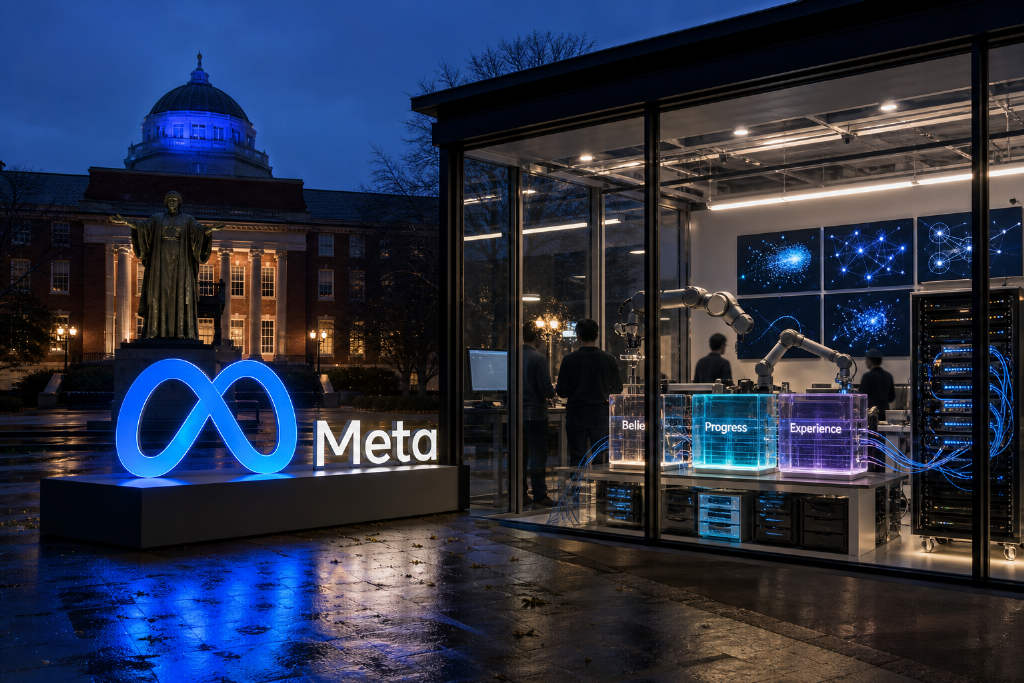
Meta and researchers from the University of Illinois have jointly developed EvoHarness-RL, a framework designed to let large language model agents create, access, and manage external state systems on their own. According to Techub, citing CryptoBriefing, the framework lifted success rates on the ALFWorld benchmark from 47.9% to 96.9%, a sharp jump in task completion performance. The system builds a structured external state through three components: Belief, Progress, and Experience. It is trained with supervised fine-tuning and GRPO optimization. The report said this setup gives agents a way to organize and use information outside the model itself while handling multi-step tasks. Researchers also observed two spontaneous behaviors during training, described as "tool annealing" and "tool evolution." These behaviors allowed agents to gradually internalize operations and refine the structure of their external state. The work centers on runtime design for AI agents and how those agents can improve the way they use tools and state over the course of training.

1060
Meta and University of Illinois researchers build EvoHarness-RL for self-evolving agent runtime
