OpenAI
Nov 3, 2026

OpenAI unveils Pando Git backend now running its main code repository

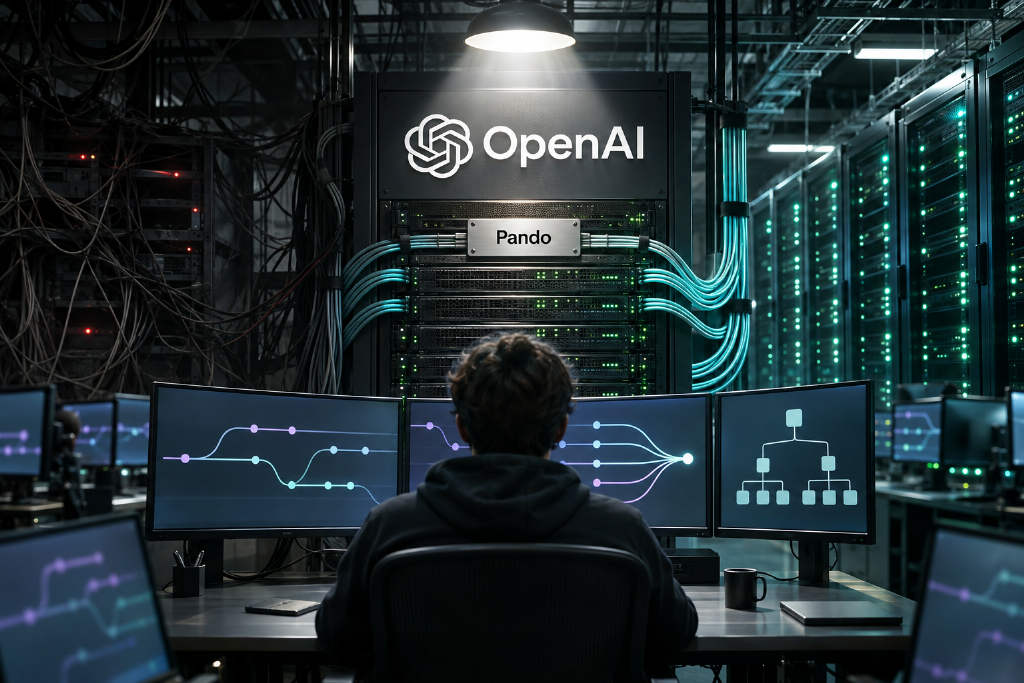
OpenAI has introduced Pando, an in-house Git backend that has already taken over the company’s main code repository, according to ChainCatcher. The move comes after a year in which Codex enabled engineers to dispatch large numbers of coding agents at the same time, driving up the volume of branches, pushes, merges, and pull requests. Under that load, OpenAI’s previous system reportedly suffered frequent slowdowns and merge failures, with reliability at one point falling below 90%. The report said one engineer led the core architecture design while several Codex agent teams helped build the system, and Pando was put into production in 10 weeks. OpenAI said the new backend allows code pushes from different branches to be processed in parallel instead of waiting in line. For code pulls, it reuses existing Git packfiles and distributes them through cache rather than generating a separate package for each client. After the change, median push latency fell by nearly 80%. The system now distributes nearly 1 PB of data per day and posts a cache hit rate above 99%, though different branches no longer guarantee the exact same point-in-time view. Unlike Anthropic’s Scion, which drops Git, OpenAI kept the Git client and protocol and rebuilt only the backend, leaving existing workflows for engineers and agents largely unchanged.

1190
OpenAI unveils Pando Git backend now running its main code repository
OpenAI
Nov 3, 2026

OpenAI launches Pando, cutting Git push latency by about 80%

OpenAI has introduced Pando, a Git backend system designed to improve performance in its monorepo workflow. According to Techub, citing Crypto Briefing, the system reduced Git push latency by about 80% through workflow optimization inside OpenAI’s single code repository setup. The report says the move is aimed at using AI’s potential to reshape software infrastructure while improving the efficiency and scalability of the development process. No additional technical details, rollout timeline, or deployment scope were disclosed in the source brief. The update centers on infrastructure performance and developer workflow gains rather than a consumer-facing product release.

950
OpenAI launches Pando, cutting Git push latency by about 80%
Apple
Oct 29, 2026

Apple blocks eMudhra certificates, but macOS git and curl may still trust compromised roots

Apple has blocked the compromised eMudhra intermediate certificates, but a security research page said on Oct. 28, Taipei time, that several developer tools bundled with macOS may still trust the affected root certificates. The issue does not mean every Mac is fully compromised. The remaining exposure is centered on command-line and development environments that still read the system certificate file or ship with older trust stores, leaving room for man-in-the-middle attacks on some HTTPS connections if an attacker is on the network path. Apple’s support document says Safari and other apps that rely on Apple’s networking framework are protected, while tools such as curl, git, python3, ruby, perl, and openssl bundled with macOS or Xcode Command Line Tools may continue to accept the certificates until /etc/ssl/cert.pem is updated in a future system release. The research page said Apple was notified on Oct. 17 and that, as of Oct. 28, the tools still trusted the compromised certificates. It also said macOS 27.2, released on Oct. 26, did not fix the issue and could overwrite user-applied mitigations. Apple has published manual mitigation steps, and Python maintainers have urged users to upgrade certifi to 2026.10.19 and pip to 26.2.2. Developers using Macs for dependency fetching, code pushes, or CI workflows have been advised to inspect their local environments and trust chains.

2040
Apple blocks eMudhra certificates, but macOS git and curl may still trust compromised roots
Tencent Hunyuan
Oct 16, 2026

Tencent open-sources Hy Memory 2.0, linking shared memory across 10 AI tools

Tencent Hunyuan has upgraded Hy Memory to version 2.0 and open-sourced the memory framework, a dedicated model, and the MemHub application. The company said Hy Memory 1.0, released in May, was focused on chat memory, including tracking how the same topic changes over time, spotting contradictions, and inferring user habits from repeated conversations. Version 2.0 adds working memory and code memory. It can record a task’s progress, the approaches that were tried, and the final result, then check whether past experience applies when a similar task appears again. For code, it uses Git records to trace changes to files and functions, including modifications that were later rolled back. MemHub is designed to share one local memory pool across tools such as Cursor, Codex, and Claude Code, with support for 10 tools in total. After user authorization, it can import historical conversations and keep syncing new records. Tencent also said it trained a dedicated model, Hy-Memory-30B-A3B, with 30 billion total parameters and about 3 billion activated per run. In Tencent’s tests of four memory systems, the average score was 55.49, slightly above Opus 5 at 54.62.

1460
Tencent open-sources Hy Memory 2.0, linking shared memory across 10 AI tools
Anthropic
Oct 14, 2026

Anthropic replaces Git in its main repository with Scion as Claude-driven coding load surges

Anthropic said it moved its main code repository off Git after a sharp rise in code changes pushed the existing setup beyond what it could comfortably handle. The company said average daily merges in its main repository climbed from about 2,500 in May to more than 30,000 in September, more than 12 times higher. To deal with that load, seven engineers, working with Claude, built a new version control system called Scion over five months, migrated the main repository, and launched a companion code review tool named Antique. Anthropic said its main branch history is close to 100GB and that its CI system checks out code about 25 million times a day. It had deployed hundreds of Git mirror servers, but said that was still not enough. According to the company, Scion cuts CPU and memory needs to 1/200 of the previous Git mirror architecture, reduces checkout times from minutes to seconds, and lowers CI CPU demand by 25%. GitLab said the same day that it is building a next-generation Git-compatible version management architecture and that a technical collaboration with Anthropic, which began in June, has now entered private testing.

1620
Anthropic replaces Git in its main repository with Scion as Claude-driven coding load surges
Cognition
Oct 6, 2026

Cognition adds Memory and daily Dreaming to Devin, open-sources the workflow

Cognition has rolled out two new features for Devin: Memory and Dreaming. Memory lets Devin retain user preferences, corrections, and project-specific experience across sessions, while Dreaming runs as a daily background process that revisits and reorganizes those stored records. Users can inspect what Devin has remembered and review recent changes made by Dreaming. The system stores those records in a personal Memory Drive, which Cognition describes as a persistent Git repository organized mainly through Markdown files. A short MEMORY.md file serves as the entry point and index, and it is loaded into context at the start of each new session. Devin then searches only the relevant memory files for a given task, rather than loading the entire memory base into the prompt. Cognition said multiple Devin sessions can read from and write to the same memory set at the same time, with each session using its own Git checkout before changes are committed and merged back. The company has also open-sourced the setup as Agent Memory Repo. Cognition noted that while other agents such as Claude Code and Cursor can use a similar file-and-Git approach, Devin’s automatically scheduled daily Dreaming still requires extra configuration in the open-source version.

1880
Cognition adds Memory and daily Dreaming to Devin, open-sources the workflow
Instinct
Sep 21, 2026

Reverse engineering suggests Instinct stores long-term memory in Git-managed Markdown files

Supermemory founder Dhravya Shah said his reverse engineering of the personal agent assistant Instinct points to a long-term memory design built around Git-managed Markdown files rather than replaying entire chat logs into context. In Shah’s account, Instinct keeps an up-to-date user state, then uses a separate file-based store for more detailed records such as preferences, decisions, tasks, and person-specific facts. His black-box testing suggested that each conversation begins with a user state summary of about 4,250 tokens, covering background, operating preferences, and communication habits. Shah said he did not find signs of vector indexing or BM25 retrieval. Instead, detailed memory appears to be fetched with keyword search similar to grep, while a background process continuously reorganizes information: temporary details are grouped under tasks, experiences are distilled into long-term preferences, old facts are revised with new ones, and Git preserves version history. He added that the main agent appears to focus on reading memory, while the cleanup and merge work happens in backend workflows that he estimates run about once a day. According to Shah, the setup is close to Supermemory’s own view of how agents should manage memory, and he said the architecture can be largely replicated with Supermemory. He shared an example that used roughly 60 lines of code to plug user profiles, memory search, version history, and continuous updates back into an agent.

4180
Reverse engineering suggests Instinct stores long-term memory in Git-managed Markdown files