HBF
Aug 28, 2026

Researchers say HBF economics and manufacturing outlook remain unproven

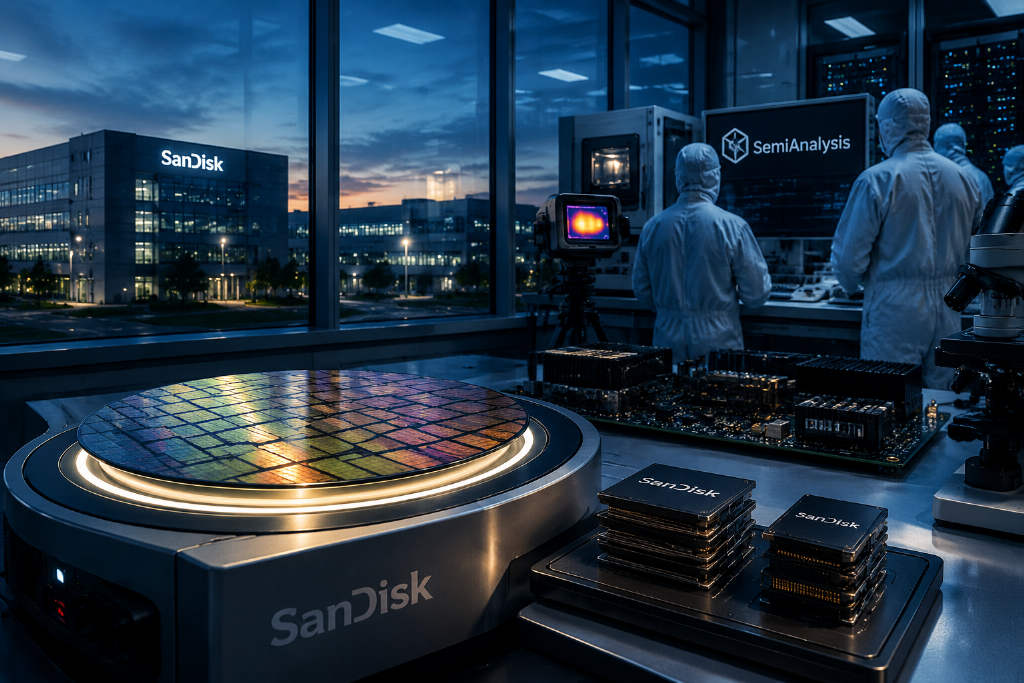
Researchers from P Equity Research and SemiAnalysis, including Nick Doyle, discussed high-bandwidth flash, or HBF, in an X Space, outlining where the technology may fit and where major uncertainties remain. Doyle said it is still too early to judge how much HBF can narrow its cost premium versus high-bandwidth memory, or HBM, because much of the current information comes from vendor claims. He cited Sandisk’s estimate that cost per bit could be about one-eighth that of HBM, while cautioning that structural costs tied to TSVs, stacking, and pSLC mode would not disappear even if yield and testing improve with scale. Endurance remains a central unknown, he said, because higher-than-expected wear would raise overall costs. The discussion also framed HBF as a narrow-use product rather than a replacement for HBM, aimed at AI inference workloads such as low-batch, long-context mixture-of-experts models. Its target bandwidth of about 1.6 TB/s, around HBM3E class, may suit sequential reads for loading model weights and smaller local or private enterprise GPU setups. Thermal reliability and mass production were also flagged as open questions, while NAND shortages are expected to last through 2028.
1710
Researchers say HBF economics and manufacturing outlook remain unproven
SK hynix
Aug 24, 2026

SK hynix and SanDisk unveil the first HBF standard at FMS 2026

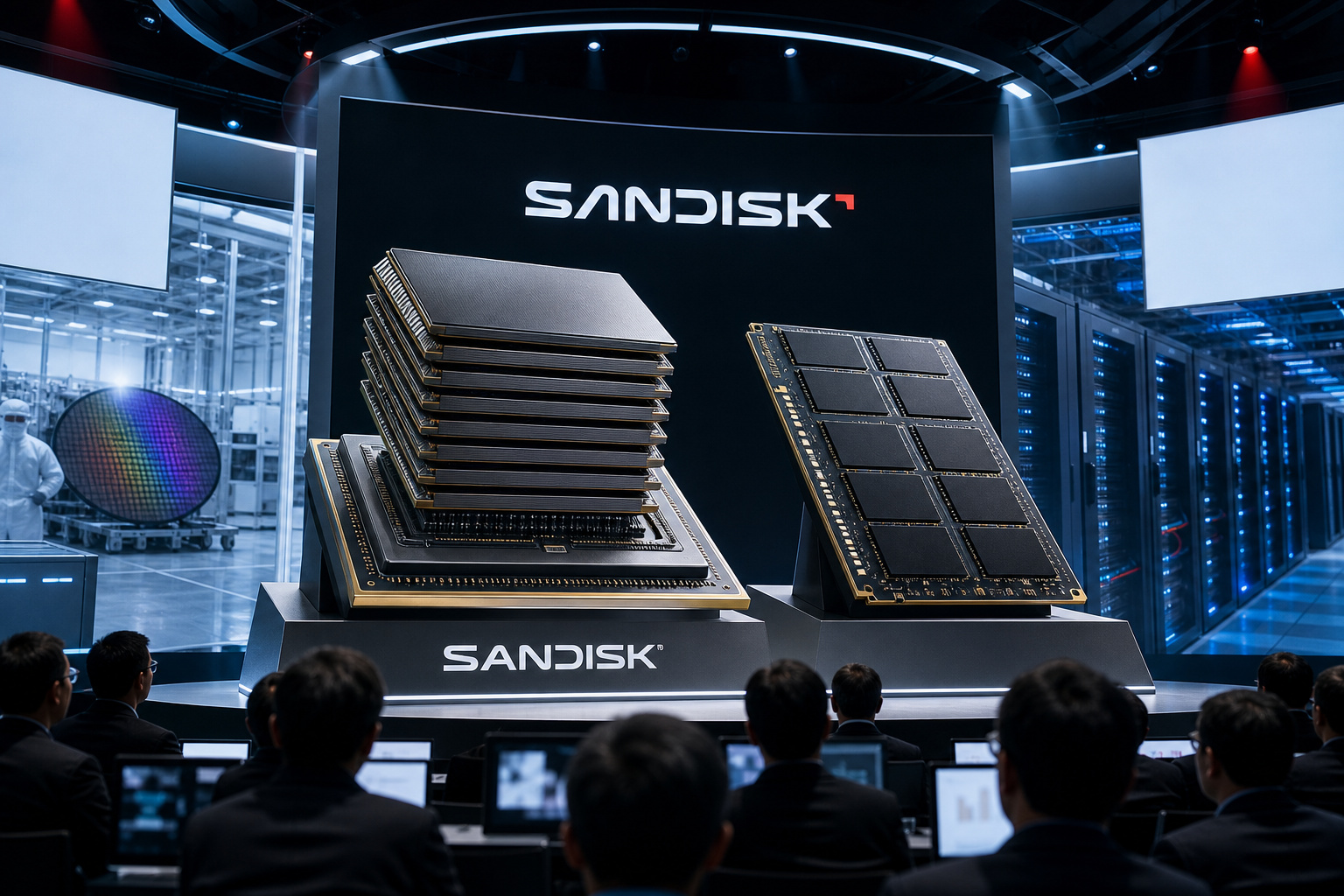
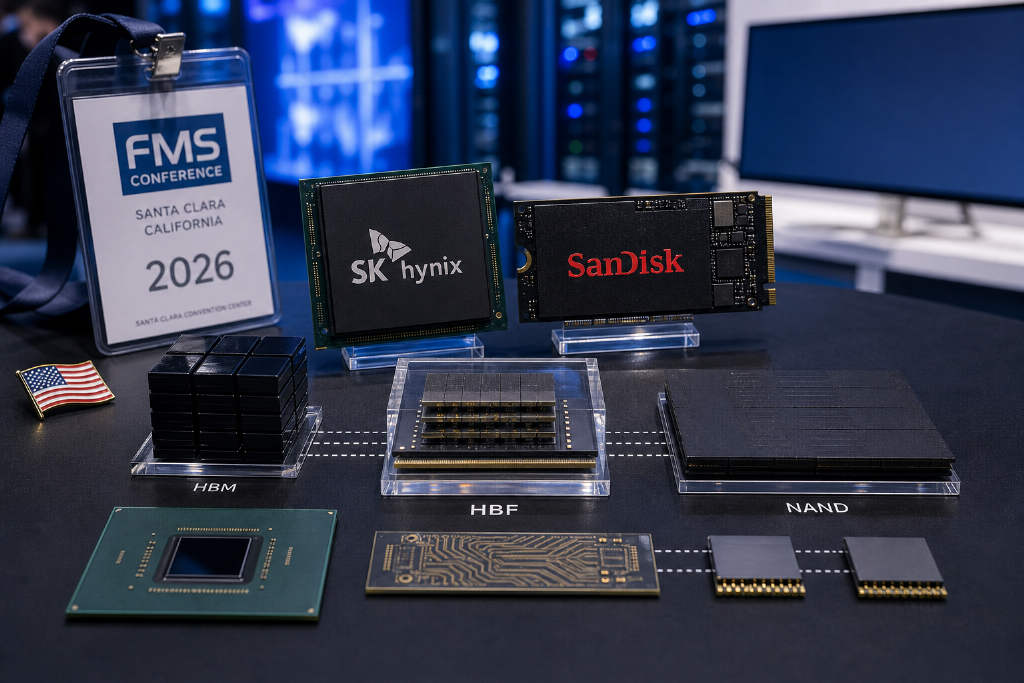
SK hynix and SanDisk introduced the first HBF specification at the 2026 FMS Conference in Santa Clara, California. The first version targets up to 512GB of capacity and bandwidth ranging from 0.4 TB/s to 3.0 TB/s, with UCIe used as the interconnect between HBF and the processor. SanDisk also showed a test case suggesting that, in a specific AI inference setup, four GPUs paired with 4TB of HBF delivered nearly the same token output per second as eight GPUs paired with 192GB of HBM. The companies are positioning HBF as a new memory tier between HBM and conventional NAND storage. SK hynix also outlined a revised memory hierarchy that adds G0.5, G1.5 and G2.5 tiers, while SanDisk said HBF is meant to support persistent KV cache and other large inference-state data. The roadmap now points to a full HBF specification in early 2027 and samples in early 2028.

2460
SK hynix and SanDisk unveil the first HBF standard at FMS 2026
AI Inference
Aug 15, 2026

AI inference is pushing NAND deeper into the memory stack, and Sandisk is betting on it

AI spending in semiconductors has largely been framed around GPUs, high-bandwidth memory, networking and power. This report argues that inference is widening that trade. As AI systems move from training to serving billions of queries, enterprise agents, multimodal workloads and real-time applications, the need to keep large pools of data accessible at reasonable cost is becoming more central. That is giving NAND a larger role as a capacity layer alongside HBM and DRAM, rather than leaving it as a conventional commodity storage product. Sandisk has become one of the clearest public advocates of that view. At its 2026 investor day, the company said enterprise data center flash demand could reach 1.2 ZB by 2030 and projected mid-to-high double-digit annual revenue growth from FY2028 through FY2030, with Reuters cited in the source for related expectations. The company is also developing High Bandwidth Flash, or HBF, for AI inference, while continuing to push denser QLC NAND products. At the same time, Sandisk and other storage makers are leaning more heavily on multi-year customer agreements. Reuters, as cited in the source, reported that Sandisk had signed eight long-term agreements with six customers worth about $93.9 billion in total. The article’s main conclusion is narrower than a permanent re-rating story. AI is unlikely to erase NAND cyclicality. What may change is the amplitude: stronger bit demand, better demand visibility and tighter supply discipline could make future NAND cycles less violent than in the past.

2680
AI inference is pushing NAND deeper into the memory stack, and Sandisk is betting on it
SanDisk
Aug 14, 2026

Citrini analyst questions SanDisk’s HBF demo, says HBM performance may have been understated

Citrini analyst Zephyr challenged SanDisk’s HBF-versus-HBM comparison shown at its investor day, arguing that the setup may have understated HBM’s real capabilities. In his post, he said SanDisk assigned the same total bandwidth of 12.8 TB/s to both HBF and HBM, which works out to 1.6 TB/s per stack, and used the Qwen3-480B-A35B model running in bfloat16 for the demonstration. Zephyr said current inference workloads more commonly use FP4 or FP8, putting the model’s memory requirement at roughly 240 GB to 480 GB depending on quantization. He also said SanDisk fixed HBM capacity at 192 GB per GPU, while a 16-layer HBM4E setup with eight stacks can reach 512 GB and deliver about 32 TB/s of bandwidth, around three times the level used in the company’s demo. Based on that, Zephyr argued that SanDisk’s result showing HBF needing only one to four GPUs while HBM needed eight does not adequately reflect the performance of higher-spec HBM configurations.

2110
Citrini analyst questions SanDisk’s HBF demo, says HBM performance may have been understated
Sandisk
Aug 14, 2026

Sandisk lays out 80% gross margin floor as HBF becomes central to long-term growth case

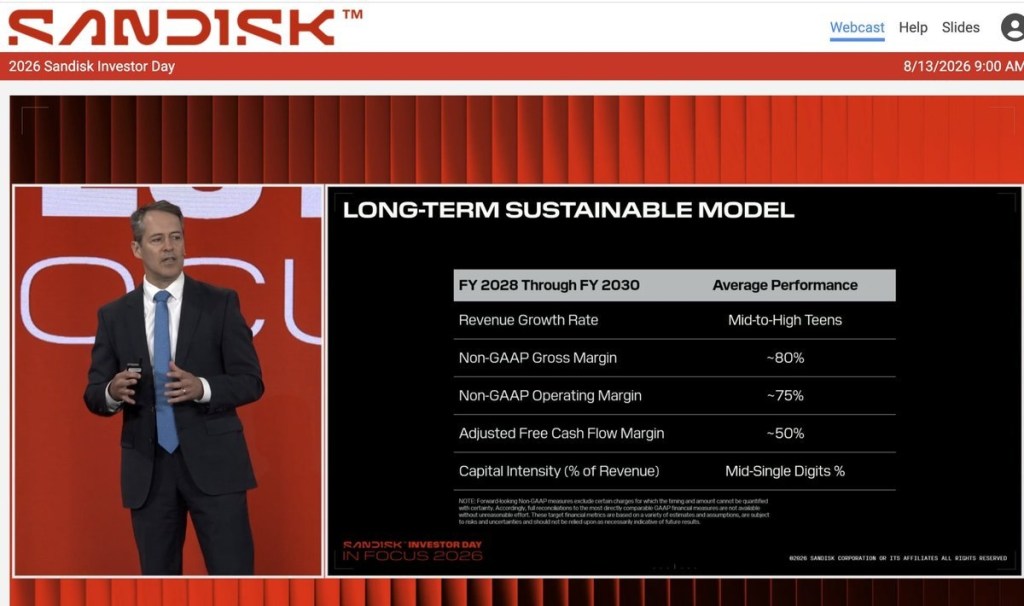
Sandisk used its Aug. 13 investor day to lay out a long-range financial model that sits well above market expectations and puts its in-house High Bandwidth Flash, or HBF, at the center of the story. The company said its long-term sustainable model, based on average performance across FY2028 to FY2030, calls for revenue growth in the mid-to-high teens, a Non-GAAP gross margin of about 80%, a Non-GAAP operating margin of roughly 75%, adjusted free cash flow margin near 50%, and capital intensity in the mid-single digits as a percentage of revenue. Mizuho Securities kept its Outperform rating on Sandisk and set a $1,900 price target, arguing that the company’s framework, buyback capacity, and exposure to AI infrastructure support upside. Sandisk also detailed the positioning of HBF, saying the product can deliver comparable read bandwidth to HBM at about one-eighth the cost, while offering 8x to 16x more capacity in a similar package footprint. The company tied that pitch to memory-heavy AI inference workloads and said HBF is meant to work alongside HBM rather than replace it.

2320
Sandisk lays out 80% gross margin floor as HBF becomes central to long-term growth case
FMS 2026
Aug 7, 2026

FMS 2026 spotlights AI memory bottlenecks as SK hynix, Samsung and Kioxia push different storage paths

At FMS 2026 in Santa Clara, held from Aug. 4 to Aug. 6, storage vendors used the industry’s largest independent storage conference to show how AI system design is pushing memory and storage into a more central role. SK hynix and Sandisk introduced the first standard specification for High Bandwidth Flash, or HBF, through the Open Compute Project, with support for 8-high and 16-high stacks and capacity of up to 512GB per package. The product’s read bandwidth ranges from 0.4 TB/s to 3.0 TB/s, putting the top end into HBM4 territory, though it was presented as an added tier below HBM rather than a replacement for it. Samsung unveiled its V10 BV-NAND with more than 400 layers and said it was the industry’s first use of wafer bonding for that route, while also previewing zHBM and zNAND-O as concepts that have not entered mass production. Kioxia, for its part, introduced the CM10, described as the first enterprise SSD to combine PCIe 6.0, 332-layer BiCS10 and direct cold-plate liquid cooling. The report also said Samsung plans to raise monthly HBM output from about 170,000 wafers to about 250,000 wafers, with the target set for the end of 2026.

3530
FMS 2026 spotlights AI memory bottlenecks as SK hynix, Samsung and Kioxia push different storage paths
Market Analysis
Aug 6, 2026

Interconnect Moves to the Top of the Bottleneck Stack as HBM and Memory Hierarchies Face Repricing

A PANews analysis argues that August 4, 2026 marked a turning point for the memory industry. On the same day, SK hynix and SanDisk introduced the first standard for high-bandwidth flash, or HBF, at FMS 2026, while TrendForce reported that Nvidia was evaluating lower HBM configurations for Rubin Ultra. The article says those two developments point in the same direction: the core constraint in AI infrastructure is shifting away from on-package memory alone and toward interconnects across chips, packages, racks, and systems. The piece traces that shift through Nvidia’s Vera Rubin launch, NVLink 6 bandwidth gains, Spectrum-X CPO shipments, Intel’s EMIB-T packaging push, TSMC’s reported work on an EMIB-like approach, and the emergence of UCIe-linked memory tiers such as HBF. In that framework, optical and electrical interconnects sit at the top of the stack, advanced packaging becomes the physical foundation, HBM remains essential but less open-ended from an investment perspective, HBF represents a new category aimed at inference-era capacity pressure, and CXL memory pooling remains an option for later years. Rather than framing this as a broad “memory bull market,” the article’s main point is that value inside the storage empire is being redistributed as the bottleneck migrates.

3400
Interconnect Moves to the Top of the Bottleneck Stack as HBM and Memory Hierarchies Face Repricing
HBF
Aug 4, 2026

HBF standard goes public, but near-term focus stays on SanDisk earnings and NAND pricing

WhiteLine Daily said the launch of a public HBF specification matters because it turns the concept from a single-company proposal into a shared industry standard. SK hynix and SanDisk published the first HBF technical specification through the Open Compute Project, defining 8-layer and 16-layer NAND stacks, capacities of up to 512GB per package, bandwidth tiers of roughly 0.4 TB/s to 3.0 TB/s, and UCIe connectivity to CPUs, GPUs and other accelerators. Google and Tenstorrent have also joined the HBF consortium. The report argues that HBF is not meant to replace HBM. Instead, it adds a new memory tier between HBM and SSD, placing larger-capacity storage closer to xPU compute. High-frequency, latency-sensitive data would still remain in HBM or DRAM, while model weights with lower access frequency could sit in HBF. That setup may be especially relevant for MoE models, where many expert weights stay idle most of the time yet still consume capacity. WhiteLine Daily said the short-term investment angle is still not HBF revenue, since first HBF samples are scheduled for the second half of 2026 and the first inference device samples using HBF are expected in early 2027. The nearer catalysts are SanDisk’s earnings, NAND pricing, data center demand, margins, customer agreements, and enterprise SSD progress.

2480
HBF standard goes public, but near-term focus stays on SanDisk earnings and NAND pricing
Total 11 items
Go topage