Yi He
Nov 4, 2026

Binance’s Yi He says work computers are barred from personal use and downloads are tightly monitored

Yi He said on X that employees are not allowed to use work computers for personal purposes under company rules, describing the policy as a safeguard against hackers. She added that downloads are subject to strict monitoring and said those controls had intercepted more than 50 earlier incidents this year. In the same post, Yi He said security is an ongoing process of iteration between attackers and defenders, and that the monitoring failed in this case because hackers are also evolving. She had previously said, in response to related discussion, that an employee who was fired for downloading iQIYI on a work computer was also part of Binance.

570

Binance’s Yi He says work computers are barred from personal use and downloads are tightly monitored
Binance
Nov 3, 2026

Binance’s Yi He says 57 suspected North Korea-linked cyberattacks were blocked since 2026

Binance co-founder Yi He said the exchange’s security team has identified and successfully blocked 57 suspected cyberattack incidents linked to North Korea since 2026. According to her statement, the cases show that state-backed hacking groups continue to target the cryptocurrency industry. She outlined a range of attack methods seen in those incidents, including fake job interviews, malware disguised as popular developer tools, compromised software packages and browser extensions, fake video meeting applications, and social engineering attempts designed to steal account credentials or deploy remote-access malware. Yi He said Binance intercepted many of these attacks, but warned that the cost of even a single failed interception could be severe. She added, 「This should not have happened.」

690
Binance’s Yi He says 57 suspected North Korea-linked cyberattacks were blocked since 2026
South Korea
Nov 3, 2026

South Korea’s Lee Jae-myung cites Binance theft, calls for cross-government cyber body

South Korean President Lee Jae-myung referred to the recent multibillion-dollar crypto asset theft involving Binance during a Cabinet meeting on Nov. 3, according to Reuters, and called for a stronger cross-government cybersecurity coordination body to oversee protection efforts across both the public and private sectors. Lee said the current security framework, which is centered on post-incident inspections and response, is showing clear limits as artificial intelligence makes hacking techniques more sophisticated. He said a preventive system needs to be built instead of relying mainly on after-the-fact measures. South Korea’s National Intelligence Service has already launched emergency security inspections covering more than 2,100 central and local government departments as well as public institutions. Earlier, the U.S. Federal Bureau of Investigation attributed the Binance theft to North Korean hackers, while North Korea denied involvement.

700
South Korea’s Lee Jae-myung cites Binance theft, calls for cross-government cyber body
North Korea
Oct 30, 2026

Experts say North Korean hackers tied to crypto theft rank among the world’s best

Techub News, citing Reuters, reported that experts said North Korean hackers linked to cryptocurrency theft rank at the top tier globally. According to the report, those hackers are seen as having leading technical capabilities on a worldwide basis. Experts also said they have been connected to multiple cryptocurrency theft cases. The report did not provide additional details on specific incidents, groups, or losses, but it framed the assessment around both technical sophistication and repeated links to crypto-related theft. The claim, as presented by Techub News and attributed to Reuters, centers on the view that North Korean hacking operations associated with digital asset theft are among the strongest in the world.

890
Experts say North Korean hackers tied to crypto theft rank among the world’s best
FEC
Oct 27, 2026

FEC official email indicates hackers are trying to breach U.S. election websites

ChainCatcher reported that an email from a U.S. Federal Election Commission, or FEC, official indicates hackers are attempting to breach U.S. election websites. The brief item attributes the information to the contents of the email and does not provide additional details on the specific websites involved, the status of the attempted intrusion, the scope of any impact, or what response measures may have been taken. No further technical information, timeline beyond the report itself, or attribution of the attack was included in the source brief. The report is presented as a short newsflash and remains limited to the claim that an FEC official email showed an ongoing attempt to target U.S. election-related websites.

800
FEC official email indicates hackers are trying to breach U.S. election websites
AI
Oct 22, 2026

Researchers say hackers can turn public AI models into cybercrime tools by bypassing safeguards

Researchers have identified a technique that can bypass safety guardrails in certain AI models and turn publicly available systems into tools for cybercrime, according to a Bloomberg-cited Techub News brief. Using the method, hackers can prompt AI models to produce malicious code or other content that could be used in cyberattacks. The issue is tied to insufficient safety measures in some models at the deployment stage, where specially crafted inputs can push the systems to return material they were originally designed to block. Researchers warned that the risk is rising as AI models are more widely open-sourced and deployed. The report did not name the researchers or specify which models were affected, but it framed the finding as a growing security concern tied to broader access to AI systems.

700
Researchers say hackers can turn public AI models into cybercrime tools by bypassing safeguards
GMO
Oct 20, 2026

GMO says hackers targeting major Japanese companies used AI tool tied to attacks on Korean banks

Tokyo-based internet security company GMO said hackers that recently breached several large Japanese companies used an AI tool developed in China. According to GMO, the same tool was linked to a series of intrusion incidents that hit multiple South Korean banks last month. The report was cited by Techub and attributed to Bloomberg. The available source material does not disclose the names of the affected companies, the banks involved, or technical details about how the tool was used. GMO’s statement connects the recent incidents in Japan with the earlier bank intrusions in South Korea, but no additional operational specifics were provided in the source text.

1210
GMO says hackers targeting major Japanese companies used AI tool tied to attacks on Korean banks
Apple
Oct 19, 2026

Hackers get Apple’s iOS running on Android phones for the first time

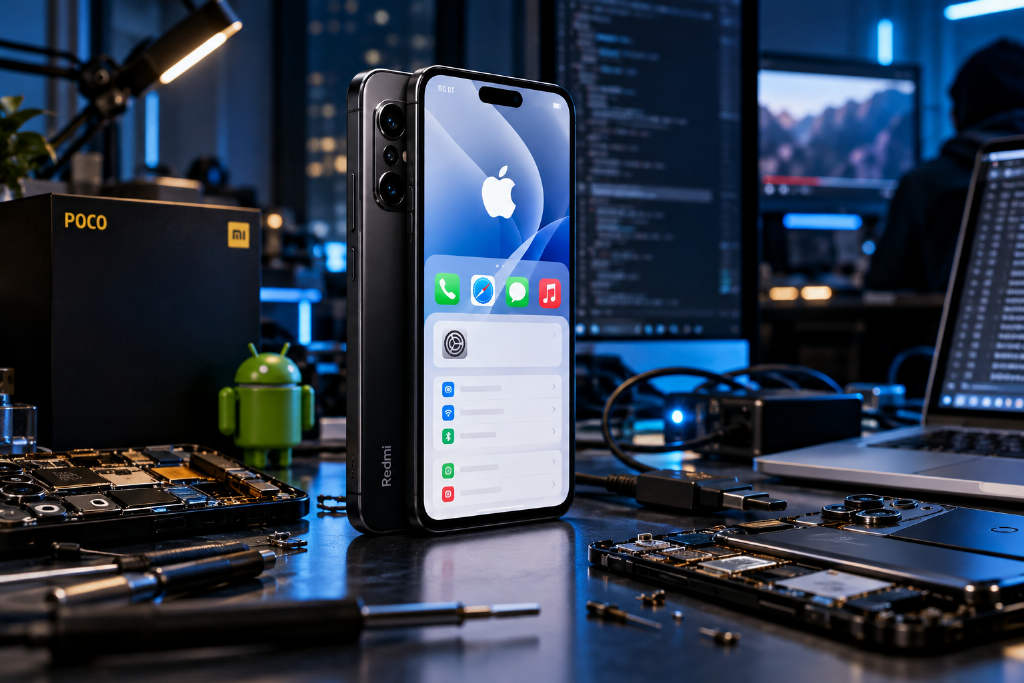
Hackers and hobbyist developers are now showing Apple’s iOS running on Android phones, a milestone that had long eluded the modding community. Videos posted on X have drawn wide attention, including a clip of iOS 16 on a Redmi Note 12 with more than 2 million views and another demo on a Nothing 3a. The most visible public codebase is an open-source GitHub project called ios-sweet for the Redmi Note 10 Pro. It patches Apple’s open-source XNU kernel to work with the phone’s Qualcomm Snapdragon 732G chip and layers unmodified iOS 16.7.16 files from an iPhone X on top. According to the project’s readme, the device can reach the lock screen, home screen, Control Center, and Settings, with touch and buttons working, but key functions such as Wi‑Fi, Bluetooth, mobile data, audio, and camera support remain unavailable. A separate group, OOSexGang, says its HackiOS project runs iOS 16.5 on a Poco X5 Pro using a custom UEFI and XNU, though no source code has been released and there is no independent verification. Decrypt also notes that recent AI-assisted reverse-engineering tools and jailbreak work are helping accelerate experiments that push software onto hardware it was never designed to support.

2160
Hackers get Apple’s iOS running on Android phones for the first time
Total 24 items
Go topage