arXiv
Oct 3, 2026

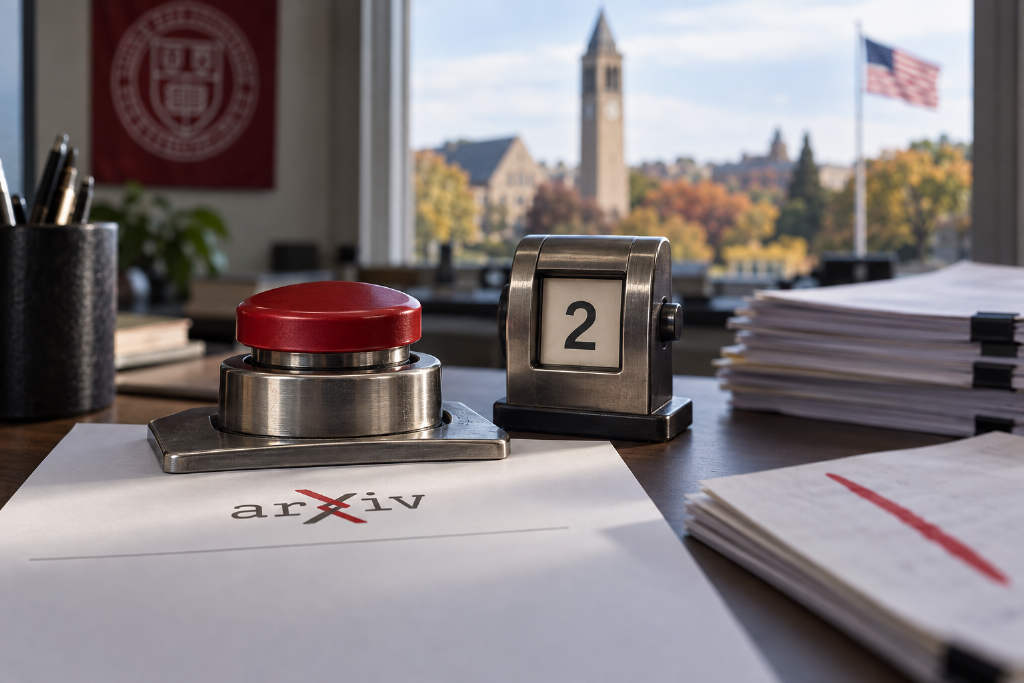
arXiv Caps Monthly Submissions at Two per Account as AI-Era Paper Surge Strains Moderation

arXiv has rolled out one of its toughest submission controls to date, limiting each submitting account to two papers per month starting Oct. 1, while capping the number of manuscripts under review at three. Rejected submissions still count against the monthly quota. The change follows a sharp rise in volume: arXiv received 40,363 submissions in September, a monthly record, and staff plus moderators handled nearly 9,000 support tickets. The platform said the spread of AI tools has changed how quickly papers can be produced, while its screening system still depends on roughly 300 volunteer moderators. arXiv does not run peer review, but every paper is checked before posting for academic fit and category placement. The policy applies only to the person who clicks submit, not to co-authors, because author identities are not fully linked at the moment of submission. That design has already drawn criticism, with users noting that teams could rotate submitters to get around the cap. arXiv described the rule as temporary and said it may later be relaxed or removed, but it has not given a timetable.

930
arXiv Caps Monthly Submissions at Two per Account as AI-Era Paper Surge Strains Moderation
ICLR
Sep 21, 2026

ICLR 2027 abstract submissions top 60,000, exceeding the conference’s combined total from 2013 to 2026

ICLR 2027 has drawn more than 60,000 abstract submissions, a figure that exceeds the combined submission count across all ICLR conferences from 2013 through 2026, according to the source article. The piece notes that the first ICLR received 67 submissions, while ICLR 2026 reached 19,525. Across the 14 editions from 2013 to 2026, total submissions were about 56,000. The article says the widely discussed “60,000+” figure refers to the scale seen after the abstract deadline, not the final number of papers that will enter formal review. This year’s abstract deadline was Sept. 18 and the full paper deadline is Sept. 25. ICLR requires abstracts to be genuine and valid, and duplicate or placeholder abstracts will be removed before later stages such as full submission, withdrawals and format checks. The surge has sharpened concerns over reviewer capacity. The source cites ICLR 2026 data showing 19,525 valid submissions, 779 desk rejects, 5,042 withdrawals and 13,763 papers reaching the accept-or-reject decision stage. Handling that load required 18,054 reviewers who submitted 76,139 reviews. ICLR has already introduced new submission policies for 2027, including caps on author participation and reciprocal reviewer requirements, and on Sept. 10 announced a partnership with Google to offer the Paper Assistant Tool, or PAT, to submitters before formal submission.

970
ICLR 2027 abstract submissions top 60,000, exceeding the conference’s combined total from 2013 to 2026
ICLR
Sep 19, 2026

ICLR 2027 receives about 50,000 paper abstracts, up more than 150% from last year

ICLR 2027 has received about 50,000 paper abstract submissions so far, a sharp increase from the 19,500 reported for ICLR 2026. Techub, citing The Decoder, said the jump exceeds 150% year over year. The report linked the surge to several factors already visible across the AI research field: sustained enthusiasm around AI, companies tying compensation to publication records, and AI tools speeding up paper production. Those conditions appear to be pushing submission volumes far above the prior year’s level. The same report said the increase could worsen existing quality issues in both the submission pipeline and the peer review process. No additional details were provided on how those issues are being handled.

710
ICLR 2027 receives about 50,000 paper abstracts, up more than 150% from last year
AI paper reproducibility
Aug 9, 2026

AI tools flag reproducibility and error issues across top research papers

AI-based review systems are beginning to expose how often published research may contain reproducibility problems or objective mistakes, according to a MarsBit report citing several recent projects focused on top artificial intelligence venues. One audit, carried out on all 168 oral papers at ICML 2026 by a U.S. research review company, found that 92 papers had at least five verifiable claims. Among those, 58 could not be reproduced. Only 34 papers had more than 40% of their claims successfully reproduced, and just eight cleared the 80% mark. The report draws a line between failed reproduction and fraud. In the cases cited, failures were tied to missing files, broken software dependencies, mismatches between paper claims and runtime results, and four papers that depended on models no longer available. A separate GPT-5-based paper checking system, introduced in late 2025 to scan already published papers in top AI conferences and journals, reported an average of 4.7 objective errors per paper, with 99.2% of papers flagged for at least one issue. The report says mathematics and formula-related mistakes made up 54.0% of all errors, while 30.8% of NeurIPS papers and 23.8% of ICLR papers contained at least one substantive error that could affect interpretation. Even so, the article notes that AI review tools still need human oversight: one checker cited had 83.2% precision and still missed about 40% of real errors in each run.

2940
AI tools flag reproducibility and error issues across top research papers