JLTXX

tokenized fun
2026-08-19 01:19:53

Tokenized fund market cap adds $2.7 billion in 90 days, led by JPMorgan and Ondo

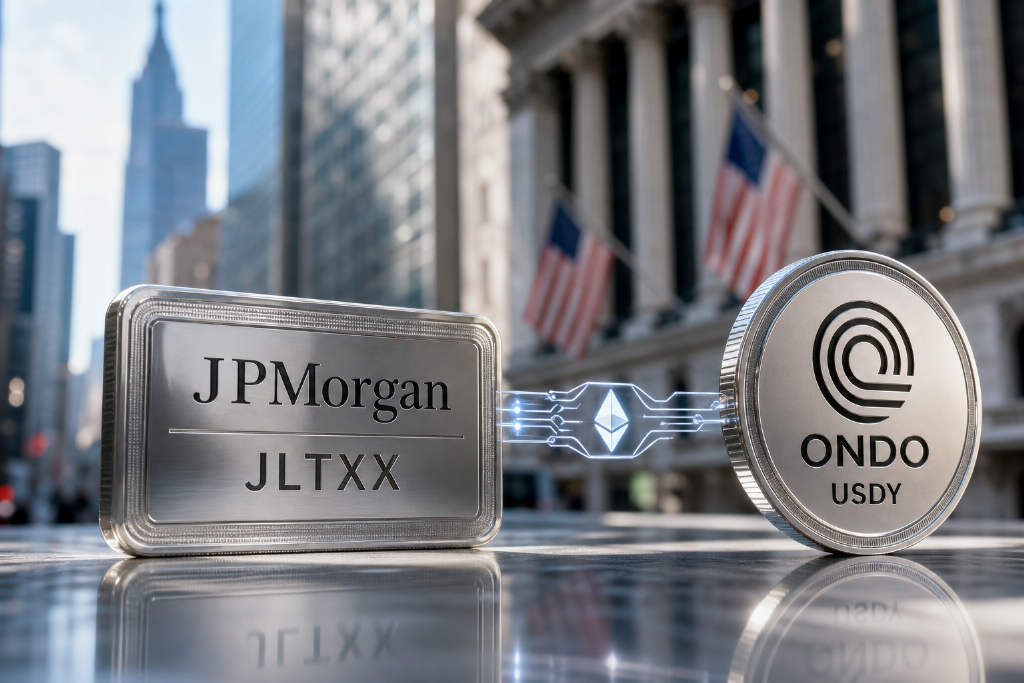
The market value of tokenized funds has increased by about $2.7 billion over the past 90 days, bringing the total value of tokenized assets to roughly $38 billion by mid-August 2026, according to a Techub News item citing CryptoBriefing. The latest gains were driven mainly by two products: JPMorgan’s JLTXX and Ondo Finance’s USDY. JLTXX, a tokenized U.S. government money market fund issued on Ethereum, reached an estimated valuation of about $809 million after launching in May 2026. USDY, meanwhile, has grown to around $2.1 billion in market capitalization and can be used as collateral in DeFi. The report also said stablecoin issuers have become major buyers in this segment, pointing to rising institutional and onchain demand for tokenized fund products. Together, the figures highlight continued expansion in tokenized real-world asset markets over the past three months, with capital concentrating in a small number of large products.

430
Tokenized fund market cap adds $2.7 billion in 90 days, led by JPMorgan and Ondo
Tokenized Fun
2026-08-13 13:14:03

Tokenized fund race shifts from size to control of digital money rails

Tokenized money market and Treasury funds are moving beyond their original role as yield products and into a new position inside institutional digital cash systems. By May 2026, tokenized Treasury and money market funds had reached about $10 billion in combined assets, with BlackRock’s BUIDL alone accounting for roughly 40% of that total. At the same time, Hong Kong moved tokenized funds from a subscription-and-redemption model toward 24/7 secondary trading, while banks in Singapore began testing tokenized fund shares as collateral for lending and trading activity. The competition is now centered on utility rather than issuance alone. In the United States, tokenized funds are increasingly being tied to stablecoin reserve structures, including JPMorgan’s JLTXX on Ethereum, which is designed for reserve use under the GENIUS Act framework. Europe and the UK are focusing on fitting these products into formal regulatory systems. Singapore is pushing the collateral use case. Hong Kong, meanwhile, is trying to combine issuers, banks, trading venues and settlement infrastructure in one regulated market structure. What is emerging is not simply a new wrapper for traditional money funds. Tokenized fund shares are being tested as assets that can circulate across trading, settlement and credit networks. That raises a broader question for asset managers, banks and crypto platforms alike: in a market where cash management tools, bank deposits and digital currencies start to share the same rails, who will control access to the system itself?

330
Tokenized fund race shifts from size to control of digital money rails
Ethereum
2026-07-30 11:00:00

Wall Street Keeps Building on Ethereum, but ETH Price Still Struggles

Ethereum is drawing deeper interest from large financial firms, yet that institutional momentum has not translated into a stronger market outlook for ETH. Since May, firms including JPMorgan, Robinhood and Morgan Stanley have rolled out Ethereum-related products and access points, while a new nonprofit, Ethereum Institutional, was launched in July by former Ethereum Foundation members to speed up enterprise adoption. At the same time, Ethereum co-founder Vitalik Buterin has introduced the "Lean Ethereum" roadmap, a three- to four-year overhaul aimed at lowering costs, improving privacy and strengthening quantum resistance. Even with that backdrop, ETH has remained under pressure. At the time of writing, it was trading a little above $1,900, down more than 60% from its roughly $4,950 all-time high in August 2025. Citigroup cut its 12-month target for ETH to $2,240 from $3,175 on July 1, citing weaker investor demand and continued net outflows from Ethereum ETFs. Researchers at Galaxy argue the disconnect between Ethereum’s expanding role and ETH’s market performance comes down to a basic problem: investors are increasingly unsure how value should accrue to the token itself, especially as layer-2 networks absorb most transaction activity and reduce fee burn on the main chain.

1490
Wall Street Keeps Building on Ethereum, but ETH Price Still Struggles