OpenAI
Sep 8, 2026

OpenAI says it plans to deploy Broadcom-developed Jalapeño AI chip by year-end

OpenAI said it plans to begin deploying Jalapeño, an AI chip developed with Broadcom, before the end of this year. The company also said the rollout will move ahead alongside accelerators supplied by Nvidia, Advanced Micro Devices (AMD), and other partners. The update was published by ChainCatcher under the technology category. No additional technical specifications, deployment scale, or launch timeline beyond year-end were disclosed in the source text. The report focused on OpenAI’s stated deployment plan and the fact that Jalapeño will be advanced in coordination with hardware from multiple chip partners rather than as a standalone effort.

1150
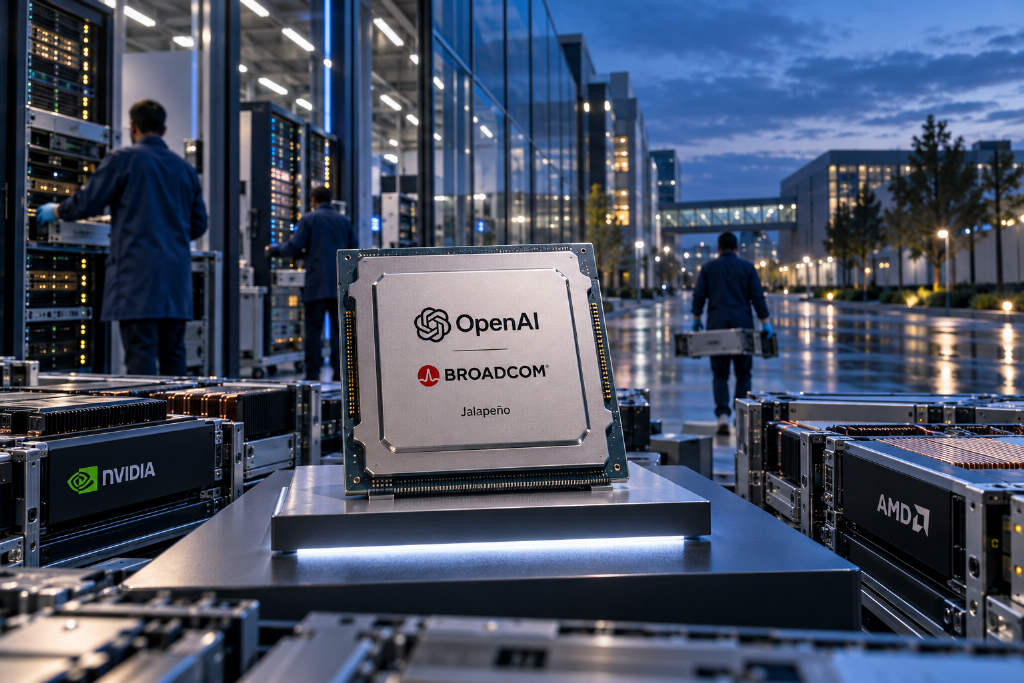
OpenAI says it plans to deploy Broadcom-developed Jalapeño AI chip by year-end
OpenAI
Aug 31, 2026

OpenAI rumor mill points to 10 trillion-parameter Bel model as Astra nears release

A fresh wave of posts on X and Reddit has pushed a new OpenAI codename into the spotlight: Bel. According to the claims cited by MarsBit, OpenAI has finished pretraining Bel at a reported 10 trillion parameters, placing it after the previously mentioned Doug model and framing it as a foundation system for the period beyond GPT-6. The same reporting says Astra, another next-generation model, could be released next Thursday and has already expanded its testing scope. The article also ties Bel to a broader narrative inside OpenAI: control over the low-level code for its in-house Jalapeño chip project, signs of recursive self-improvement, and an internal push to use frontier models to optimize training stacks, CUDA kernels, and infrastructure. Claims in the report go further, describing Bel as stronger than Astra in coding, reasoning, and long-horizon agent tasks, with the ability to operate for days with little or no human intervention while coordinating hundreds of subagents. Much of the information comes from named social media accounts, podcast remarks, and community discussions rather than formal OpenAI disclosures. That makes the story notable, but still unconfirmed on the record.

3360
OpenAI rumor mill points to 10 trillion-parameter Bel model as Astra nears release
OpenAI
Aug 26, 2026

OpenAI posts first Jalapeño benchmark results as South Korean DRAM export prices jump 401%

WuBlockchain’s WhiteLine Daily rounded up several developments across AI infrastructure and semiconductors. OpenAI released the first benchmark readout for its in-house inference chip, Jalapeño, and said peak throughput per watt was 1.5x to 1.9x higher than comparison systems across tests involving GPT-OSS 120B, DeepSeek R1 670B, and Kimi K2.5 1T, while end-to-end latency was 1.7x to 3.6x lower. SemiAnalysis said its team verified benchmark execution on site at OpenAI’s lab, though the performance figures themselves came from OpenAI. Separately, ChosunBiz, citing TRASS data, reported that South Korea’s DRAM export unit price for Aug. 1-20 reached $92,183 per kilogram, up 401% year over year, while export value rose 504.8% to $9.807 billion. Bloomberg, citing Morgan Stanley, said AI infrastructure-related commitments from five hyperscalers plus Nvidia and Broadcom have surpassed $3.1 trillion. Semtech also reported strong data center growth and projected another sequential increase in the third quarter.

1780
OpenAI posts first Jalapeño benchmark results as South Korean DRAM export prices jump 401%
OpenAI
Aug 26, 2026

SemiAnalysis says OpenAI’s Jalapeño inference chip outperformed Nvidia Blackwell in lab tests

SemiAnalysis said OpenAI’s in-house inference chip, Jalapeño, delivered higher token throughput per megawatt than Nvidia’s Blackwell in lab testing, and in some comparisons even came in ahead of the next-generation Rubin lineup. The report says the chip went from design to tape-out in about 16 months after development began in mid-2024, with OpenAI and Broadcom building the first-generation ASIC from scratch. According to the published results, SemiAnalysis ran the benchmarks with the InferenceX suite and found Jalapeño leading on token throughput per megawatt without using multi-token prediction, while the other chips in the chart had MTP enabled. The report lists more than 700 tokens per second per user on DeepSeek R1 at concurrency 1, about 1,400 tokens per second per user on Kimi-K2.5 and GPT-OSS, and GSM8k scores in line with Nvidia chips. The piece argues that Rubin, not Blackwell, is the more relevant comparison because both Jalapeño and Rubin use HBM4. It also says OpenAI is optimizing for performance per watt because data center power, rather than budget or floor space, is the current constraint. The architecture described in the report allows up to 2,048 Jalapeño XPUs within a single scale-out network, with OpenAI’s next target set at 100MW.

1940
SemiAnalysis says OpenAI’s Jalapeño inference chip outperformed Nvidia Blackwell in lab tests
OpenAI
Aug 26, 2026

OpenAI says Jalapeño beat Nvidia GB300 in tests, but benchmark limits remain

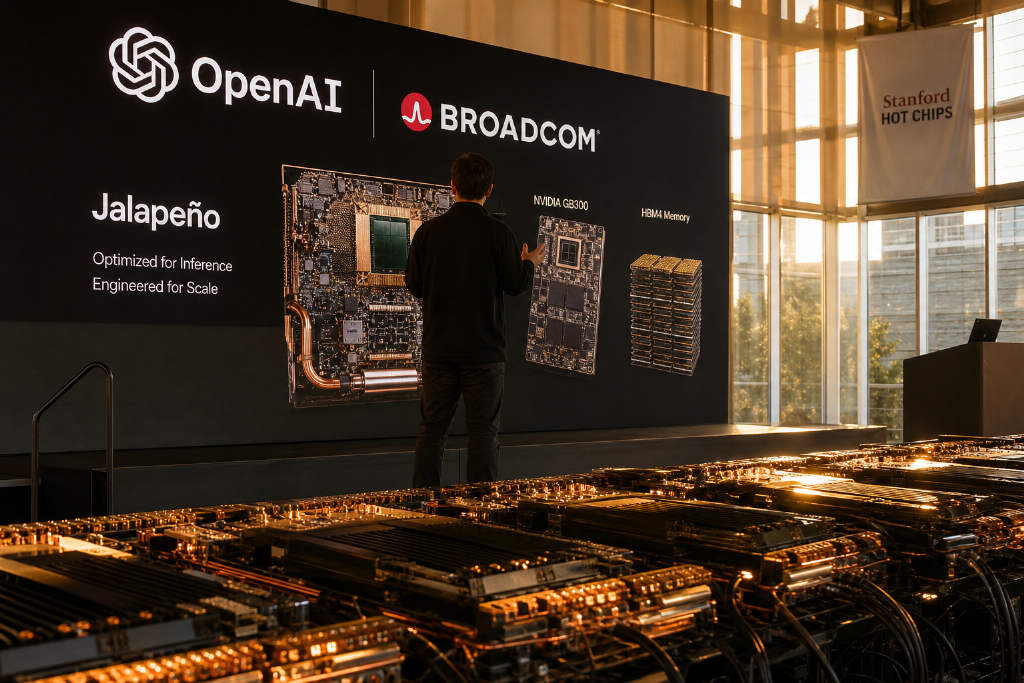
OpenAI says its in-house Jalapeño inference chip, developed with Broadcom, outperformed Nvidia’s GB300 on power efficiency and response time in internal testing, according to remarks by chip lead Richard Ho at Stanford University’s Hot Chips conference. The chip is designed for inference rather than model training and was formally introduced in June after a development cycle that OpenAI says took nine months from project start to tape-out. A 128-chip Jalapeño system delivers 1.7 exaFLOPS of 4-bit MXFP4 compute, or about 13.4 petaFLOPS per chip, and includes 27.5 TB of HBM4 memory. Technical analysis cited by The Register said the system posted 1.5x to 1.9x higher peak throughput and 1.7x to 3.6x lower end-to-end latency in OpenAI’s custom InferenceX benchmark, with even larger gains in ultra-low-latency scenarios. Bloomberg, however, said the results come with at least four caveats: Jalapeño was not compared with Nvidia’s newer Vera Rubin chips; speculative decoding was excluded from the benchmark; the system trails Nvidia GB200 NVL72 and GB300 NVL72 racks in raw compute and memory capacity; and OpenAI has not disclosed actual power draw. The report added that volumes will remain limited in 2026, with mass production only expected in 2027.

1640
OpenAI says Jalapeño beat Nvidia GB300 in tests, but benchmark limits remain