AI chip stocks
Nov 3, 2026

AI chip stocks pull back over the past month, with the Philadelphia Semiconductor Index down 21.9%

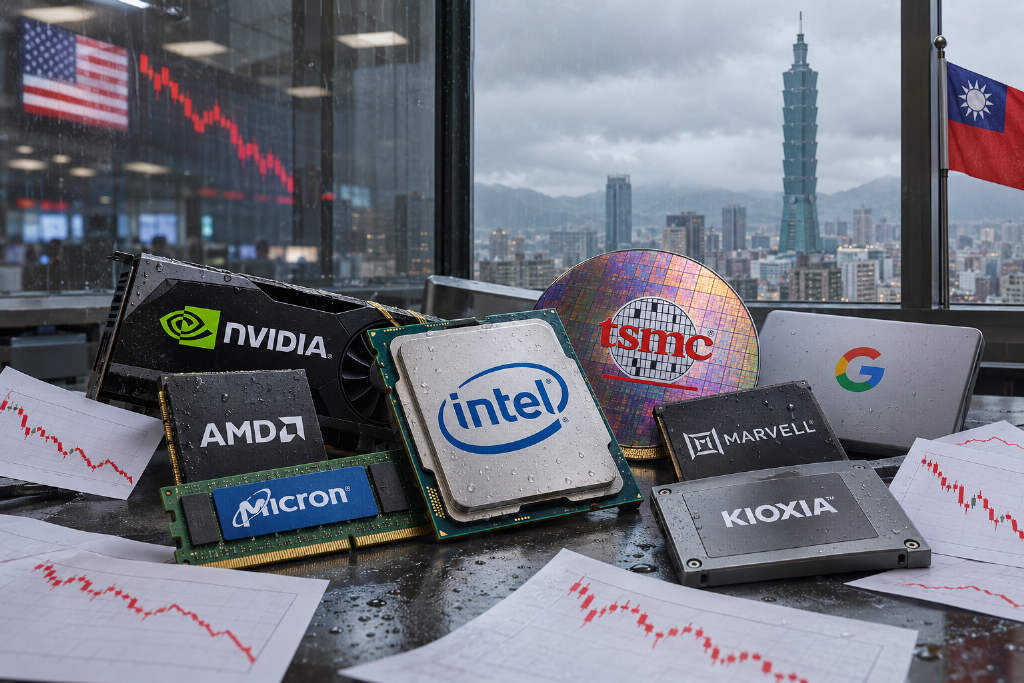
ABMedia’s latest roundup shows a broad correction across AI-related chip names over the past month, though the drivers were not the same from stock to stock. The Philadelphia Semiconductor Index closed at 10,328.33 on Nov. 2, down 21.9% from its Oct. 6 high of 13,217.82. Taiwan’s weighted index closed at 43,307.54 on Nov. 3, down 13.1% from its Oct. 6 peak, after falling 1,612.60 points, or 3.59%, in a single session. Among individual names, Intel posted the steepest decline in the table at 48.4% from its recent high after issuing fourth-quarter revenue guidance of $15 billion to $16 billion, below third-quarter revenue of $16.5 billion. Kioxia fell 40.7% after forecasting October-to-December revenue of JPY 2.5 trillion, only 0.8% above the prior quarter. Marvell dropped 40.3% as the market reacted to its all-stock acquisition of Lumentum, a deal the company said implied an enterprise value of $115 billion. Alphabet fell 21.1% after reporting negative free cash flow for a second straight quarter. ABMedia also noted that Nvidia, Micron, AMD and TSMC did not release company-level negative announcements during the period, even as their shares moved lower from recent highs.
520
AI chip stocks pull back over the past month, with the Philadelphia Semiconductor Index down 21.9%
Kioxia
Nov 2, 2026

Kioxia shares sink nearly 16% after forecast points to just 0.8% quarterly revenue growth

Kioxia shares fell sharply in Tokyo after the Japanese memory maker projected only modest growth for the October-to-December quarter. The company said revenue is expected to reach JPY 2.5 trillion, up 0.8% from the prior quarter, while operating profit is seen at JPY 1.995 trillion, largely flat sequentially. On Nov. 2, the stock closed at JPY 11,345, down 15.78%, after falling as much as roughly 17.3% intraday to JPY 11,135. That marked its lowest closing level since late April and left the stock about 70% below its June 22 intraday high of JPY 37,566 on a split-adjusted basis. Kioxia said strong data center demand should continue, but a stronger yen is expected to cut adjusted operating profit by about JPY 55 billion. For the July-to-September quarter, revenue rose 40.3% sequentially to JPY 2.48 trillion, helped mainly by higher prices. The company also said supply shortages are expected to last through all of 2027, with well over half of its 2028 bit shipments already locked in under multi-year contracts.

840
Kioxia shares sink nearly 16% after forecast points to just 0.8% quarterly revenue growth
Kioxia
Nov 2, 2026

Kioxia shares fall as quarterly profit outlook misses estimates

Shares of Japanese NAND flash maker Kioxia Holdings fell as much as 15% on Monday after the company issued weaker-than-expected operating profit guidance for the December quarter. The company said on Friday that it expects operating profit of 2 trillion yen, or about $12.7 billion, below the 2.35 trillion yen consensus estimate from analysts and only slightly above the 1.99 trillion yen reported for the September quarter. Kioxia said the slower growth was tied to shipment timing rather than weaker demand. Some orders originally scheduled for the current quarter were brought forward into the September quarter at customers’ request, while others were pushed into the March quarter next year because a higher mix of enterprise storage products has lengthened production and delivery cycles. Chief Financial Officer Yoshihiko Kawamura said on a call last week that the company expects faster growth to return in the March quarter and that demand from AI data center operators remains strong. He also said Kioxia’s planned capacity for next year is already sold out, more than half of the following year’s output has been allocated, and some major customers have started talks on contracts extending to 2029 and beyond.

500
Kioxia shares fall as quarterly profit outlook misses estimates
Kioxia
Oct 30, 2026

Kioxia ADR drops 15% as third-quarter outlook misses expectations

Kioxia’s American depositary receipts fell 15%, according to market data cited by ChainCatcher from Gate. The move came after the company’s outlook for the third quarter came in below market expectations. The report did not provide additional financial figures or guidance details beyond the miss versus expectations. ChainCatcher categorized the item under market analysis and published it on Oct. 30, 2026. No images were attached to the source entry.

580
Kioxia ADR drops 15% as third-quarter outlook misses expectations
Kioxia
Oct 30, 2026

Kioxia says third-quarter operating profit jumped 22-fold as AI storage demand lifted flash pricing

Kioxia Holdings Corp. reported a 22-fold surge in third-quarter operating profit and said it will pay an interim dividend, according to a Bloomberg-cited Techub News brief. The company said data center operators have been willing to pay higher prices for flash memory chips, with the increase tied to a sharp rise in data storage demand driven by artificial intelligence workloads. The update points to continued strength in enterprise storage spending as AI-related infrastructure buildouts support pricing for memory products. No additional financial details were disclosed in the source brief beyond the profit increase and the dividend announcement. Bloomberg was cited as the source of the report, and Techub carried the item as a technology news flash.

520
Kioxia says third-quarter operating profit jumped 22-fold as AI storage demand lifted flash pricing
Kioxia
Oct 30, 2026

Kioxia posts 40.3% revenue growth in fiscal Q2, citing strong AI data center demand

Kioxia, a NAND flash manufacturer, reported revenue of JPY 2.480 trillion for the second quarter of fiscal 2026, covering July through September, according to a report cited by ChainCatcher from STAR Market Daily. Operating profit came in at JPY 1.995 trillion, up 57.1% from the previous quarter. The company also said net profit for the first nine months is expected to reach JPY 3.56 trillion, marking a 61.0% quarter-on-quarter increase. For the third quarter, Kioxia forecast operating profit of JPY 2.00 trillion, below the market expectation of JPY 2.35 trillion. The company also plans to pay an interim dividend of JPY 90 per share. Kioxia said the revenue increase was mainly driven by strong demand from generative AI data center customers, which lifted average selling prices and increased bit shipments.

480
Kioxia posts 40.3% revenue growth in fiscal Q2, citing strong AI data center demand
Apple
Oct 30, 2026

Apple’s grip on flash memory pricing weakens as AI cloud demand drives costs higher

A Wall Street Journal report says Apple’s long-standing leverage over flash memory suppliers is being challenged as AI hyperscalers absorb more supply and push prices sharply higher. For years, Apple used its scale as the world’s largest flash buyer to demand rock-bottom prices, audit supplier books, and enforce terms designed to keep it the lowest-paying customer. Suppliers, including Kioxia, had little room to resist. That balance has shifted. TechInsights estimates flash prices have risen fivefold over the past year as demand from Microsoft, Amazon, Meta, and Google expanded. Two years ago, Apple’s flash purchases were nearly double the combined volume of those four companies. Now, hyperscaler demand is estimated at twice Apple’s level. Meta, Microsoft, and Amazon have also signed contracts with Kioxia this year that lock in long-term supply at higher prices. The report says Apple may spend $25 billion on flash this year for roughly the same volume that would have cost $6 billion in 2025. That increase threatens the economics of Apple’s high-margin storage upgrade business, which the Journal says has historically generated gross margins above 80 cents on every extra $1 charged for iPhone and iPad storage through 2025. The story also details how Apple built its purchasing power over two decades and why suppliers now see a rare opening to push back.

490
Apple’s grip on flash memory pricing weakens as AI cloud demand drives costs higher
Apple
Oct 30, 2026

AI-driven flash demand shifts pricing power to Kioxia and other suppliers, squeezing Apple

Apple is facing a sharp reversal in the memory market as AI data center demand pushes NAND Flash prices higher and gives suppliers more leverage in negotiations. ABMedia, citing The Wall Street Journal, reported that Apple is expected to spend $25 billion on NAND Flash this year, compared with $6 billion for the same volume in 2025. The jump in procurement costs is now feeding into iPhone pricing. The shift is tied to a change in who buys the most flash. TechInsights estimates that two years ago Apple bought nearly twice as much flash capacity as Microsoft, Amazon, Meta and Google combined. Now those hyperscalers together are buying twice as much as Apple. Flash prices, which fell from $68 per GB in 2005 to about $0.05 in 2023, have climbed back above $0.30 under AI demand. The report says Apple’s high-margin storage upgrade strategy is under pressure, while TrendForce data points to a broader supply squeeze across DRAM, HBM and NAND. That pressure is no longer limited to Apple. It is also reaching Android vendors as memory makers hold firm on higher quotes and supply remains tight into 2028.

540
AI-driven flash demand shifts pricing power to Kioxia and other suppliers, squeezing Apple
Total 71 items
Go topage