MCN

WasabiCard
2026-09-03 07:39:08

WasabiCard expands stablecoin payment rails for global payroll and creator payouts

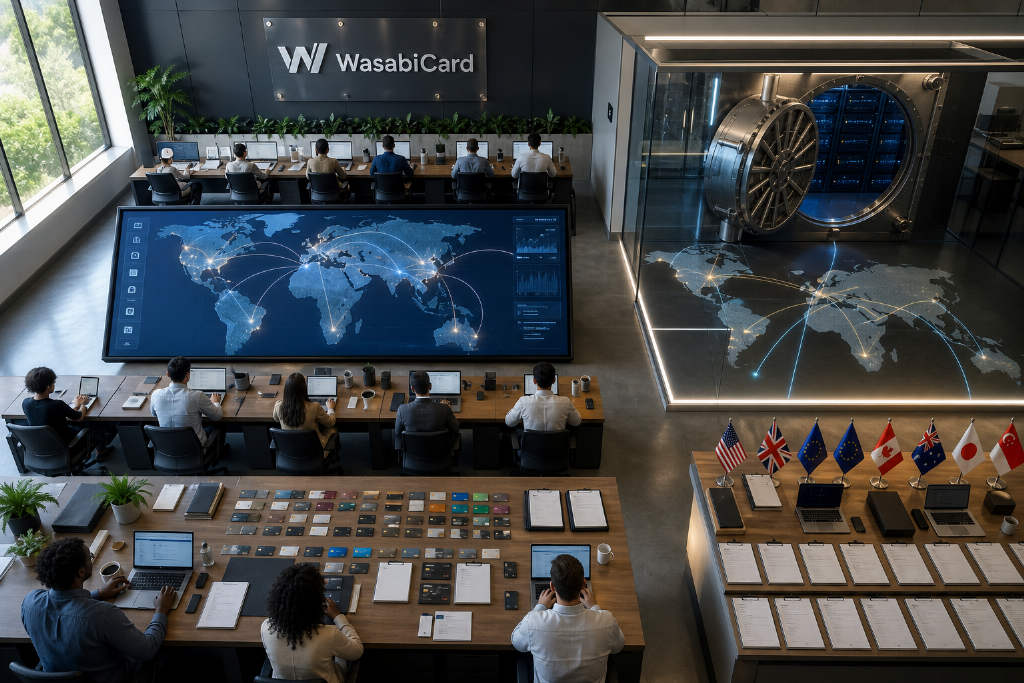
WasabiCard said it is extending its stablecoin-based payment infrastructure to the global creator economy, targeting businesses operating across more than 200 countries and regions. The company said its unified platform and API can handle bulk payouts, local fiat settlement, direct bank transfers, card spending and transaction management across markets. The supported use cases include payroll for regional teams, payments to streamers and signed creators, commissions and revenue sharing for creator and affiliate networks, service fees for production crews and contractors, and day-to-day business spending such as travel, equipment, software, advertising and content production. Companies can fund eligible payments with stablecoins and initiate bulk disbursements through the WasabiCard platform or API. Funds can then be converted into supported local fiat currencies based on the recipient’s market and settled directly into bank accounts held in the recipient’s own name. WasabiCard said it currently supports cross-border payouts in more than 30 fiat currencies and offers both virtual and physical cards in supported markets. Co-founder and CEO Ray Yang said the company aims to connect the flexibility of moving funds globally with stablecoins to local payment infrastructure that can deliver money to specific people and business workflows.

20
WasabiCard expands stablecoin payment rails for global payroll and creator payouts
AI
2026-08-21 01:43:00

After Two and a Half Years, This AI-Heavy Startup Says It Has Become More Traditional, Not Less

PANews has published a long first-person essay by Digital Life Kha'Zix on what happened after his company spent the past two and a half years pushing AI across nearly every function. The firm, he wrote, now has close to 100% AI penetration, with agents used in finance, HR, legal, business development, talent management, and operations. Yet instead of shrinking, the company is hiring more people and preparing to move into a larger office because the current space is no longer enough. The core argument is that broad AI adoption did not turn the company into a lean, automated machine run by a small number of people. In his account, it had the opposite effect: the more routine, describable, and repeatable work agents absorbed, the more the organization was pushed back toward old-fashioned human tasks such as trust-building, judgment, responsibility, training newcomers, and direct communication with clients and creators. He argues for a "thin middle platform, thick front line" structure, saying companies with fewer than 100 native employees should be cautious about building a heavy AI platform team. He also says data accumulation and data governance matter more than agents themselves. The essay closes on a broader point: AI may change tools, workflows, and efficiency, but the real test for any organization still comes down to how it treats people.

400
After Two and a Half Years, This AI-Heavy Startup Says It Has Become More Traditional, Not Less
MiniMax
2026-08-07 05:03:26

MiniMax shares jump 78.21% after H3 launch and open-source release as investors reprice video AI

MiniMax has become one of the market’s sharpest AI rerating stories in the span of a week. After releasing its multimodal generation model H3 on July 31 and open-sourcing it on Aug. 3, the company’s shares climbed 78.21% from the post-launch period through 10:53 a.m. on Aug. 7, including a 23.15% gain on the day. The source article argues that investors are no longer treating H3 as just another benchmark-driven model release. Instead, they are pricing in a broader thesis around video generation as a high-token-consumption workload, lower inference costs, and the ecosystem effects that follow an open-source strategy. According to MiniMax, H3 supports text, image, video and audio context, and can generate up to 15-second videos at 2K resolution, 24FPS, with native stereo audio. In Artificial Analysis blind testing, H3 scored 1242 Elo in text-to-video with audio, ranking second globally, while placing first in video editing and among the top three in image-to-video. The article also highlights price as a key factor, saying H3’s per-second 2K cost is less than one-third of flagship models and its 768P pricing is less than half of mainstream offerings. The strongest shift in sentiment came after open-sourcing. MiniMax said 16 chip vendors, multiple developer communities, cloud inference platforms and inference frameworks had already adapted or integrated H3, with more than 100 enterprises going live on Day 0. That has pushed the discussion beyond model rankings toward revenue growth, ecosystem distribution and strategic positioning.

1550
MiniMax shares jump 78.21% after H3 launch and open-source release as investors reprice video AI
Base
2026-07-17 00:50:31

Base backs away from its social push, but that does not mean decentralized social is dead

Base’s retreat from social and creator-token experiments has turned into a public admission of failure from the people who championed the strategy. On July 15 and 16, Jesse Pollak said on X that he had been “definitively wrong” on social and creator coins, describing the first quarter of 2026 as a “punch in the face.” Coinbase CEO Brian Armstrong had already said content coins “didn’t work” and wrote, “We messed up, time to turn the page.” Base App has since been handed back to Coinbase, with Jordan Fish taking over, while Pollak returns to product and engineering work around Base’s broader financial infrastructure ambitions. The article argues that Base did not fail because decentralized social is inherently unworkable. It failed because token incentives were placed ahead of social behavior itself. Zora’s token fell from a market cap of about $550 million to roughly $30 million, while Farcaster’s activity and revenue metrics also slid sharply after earlier hype around Frames. By contrast, the piece points to Bluesky and Hive as examples of projects on the same broad track that chose different models. One removed token speculation at the product layer; the other treated tokens as rewards rather than the purpose. The broader conclusion is that the real challenge is not whether decentralized social can exist, but whether builders are willing to prioritize censorship resistance, data portability, privacy, open infrastructure, and sustainable governance over growth driven by speculation.

550
Base backs away from its social push, but that does not mean decentralized social is dead