Google
Oct 2, 2026

Google Gemini agent finds new proofs for five unsolved math problems

Google’s Gemini AI agent has found new proofs for five long-unsolved mathematical problems, according to Techub, citing Crypto Briefing. The reported results span fields including combinatorics and quantum optics. While the brief did not disclose the specific problems, it said the work points to growing use cases for AI in basic scientific research. The development also suggests AI could take on a stronger supporting role in research workflows, especially in areas that rely on formal reasoning and proof discovery. The report frames the advance as a sign that AI systems are moving beyond consumer and productivity tools into more specialized academic and scientific settings.

900
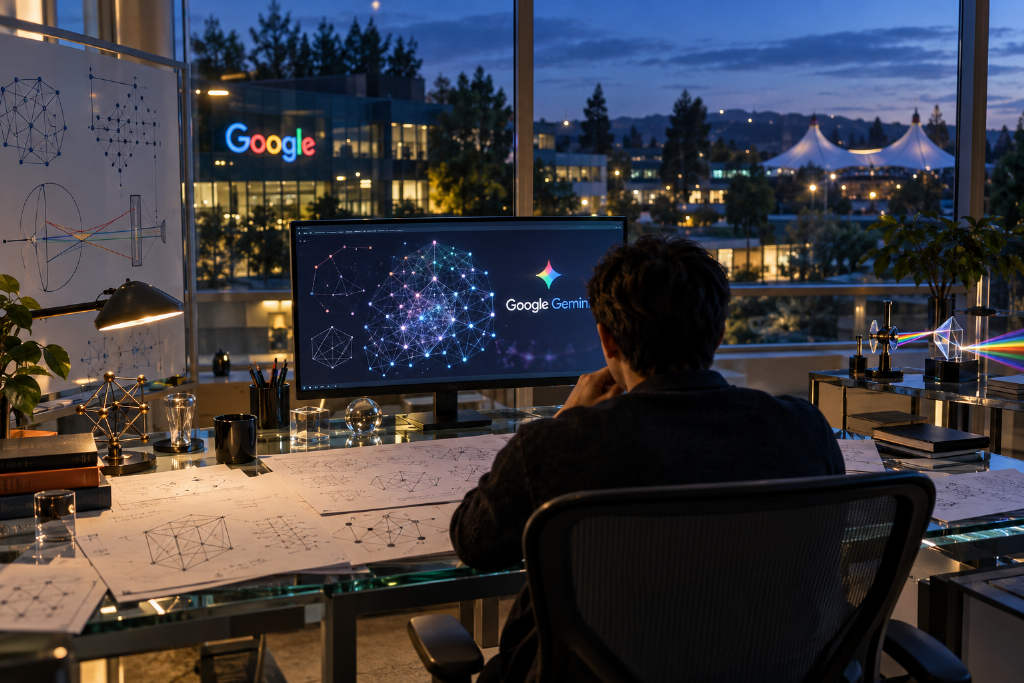
Google Gemini agent finds new proofs for five unsolved math problems
Claude
Sep 30, 2026

Ten Claude Sonnet 5.5 agents formally prove the N=7 Thomson problem

A virtual lab made up of 10 Claude Sonnet 5.5 agents has produced a formal proof for the N=7 case of the Thomson problem, a question that traces back 122 years to J.J. Thomson’s 1904 work on electron arrangements. According to a MarsBit report citing the WeChat account Xinzhiyuan, the agents spent 15 hours exchanging 1,270 technical messages and generated 17,895 lines of Lean code to prove that the pentagonal bipyramid is the minimum-energy arrangement for seven electrons on a sphere. The report says the agents operated without human intervention during the proof process and without preset division of labor. Human operators only fixed the task boundary, supplied two Lean theorem statements and nine possible research directions, then left the agents to work inside an interactive board and Lean environment. One agent eventually took on an integrator role and merged verified components into a single file, Solution.lean. The resulting proof was checked in two ways. Lean’s kernel completed a full compilation in 599 seconds, with lake build taking 344 seconds across 8,928 compilation tasks. An independent kernel, nanoda, verified 47,854 declarations with zero errors. In a negative-control test, changing a single integer in the proof data caused nanoda to fail immediately. The article frames the result as a sign that AI systems are moving beyond solving isolated problems and beginning to handle larger parts of the research workflow itself.

1040
Ten Claude Sonnet 5.5 agents formally prove the N=7 Thomson problem
OpenAI
Sep 28, 2026

OpenAI forms independent math advisory group, but members say rollout was chaotic

OpenAI has set up an independent advisory group made up of elite professionals as it tries to repair its relationship with the mathematics community. But according to The Verge, mathematicians — including members of the group itself — said the process was disorganized and confusing. They also said the effort carried many of the same traits seen in OpenAI’s earlier rushed attempts to move into the math field. The development points to tension not over the stated goal of outreach, but over how the initiative was handled. The report cited criticism from within the group, making the complaints notable because they did not come only from outside observers.

810
OpenAI forms independent math advisory group, but members say rollout was chaotic
AI
Sep 28, 2026

Four-person team uses AI and Lean to fully formalize the Poincare conjecture proof

A four-person team has turned the full proof of the Poincare conjecture into machine-checked code using the Lean proof assistant, according to a report cited by MarsBit. The project spans about 4.7 million lines of code, with roughly 2.7 million lines produced in the final two weeks with help from AI systems including ChatGPT and Claude. The entire codebase passed Lean kernel verification without leaving any "sorry" placeholders behind. The report says the dependency chain behind the final theorem touches 14,197 files and about 4.02 million lines of code, with the longest chain running through 353 files. Code corresponding to Grigori Perelman’s three papers accounts for about 660,000 lines, or roughly one-sixth of the total. The rest covers the mathematical groundwork that the papers assume, including about 1.09 million lines in analysis and 770,000 lines in differential geometry. The team includes UC San Diego mathematician Ben Chow, Cornell graduate Ziyang Qin, UCSD PhD student Yuan Liao, and Princeton’s Ayush Khaitan, who joined in September. The report also describes a layered AI workflow in which a lead model handled planning and review, a scheduler agent assigned work, and short-lived coding agents wrote and checked proofs. The final formalized theorem is contained in a 23-line file, but it rests on millions of lines of supporting code.

880
Four-person team uses AI and Lean to fully formalize the Poincare conjecture proof
OpenAI
Sep 22, 2026

OpenAI forms math advisory group with three Fields Medal winners as unpublished results pile up

OpenAI has set up a Mathematics and AI Advisory Group, hosted by the Institute for Advanced Study in Princeton, as it says one of its internal research models has already solved more than 100 long-standing open problems across multiple areas of mathematics. The company said its previously disclosed work on the Navier-Stokes Millennium Prize problem also came from the same model, though most of the results have not been published. The first cohort has nine members, including Fields Medal winners Timothy Gowers, Martin Hairer, and Edward Witten. OpenAI said the group will review the significance of the findings, how they should be released, and the academic norms surrounding publication. Members will not be paid by OpenAI, may criticize the company publicly, and can publish independent recommendations. At the same time, OpenAI said the panel will have no decision-making authority and will not weigh in on the pace of the company’s internal mathematics research. The move comes as a direct response to criticism from mathematicians, after 25 Fields Medalists including Terence Tao, Ken Ono and Peter Scholze signed a statement arguing that AI companies are turning major mathematical problems into benchmarks in ways that are already harming mathematical research.

1100
OpenAI forms math advisory group with three Fields Medal winners as unpublished results pile up
OpenAI
Sep 22, 2026

OpenAI says new model solved 100-plus math problems in 24 days, forms independent advisory group

OpenAI said an internal model that began training on Aug. 28 has already solved more than 100 long-standing mathematics problems across much of the field, including a Navier-Stokes-related Millennium Prize problem. The company also announced a new independent advisory group made up of nine prominent mathematicians, with named members including Fields Medalists Timothy Gowers and Martin Hairer, as well as theoretical physicist Edward Witten. According to the article, OpenAI had earlier disclosed that one of its internal systems produced a proof for the existence and smoothness problem for the Navier-Stokes equations after about 88 hours of work by more than 10,000 concurrent agents, followed by 17 hours of Lean formalization and verification by GPT-6 Astra. The move comes after 27 Fields Medal winners published an open letter criticizing how AI companies release mathematics results. OpenAI said the advisory group will help assess the importance of new results, discuss how and when they should be published, and watch over academic and professional norms in AI-era mathematical research.

1090
OpenAI says new model solved 100-plus math problems in 24 days, forms independent advisory group
OpenAI
Sep 21, 2026

OpenAI says internal model solved more than 100 unsolved math problems, forms independent advisory group

OpenAI said on Sept. 21 that it will work with an independent advisory group formed by mathematicians to help shape how the company reviews and discloses AI-generated mathematical results. According to OpenAI’s announcement, the new Mathematics and AI Advisory Group has nine members, none of whom are paid by the company, and the group is free to publish its views publicly. OpenAI also said an internal model that began training on Aug. 28 has already solved more than 100 long-standing unsolved problems across most areas of mathematics, excluding the Navier-Stokes problem. The company said the pace of progress surprised even its own mathematicians and prompted internal discussion about how to inform the broader math community so it can prepare and adapt. The move follows criticism tied to OpenAI’s Sept. 9 disclosure of work related to Navier-Stokes. New York University mathematician Tristan Buckmaster had questioned whether OpenAI moved first after learning about his research progress, raising concerns around research ethics and attribution. OpenAI also cited a public statement posted on mathandai.org, signed by multiple Fields Medalists, which warned about the negative externalities of using unsolved problems as benchmarks for new AI systems.

1110
OpenAI says internal model solved more than 100 unsolved math problems, forms independent advisory group
OpenAI
Sep 21, 2026

OpenAI forms independent math advisory group to guide responsible sharing of AI and mathematics advances

OpenAI said it is working with an independent mathematics advisory group to support the responsible sharing of progress in AI and mathematics. The group will advise the company on how to assess and communicate new mathematical results, uphold academic and professional standards, and build tools that support mathematics research and learning. OpenAI said the effort is intended to place mathematicians at the center of shaping how AI supports mathematical understanding and how the benefits of that work reach a broader community. The announcement was cited by Techub News and attributed to OpenAI.

800
OpenAI forms independent math advisory group to guide responsible sharing of AI and mathematics advances
Total 86 items
Go topage