Meta
Oct 30, 2026

UK probes whether Meta’s commercial terms harm publishers and advertisers

Meta Platforms Inc. is facing an investigation in the UK over whether its commercial terms impose what were described as "exploitative" conditions on publishers and advertisers. The probe is centered on the fine print in Meta’s business terms and whether those provisions may have caused harm to the affected parties. The report, cited by Techub News, attributes the information to Bloomberg. At this stage, the available details are limited to the existence of the investigation and its stated focus on potential harm tied to Meta’s contractual language. No further findings, remedies, or timeline were disclosed in the source material.

620
UK probes whether Meta’s commercial terms harm publishers and advertisers
Meta
Oct 30, 2026

UK antitrust probe targets Meta business terms over AI content use

Meta Platforms is facing a UK competition investigation over business terms that regulators say may impose "exploitative" conditions on publishers and advertisers using its platforms. The UK Competition and Markets Authority said Friday it will examine whether Meta abused a dominant market position through those terms in a way that could "unfairly harm" businesses that rely on its services. The regulator also said Meta had planned to revise the terms from Nov. 20, but that rollout has now been paused. Under the terms in question, Meta could potentially collect content from publishers' websites without first obtaining consent, then use that material to develop and offer its own products and services, including AI features. Responding to the probe, Meta said there was no reason to open a competition investigation and added that it had already committed not to change the terms before consulting publishers and other stakeholders. The report was cited to Bloomberg.

680
UK antitrust probe targets Meta business terms over AI content use
OKX
Oct 30, 2026

OKX prediction markets show why an earnings beat does not guarantee a stock gain

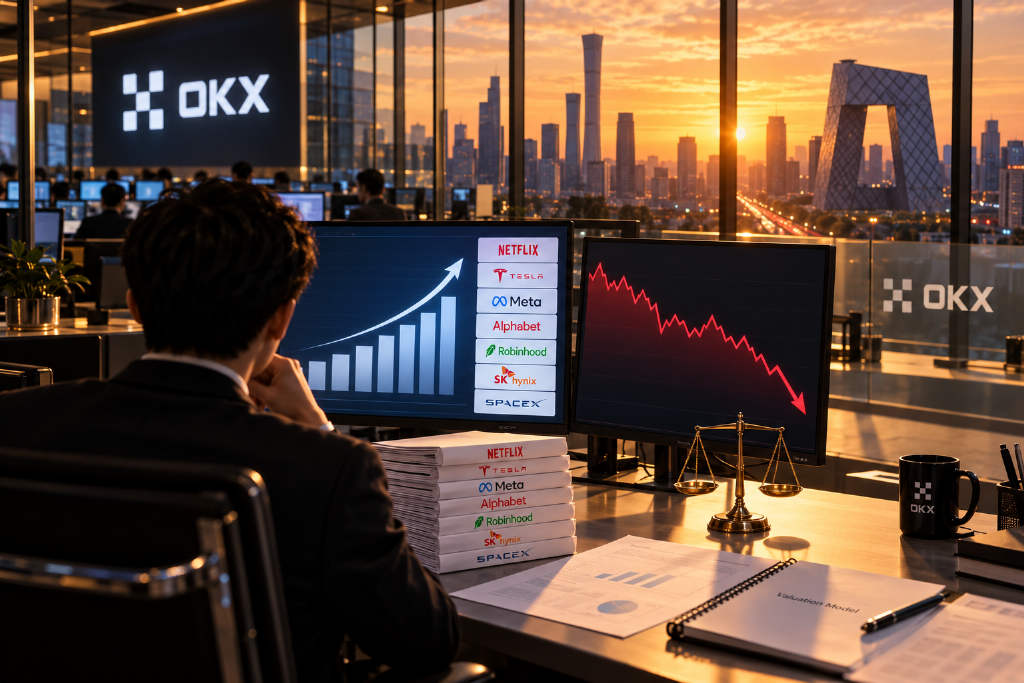
BlockTempo examined how OKX’s earnings-season prediction markets separate two questions that traders often treat as one: whether a company clears a preset earnings threshold, and whether its price rises after the report. The article argues that these outcomes can diverge sharply because markets do not trade the scorecard alone; they trade how that scorecard changes expectations for future growth, guidance, spending, cash flow and valuation. The piece points to Netflix, SpaceX, Tesla and Meta as early examples. Netflix posted third-quarter earnings per share of $0.87 and the OKX earnings contract settled Yes, yet the related perpetual contract fell about 5.30% from the pre-earnings U.S. close to the close of the first full trading day after the release. SpaceX saw earnings and price move higher together, while Tesla and Meta showed more mixed signals once margins, litigation costs and capital spending were considered. It also reviews later cases involving Robinhood, SK Hynix and Alphabet, and argues that prediction markets are most useful when they force participants to separate “Will the company beat?” from “How will the market react?” rather than treating those as the same trade.

570
OKX prediction markets show why an earnings beat does not guarantee a stock gain
OKX
Oct 30, 2026

Why a Correct Earnings Call Can Still Lead to a Losing Trade: What OKX’s Two Prediction Tracks Show

OKX’s earnings-season prediction format highlights a gap that often gets lost in headline reactions: a company can clear a preset earnings threshold while its stock-linked contract still falls after the report. Netflix offered a clear example. Its third-quarter earnings per share came in at $0.87, enough for the OKX earnings question to settle as Yes, yet the related perpetual contract fell about 5.30% from the U.S. stock market close before earnings to the close of the first full trading day after the release. The broader set of cases in the article points to the same divide. SpaceX saw earnings and price move higher together, while Netflix, Tesla and Meta each showed why a “good” report is not a complete pricing answer. Investors may focus on lowered forward expectations, weaker margins, litigation costs, heavy capital spending or cash flow pressure even when a headline metric passes the line set by a prediction market. The piece also examines OKX’s multi-round “earnings winner” challenge, where users must answer both the earnings question and the post-report price question. Results involving Robinhood, SK hynix and Alphabet show that even when companies miss a defined earnings hurdle, price reactions can still diverge. The takeaway is narrow but useful: earnings outcomes and market reactions should be analyzed separately, then checked against guidance, valuation, capital intensity and what had already been priced in before the report.

580
Why a Correct Earnings Call Can Still Lead to a Losing Trade: What OKX’s Two Prediction Tracks Show
OKX
Oct 30, 2026

OKX says getting earnings right does not guarantee the market will move the same way

OKX used a series of earnings-season examples to argue that correctly calling a company’s results and correctly calling its post-earnings price move are two different tasks. The piece points to Netflix, SpaceX, Tesla and Meta to show how a report can clear a preset earnings threshold while the related contract or price still moves the other way. In Netflix’s case, third-quarter earnings per share came in at $0.87 and the OKX earnings question settled Yes, yet the related perpetual contract fell about 5.30% from the U.S. stock close before earnings to the close of the first full trading day after the release. The article says market pricing depends not only on reported profit, but also on what investors had already expected, whether guidance changes, how expensive the valuation had become, and how much capital spending and cash flow pressure sit behind the headline numbers. It also highlights Meta’s gap between GAAP EPS of $3.83 and EPS of $7.40 excluding litigation-related costs, plus capital expenditure of about $34.9 billion and negative free cash flow of $2.12 billion, as an example of why profit alone can miss the full picture. OKX also reviewed results from its "Earnings Winner" event, including Robinhood, SK Hynix and Alphabet, to show that even when two companies both miss an earnings threshold, their price reactions can still diverge. The broader point: separate the question of what the business delivered from the question of how the market reprices it.

780
OKX says getting earnings right does not guarantee the market will move the same way
AI
Oct 30, 2026

Big Tech updates 2026 capex outlooks, with combined upper bound seen topping $740 billion

Market concern over whether massive AI spending can be sustained is starting to show up in guidance from the largest U.S. technology companies. In third-quarter updates, Meta, Microsoft, Alphabet and Amazon revised or reaffirmed their 2026 capital expenditure outlooks, revealing a split in expansion pace rather than a uniform pullback. Based on current figures, the combined upper bound of 2026 capex for the four companies could exceed $740 billion, well above their combined actual capital spending of $455.8 billion in 2025. Meta raised the lower end of its full-year spending guidance, with its third-quarter outlook set at $135 billion to $145 billion, versus a midyear range of $130 billion to $145 billion. Microsoft lowered its third-quarter outlook to $170 billion from $175 billion at midyear, while noting that the change reflected an accounting adjustment and that its underlying AI infrastructure investment plan remained unchanged from the start of the year. Alphabet and Amazon left their capex expectations unchanged at $195 billion to $205 billion and $220 billion, respectively.

680
Big Tech updates 2026 capex outlooks, with combined upper bound seen topping $740 billion
Amazon
Oct 29, 2026

AWS posts $45.98 billion in Q3 revenue, up 39% year over year

Amazon Web Services reported third-quarter revenue of $45.98 billion, up 39% from a year earlier and above analysts’ expectation of $45.29 billion. Operating income for the quarter reached $17.77 billion, marking a 55% year-over-year increase. AWS now accounts for nearly 23% of Amazon’s total revenue, a record share for the company’s cloud unit. During the quarter, AWS said it would expand its Nvidia GPU lineup for AI workloads, acquired data analytics startup DuckLabs, and signed partnership agreements with Meta and OpenAI. CNBC said major cloud providers are racing to build more data centers to meet strong AI demand.

550
AWS posts $45.98 billion in Q3 revenue, up 39% year over year
Meta
Oct 29, 2026

Meta rolls out Style Sketch, an AI fashion app, in Southeast Asia

Meta has quietly launched Style Sketch, an AI fashion app, in Indonesia, Singapore, and Thailand, according to Techub News, citing TechCrunch. The app can connect to Instagram and build a virtual wardrobe from photos users have already posted. Users can also add clothing images manually. Based on that wardrobe and a user’s style, Style Sketch suggests outfit combinations and shows virtual try-on results using models matched to the user’s body type and skin tone. It also includes a travel planning feature that recommends what to wear each day based on a destination, itinerary, and weather forecast. The rollout points to Meta’s push into consumer-facing AI tools that blend social media data with personalized recommendations.

470
Meta rolls out Style Sketch, an AI fashion app, in Southeast Asia
Total 598 items
Go topage