Bloomberg Billionaires Index
Oct 12, 2026

Bloomberg index shows AI boom added $845 billion to tech billionaires’ wealth

Bloomberg’s Billionaires Index shows that by September this year, the AI boom had added a record $845 billion to the fortunes of technology moguls, while billionaires outside the tech sector collectively lost $62 billion over the same period. The report said the wealth calculations included the equity value of private AI developers such as Anthropic. According to analysis cited from wealth reporter Dylan Sloan, the top 10 names on the ranking have all been Americans since Sept. 10, marking the first time that has happened since Bloomberg began tracking the index in 2012. The report also said more new entrants came from China, including the founders of AI labs DeepSeek and MiniMax. Separately, Lone Pine Capital’s flagship fund had posted a 44% gain through June this year, but almost all of that advance was erased after AI trades reversed. Bridgewater Associates founder Ray Dalio also warned last week about the risk of an AI bubble.

1350
Bloomberg index shows AI boom added $845 billion to tech billionaires’ wealth
AI
Oct 10, 2026

Recursive self-improvement moves from theory to lab reality in 2026

A joke project from Andrej Karpathy has become a useful entry point into one of the most closely watched ideas in artificial intelligence this year: recursive self-improvement, or RSI. In 2026, Anthropic, OpenAI, MiniMax, Zhipu and several research teams published data or experiments showing AI systems writing more code, optimizing training workflows, improving agent harnesses and building production infrastructure tied to newer models. Anthropic said Claude wrote more than 80% of code merged into its repository by May and was leading 26% of R&D work by August. OpenAI said its first “research intern” milestone had been met and disclosed that every human workday in research now corresponds to about 3.1 “agent workdays.” In China, MiniMax and Zhipu described engineering loops in which models iterated on scaffolding or inference systems rather than model weights themselves. At the same time, Princeton researchers, Anthropic’s own evaluations and recent agent-related security incidents all point to a boundary: today’s models can be strong engineers, but they still struggle with research taste, judgment and fully autonomous closed-loop improvement. That gap is now central to how the industry measures RSI progress.

1920
Recursive self-improvement moves from theory to lab reality in 2026
MINIMAX
Oct 8, 2026

MINIMAX falls over 10% intraday, while ZHIPU drops more than 7.6%

Odaily reported that data from MSX.COM showed sharp intraday losses for two tokens. MINIMAX was down more than 10% on the day and last traded at $27, while ZHIPU had fallen more than 7.6% to $81.1. The update also identified MSX as a major real-world asset, or RWA, trading platform. According to the report, the venue has listed hundreds of RWA tokens so far. Those offerings cover tokenized exposures tied to popular U.S. stocks and ETFs, including Nvidia, GOOGL, MSFT, AMZN, META, TSM, and AMD. No additional market context or cause for the moves was provided in the source item.

1320
MINIMAX falls over 10% intraday, while ZHIPU drops more than 7.6%
Hong Kong stocks
Oct 8, 2026

Hong Kong AI stocks fall as cheaper overseas models raise pressure on Chinese peers

Hong Kong-listed artificial intelligence names moved lower on Oct. 8, with MiniMax down more than 10%, Zhipu down more than 6%, and Xunce off nearly 5%, while Baidu and Meituan also slipped, according to Bitget market data. The move came as overseas foundation model providers continued cutting prices. Anthropic launched its new Haiku 5.5 model and lowered inference costs, while OpenAI rolled out lower-priced GPT-6 Sol and Luna products. Luna API pricing was 50% lower than the earlier GPT-5.6 series. Investors are weighing what that means for Chinese large-model companies. As leading overseas models improve performance and push API prices lower, domestic players may face more direct pricing pressure. After exchange-rate conversion, some dollar-priced overseas products are already cheaper than comparable domestic offerings, narrowing the local pricing and localization edge that Chinese model companies had relied on. The latest cuts also come after domestic names such as DeepSeek had already pushed API pricing downward, extending the price war from China into the global market and prompting fresh scrutiny of commercialization prospects, margins, and valuations for firms including Zhipu and MiniMax.

920
Hong Kong AI stocks fall as cheaper overseas models raise pressure on Chinese peers
Anthropic
Oct 8, 2026

Claude Haiku 5.5 squeezes low-cost model segment as Zhipu and MiniMax shares fall

Anthropic’s release of Claude Haiku 5.5 is adding pressure to China’s low-cost foundation model segment, and the market reaction showed up quickly in Hong Kong trading on Oct. 8. Shares of large-model companies weakened during the session, with MiniMax down more than 9% and Zhipu down more than 6%, while the Hang Seng Tech Index slipped about 1% over the same period. Pricing is at the center of the comparison. Haiku 5.5 lists a base API rate of $0.1 per million input tokens and $0.5 per million output tokens. By comparison, DeepSeek V4.1 Flash charges $0.3 and $1.2 during peak periods, falling to $0.15 and $0.6 in off-peak hours, while Zhipu’s GLM-5.3 Flash is priced at $0.15 and $0.5. For prompts with no more than 100,000 input tokens, Haiku 5.5 already shows a clearer unit-price edge. On benchmarks, Artificial Analysis gave Haiku 5.5 an intelligence score of 43, ahead of GLM-5.3 Flash at 42, DeepSeek V4.1 Flash at 39, and Xiaomi’s MiMo-V2.6-Flash at 38. In the Terminal-Bench 4.0 coding test, Haiku 5.5 and GLM-5.3 Flash both scored 33%, above DeepSeek’s 27% and MiMo’s 23%. The report also noted limits to that advantage: token consumption is relatively high, and long-context usage can trigger pricing that is five times higher.

1020
Claude Haiku 5.5 squeezes low-cost model segment as Zhipu and MiniMax shares fall
SemiAnalysis
Oct 6, 2026

SemiAnalysis finds Claude subscription plans offer the richest API-equivalent value among major AI coding tiers

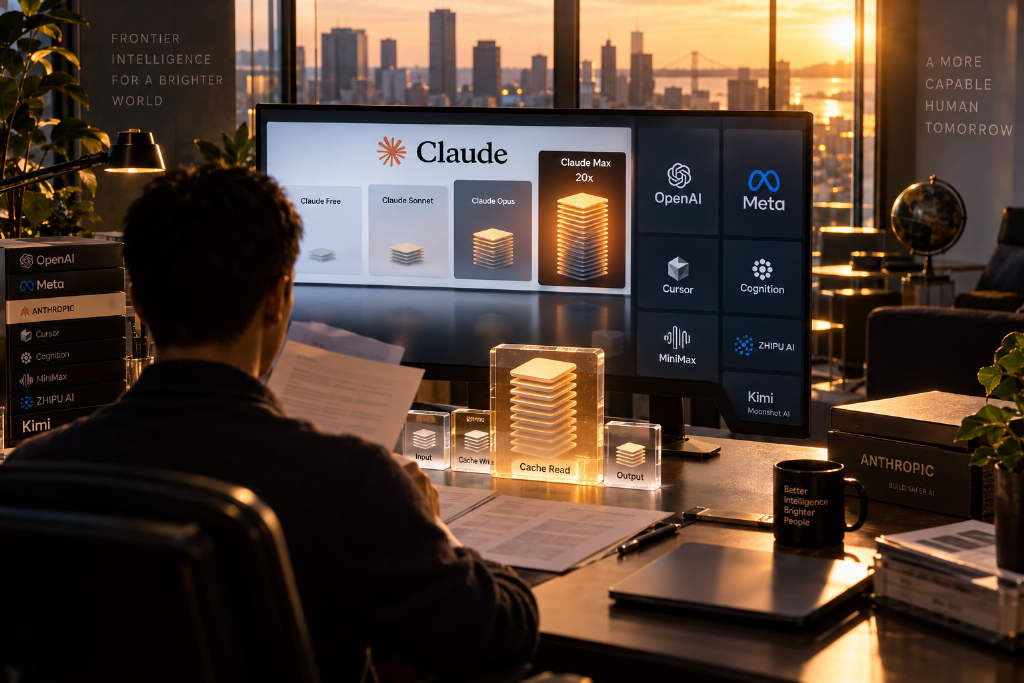
SemiAnalysis tested AI subscription plans from OpenAI, Anthropic, Meta, SpaceXAI, MiniMax, Moonshot AI, Zhipu, Cursor, and Cognition, measuring how input, cache writes, cache reads, and output consume plan quotas. It then applied its own September agent usage mix, where roughly 96.6% of activity came from cache reads, and converted the resulting token usage into an "API-equivalent value" based on each provider’s API pricing. The biggest subsidy in the comparison came from Anthropic’s Claude plans. On the $200-per-month Max 20x tier, Sonnet 5.5 reached about $12,529 in API-equivalent usage, or 62.6x the subscription price, while Opus 5.5 came in at about $11,726, or 58.6x. Claude Fable 5.1 was much lower at about $2,485, or 12.4x, showing how quota burn rates differ by model and token type. SemiAnalysis also said domestic coding plans heavily subsidize power users, though not to Claude’s level. It measured MiniMax Token Ultra at about 23.4x, Zhipu GLM Coding Max at 11.6x, and Kimi Code Ultra at 6.7x. The report added that OpenAI has recently tightened subsidies by halving token quotas for newly purchased Pro 200 plans, while older plans keep previous limits until Oct. 29. It also noted that providers can change backend quota accounting without changing headline subscription prices.

1650
SemiAnalysis finds Claude subscription plans offer the richest API-equivalent value among major AI coding tiers
Anthropic
Oct 9, 2026

Anthropic and OpenAI reset the LLM price curve as Chinese models lose their old cost edge

Anthropic’s launch of Haiku 5.5 on Oct. 8 pushed short-request pricing down to $0.1 per million input tokens and $0.5 per million output tokens, a tenth of Haiku 4.5. That move landed the model on the low-cost edge of Artificial Analysis charts that, just months earlier, had been dominated by Chinese names such as MiMo, DeepSeek, MiniMax and GLM. According to the source article, the shift does more than rearrange benchmark plots: it shows that the low-price boundary Chinese model makers spent two years forcing into the global market is no longer theirs alone. The piece traces how DeepSeek’s 2024 pricing shocked the sector, how open-weight Chinese models spread through US startups and developer platforms, and why growing usage did not translate into equivalent revenue capture. It also details the response from OpenAI and Anthropic, including engineering-driven cost cuts, permanent low-price resets, API credits for subscribers, and the financial firepower behind those decisions. The result, in the article’s framing, is a new phase of competition where low price is still necessary, but no longer a moat that Chinese model vendors can claim by themselves.

1040
Anthropic and OpenAI reset the LLM price curve as Chinese models lose their old cost edge
Hong Kong stocks
Oct 5, 2026

Hong Kong-listed AI application shares split at the open, with DeepEye Intelligent up over 10%

Hong Kong-listed AI application stocks moved in different directions after the market opened on Oct. 5, according to Bitget market data cited by BlockBeats. DeepEye Intelligent led the group with a gain of more than 10%. Zhifu rose nearly 2%, while MINIMAX added 0.99%. In contrast, UDrive Innovation and RoboSense, among others, fell by nearly 3%. The move points to a mixed opening for the AI application segment in Hong Kong trading, with gains concentrated in a small number of names and declines appearing in others across the board.

920
Hong Kong-listed AI application shares split at the open, with DeepEye Intelligent up over 10%
Total 95 items
Go topage