Tencent Hunyuan
Sep 2, 2026

Tencent Hunyuan Hy4 Preview Goes Live on B.AI API

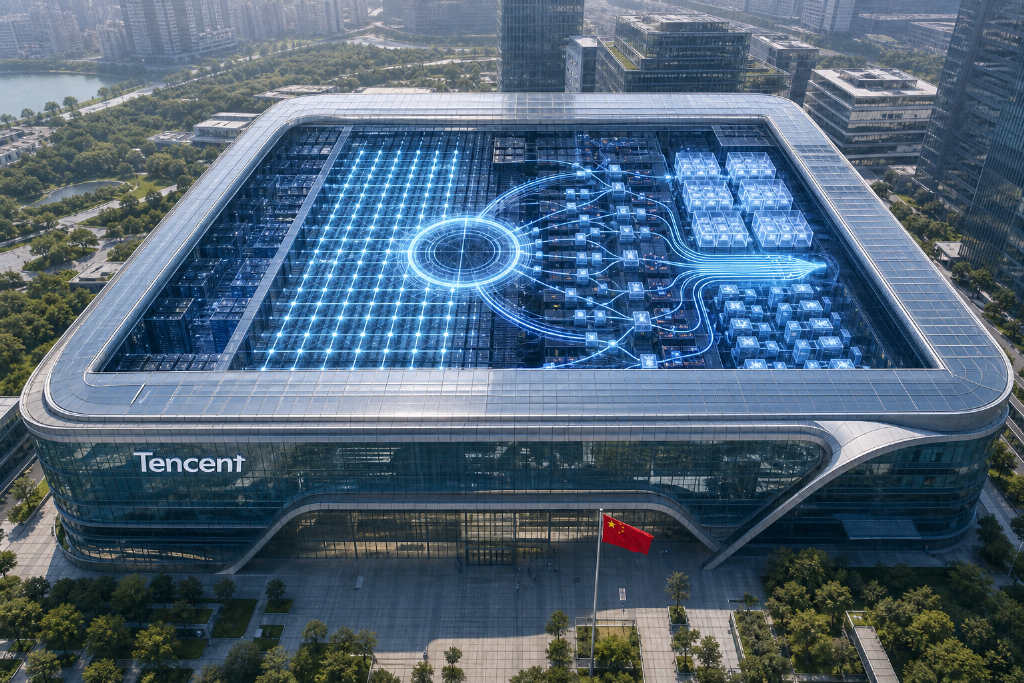
On September 2, the B.AI platform announced that Hy4 Preview, the latest open-source flagship model from Tencent's Hunyuan team, has officially launched through its API service and is now fully open for developer access. Hy4 Preview is described as an early version in the Hy4 series. The underlying architecture is a 770B sparse mixture-of-experts (MoE) design, with 49B parameters activated for every token processed. The model also provides an extended context window of up to 1 million tokens. According to B.AI, that combination gives the model professional-grade performance in software engineering agents, office data workflows, game development, and scientific research. Starting immediately, developers can call Hy4 Preview directly through the official B.AI API channel. For further information, they can visit chat.b.ai/chat for more details and immediate testing. B.AI also said that going forward it will continue to introduce frontier models, providing developers with a richer and more cost-effective range of AI compute options.

1810
Tencent Hunyuan Hy4 Preview Goes Live on B.AI API
Tencent Hunyuan
Sep 1, 2026

Tencent Hunyuan Releases Extreme Quantization of Hy4 Preview: 1.5TB Shrunk to 214GB, Heterogeneous Inference 6x Faster

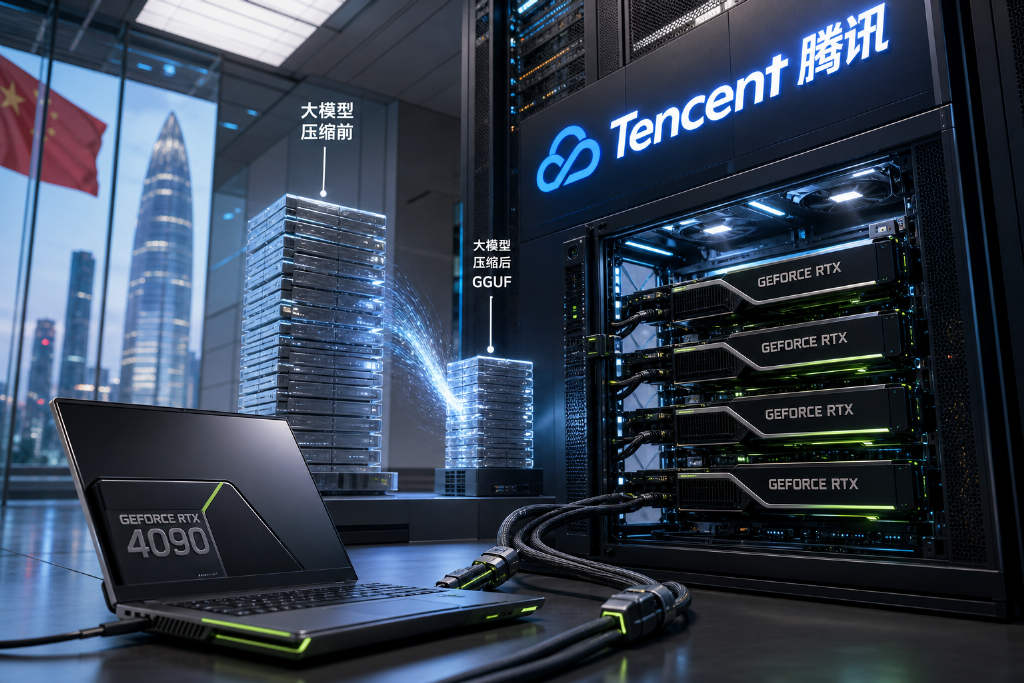
Tencent's Hunyuan team has released an extreme quantization version of the Hy4 preview model, compressing the original 1.5TB weights to about 214GB in GGUF format. Using a layer-wise quantization strategy, the average bit-width is 2.38 bpw, with performance loss of only 0.2-1.6 points on benchmarks. The team also tested heterogeneous joint inference with prima.cpp, achieving 1.02 token/s on a setup combining an RTX 4090 laptop and a quad-RTX A4000 server, 6x faster than laptop-only offloading.

1740
Tencent Hunyuan Releases Extreme Quantization of Hy4 Preview: 1.5TB Shrunk to 214GB, Heterogeneous Inference 6x Faster
Tencent
Aug 28, 2026

Tencent Hunyuan Hy4 Preview Overhauls Architecture with DeepSeek Sparse Attention and Zhipu IndexCache

In a flash update on Aug 28, BlockBeats detailed the architectural changes behind Tencent's Hunyuan Hy4 preview. The model is bigger, but the bigger story is under the hood. Hy3 used full attention; Hy4 moves to Gated DSA, a gated form of DeepSeek Sparse Attention. On long inputs, instead of recomputing the entire context, the model selects the most relevant parts and focuses compute there. In Hy3 every layer had to decide what mattered; Hy4 layers Zhipu's IndexCache on top of DSA, so some layers can reuse earlier selections and cut repeated work. Tencent credits DeepSeek and GLM as inspirations. Residual structure also gets a rethink: a standard Transformer is often described as having a single information trunk, while Hy4's iHC widens that to four trunks so the network can retain more information at depth. MoE configuration moves from Hy3's 192 experts to 256 routing experts plus one shared expert, with each token choosing 8 routing experts while always passing through the shared expert.

2150
Tencent Hunyuan Hy4 Preview Overhauls Architecture with DeepSeek Sparse Attention and Zhipu IndexCache
Zhipu
Aug 27, 2026

Zhipu launches GLM-5.3 Flash, says inference runs on a cluster of more than 100,000 domestic chips

Zhipu has unveiled GLM-5.3 Flash, a lightweight flagship model positioned against DeepSeek V4 Flash, and said its inference service is supported by a domestic chip cluster with more than 100,000 chips. The model has roughly 300 billion parameters, or about 40% of GLM-5.3, and is described as broadly comparable in size to DeepSeek V4 Flash. Built on a mixture-of-experts, or MoE, architecture, it activates about 18 billion parameters in practice. The company said GLM-5.3 Flash has native multimodal capabilities and supports both image and video input. It is also the first new model with multimodal support since Zhipu shifted its strategy toward coding. On benchmark results, Zhipu said the model scored above the previous flagship GLM-5.2, matched Claude Opus 4.8, and ranked above the relevant scores of the official version of DeepSeek V4 Pro. Pricing was set at RMB 0.8 per million input tokens, RMB 2.8 per million output tokens, and RMB 0.23 per million cached-hit tokens, which Zhipu said is about one-tenth the cost of GLM-5.3. The company is also offering a 50% discount during the first two weeks after launch.

1930
Zhipu launches GLM-5.3 Flash, says inference runs on a cluster of more than 100,000 domestic chips
Alibaba
Aug 26, 2026

Alibaba open-sources Qwen3.8-Flash-Next as an early look at the Qwen 4 architecture

Alibaba’s Qwen team has released Qwen3.8-Flash-Next on August 26, presenting it as a preview of the Qwen 4 architecture before the full Qwen 4 family arrives. According to the model page on Hugging Face, the release gives developers an early chance to test and prepare for the next-generation architecture rather than wait for the formal rollout. The model is described as an open-source multimodal system built on a mixture-of-experts, or MoE, design. Alibaba said it has about 125 billion total parameters, while activating roughly 6 billion parameters per token. The stated goal is to keep the knowledge scale of a large model while lowering inference costs in practice. Model weights are already available on Hugging Face, and Alibaba said the model is also planned for China’s ModelScope platform. That means developers can access it without relying on a proprietary API. At the same time, Alibaba has not released benchmark results for Qwen3.8-Flash-Next, and the published parameter specifications have not yet been independently verified. Full performance still awaits broader evaluation.

1950
Alibaba open-sources Qwen3.8-Flash-Next as an early look at the Qwen 4 architecture
Nvidia
Aug 25, 2026

Nvidia says Groq 3 LPX is in full production, hits 3,400 tokens per second on Gemma 4 31B

Nvidia said its Groq 3 LPX inference chip has entered full production and reached an inference speed of 3,400 tokens per second on the Gemma 4 31B model. The company said that figure is four times faster than Cerebras. The comparison, though, is not straightforward. According to the report, Nvidia needs at least 64 accelerators to reach that throughput, while Cerebras requires only one to two. That makes raw tokens-per-second figures harder to compare without accounting for system scale. The report also flagged an open question around architecture scalability. While Nvidia presented the production milestone and throughput result, its ability to scale on large mixture-of-experts, or MoE, models remains to be seen. The report was cited by Techub News, with The Decoder named as the source.

1560
Nvidia says Groq 3 LPX is in full production, hits 3,400 tokens per second on Gemma 4 31B
Stanford
Aug 24, 2026

Stanford professor Percy Liang opens Marin 535B model training to the public

Stanford professor and Simile AI founder Percy Liang has kicked off training for Marin 535B-A23B and is making the process public in real time. The model is described as having 535 billion total parameters and 23 billion active parameters, trained on 18.75 trillion tokens across 11 GB200 NVL72 systems, or about 792 GB200 GPUs. Liang said the run is expected to last roughly three months and consume about 2.7e24 FLOPs, followed by a post-training phase. Before starting the main run, the team completed a four-stage scaling ladder ranging from 1.6B-A61M with 48 billion tokens to 27.7B-A1.2B with 926 billion tokens. Liang said those smaller runs were used to surface and debug issues early and to forecast the behavior of the larger “hero run.” The project has drawn attention because it exposes details that are usually hidden in frontier model development, including data mix, processing methods, training configuration, code, experiment design, live loss curves, and model-state tracking. The team has also published links to a data overview page, a Weights & Biases dashboard, and a GitHub issue page where the work can be followed in detail.

3360
Stanford professor Percy Liang opens Marin 535B model training to the public
Z.ai
Aug 19, 2026

Z.ai founder Jie Tang says bigger parameter counts no longer tell the full story of model strength

Jie Tang, founder of Z.ai and a professor at Tsinghua University, argues that asking only how many parameters a model has no longer says much about how strong it is. In his review of the evolution of scaling laws—from GPT-3 to Chinchilla and then Mixture of Experts (MoE)—he says model capability depends on more than parameter count. Training data volume, where compute is spent, and how a model is actually used all matter. Tang’s point is that the old training-first view of scaling is less useful once commercial AI systems are deployed and called billions of times a day. Under that setup, inference cost changes the optimization target. A smaller model trained for longer may make more sense than a larger one trained less efficiently. He cited Llama-2-7B and Gemma-2-9B as examples of models trained far beyond the classic Chinchilla ratio. He also said MoE makes headline parameter numbers even less informative, because total parameters and activated parameters describe different things. For reasoning-heavy workloads, Tang argued that effective depth in a single inference pass and post-training may now be more important scaling dimensions. He described GLM-5.3 as a controlled test of that idea, keeping the base model and parameter counts unchanged from GLM-5.2 while expanding long-horizon environments and reinforcement learning over a month.

2510
Z.ai founder Jie Tang says bigger parameter counts no longer tell the full story of model strength
Total 41 items
Go topage