Bitcoin
Aug 12, 2026

Bitcoin’s BIP-110 fork stalls with 2.6% miner support, and Luke Dashjr loses BIP editor role

Bitcoin developer Luke Dashjr’s BIP-110 soft fork effort collapsed after drawing only about 2.6% miner support, far short of the 55% threshold set for activation. The forked chain produced just two blocks before stalling, while Bitcoin’s main chain continued operating normally. The proposal had aimed to curb the use of Bitcoin block space for images, text and other non-financial data, taking aim at inscription activity that expanded after the rise of the Ordinals protocol. After the failed push, Dashjr was removed from his editor role for Bitcoin Improvement Proposals, or BIPs. Critics accused him of misusing editorial authority by assigning a BIP number before enough discussion had taken place and merging updates into the repository outside normal procedure. Bitcoin developer Mark Erhardt, in backing the removal motion, said Dashjr had contributed almost none of the routine editorial maintenance since joining the team in April 2024. Dashjr rejected the accusations on X, calling the move an abuse of power and saying the claims were false. He also said he would temporarily step down as chairman and CTO of Bitcoin mining pool Ocean to focus on Bitcoin and open-source projects. The dispute now spans both inscription policy and governance procedure.


2070
Bitcoin’s BIP-110 fork stalls with 2.6% miner support, and Luke Dashjr loses BIP editor role
Bitcoin
Aug 11, 2026

Luke Dashjr removed as BIP editor after stalled BIP-110 fork fight

Bitcoin’s core development circle is facing a governance dispute after veteran developer Luke Dashjr was removed as an editor of the Bitcoin Improvement Proposals, or BIPs, according to Decrypt as cited by ABMedia. The move followed controversy around BIP-110, a soft fork Dashjr pushed that later stalled. The removal motion was initiated on Aug. 9 by fellow BIP editor Mark Erhardt, known in the community as Murch, through a pull request deleting Dashjr’s name from the editor list in BIP 3. Erhardt cited four reasons: an alleged conflict of interest in how Dashjr handled BIP-110, minimal editorial contributions since April 2024, concern that the proposed soft fork was turning into a hard fork, and a breakdown of trust among editors. BIP-110 aimed to temporarily block non-financial data such as Ordinals inscriptions from entering Bitcoin transactions. Miner signaling peaked at 51 out of 2,016 blocks, or about 2.53%, well below the 55% activation threshold. A minority chain produced only two blocks in eight hours before stalling. Michael Saylor said 99.85% of hash rate remained on Bitcoin’s main chain. Dashjr has disputed the removal on X and said on Aug. 10 that he would take an extended leave from Ocean pool to focus on Bitcoin and open-source projects.

2340
Luke Dashjr removed as BIP editor after stalled BIP-110 fork fight
Bitcoin
Aug 11, 2026

Bitcoin splits at block 961632 as BIP-110 enforces rules despite 2.53% support

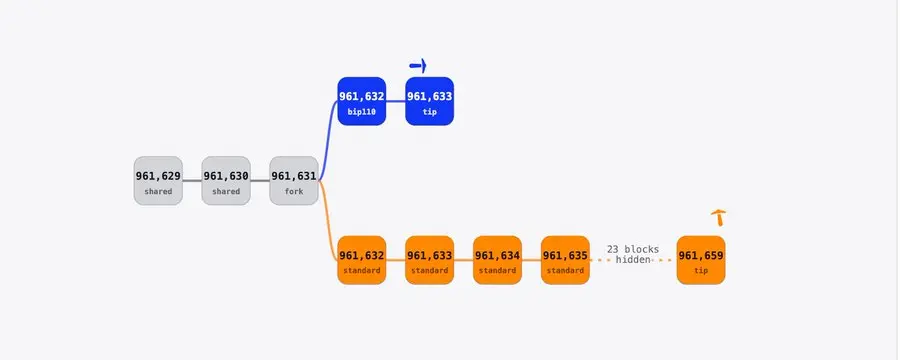
Bitcoin split into two incompatible chains on Aug. 8 after BIP-110 nodes began rejecting blocks that did not signal bit 4 at block height 961632, even though the proposal had received support from just 51 blocks in the prior 2,016-block window, or 2.53%. The higher-work chain continued under the existing rules, while the BIP-110 branch fell behind, reaching block 961633 by 9:00 a.m. Beijing time on Aug. 9, 21 blocks behind the main chain at 961654. The proposal was put forward by pseudonymous developer Dathon Ohm, with Luke Dashjr involved in the early draft and technical suggestions. Its reference implementation is based on Bitcoin Knots rather than Bitcoin Core, and it did not secure majority miner support. Supporters are trying a user-activated soft fork, arguing that nodes, exchanges, wallets and payment services can define valid blocks even without strong miner signaling. For now, BIP-110 has not activated its data limits on Bitcoin mainnet. What exists is a low-hashrate execution chain. The main chain still follows the original rules, and the 21 million BTC cap, existing balances and everyday payments remain unchanged. Risks are concentrated among nodes, wallets and services using BIP-110 infrastructure because the split came without dedicated replay protection.

2760
Bitcoin splits at block 961632 as BIP-110 enforces rules despite 2.53% support
Bitcoin
Aug 10, 2026

BIP-110 fork stalls after two blocks, reviving the question of who can change Bitcoin

Bitcoin reached block height 961,632 in the early hours of Aug. 9 Beijing time, triggering BIP-110’s mandatory signaling phase and a split between nodes enforcing the proposal and the main chain. The result was brief. The BIP-110 branch produced only two blocks before stalling, while Bitcoin’s main network continued operating normally. In the previous difficulty period, the proposal had received support signals from just 51 blocks, or 2.53%, far below its self-defined 55% threshold for voluntary early lock-in. BIP-110, submitted by pseudonymous developer Dathon Ohm with early draft input from Luke Dashjr, aimed to impose temporary consensus-level limits that would raise the cost of writing large amounts of continuous data to Bitcoin, including Ordinals-style inscriptions. Supporters argued that full nodes bear the burden of downloading, validating, and in some cases storing this data, while critics said changing consensus rules to target an unpopular but fee-paying use of Bitcoin would create a dangerous precedent. The fork’s failure has not ended the dispute. Debate continues over on-chain data, protocol neutrality, user-activated soft forks, miner support, and Bitcoin’s development process. For ordinary holders, the short-term concern is replay risk: because the minority chain lacks built-in replay protection, developers and Ledger have warned that moving or selling forked coins could also move corresponding BTC on the main chain if users are not careful.

2750
BIP-110 fork stalls after two blocks, reviving the question of who can change Bitcoin
Bitcoin
Aug 10, 2026

BIP-110 fork stalls after two blocks as miners stay on Bitcoin’s main chain

Bitcoin’s BIP-110 fork quickly lost momentum after nodes enforcing the proposal split from the main network over the weekend and produced only two blocks. The chain split began at block 961,632, when BIP-110 entered its mandatory signaling window and nodes running the software started rejecting blocks that did not signal support via version bit 4. A pseudonymous mining group, Roughnecks, mined blocks 961,632 and 961,633 using Ocean’s DATUM protocol, but the enforcing branch then stalled. By Sunday afternoon, it remained stuck at 961,633 while Bitcoin’s main chain had advanced to 961,744, leaving a gap of 111 blocks and about 17 hours without a new block on the fork. Support for the proposal had already been weak: only 51 of the previous 2,016 blocks, or about 2.53%, signaled for BIP-110, far below the 55% needed for voluntary lock-in. Ocean later told clients that some miners using its Stratum templates may have unknowingly mined on the BIP-110 chain and said it would reimburse affected miners for rewards they would have earned on the non-BIP-110 chain during that period.

2640
BIP-110 fork stalls after two blocks as miners stay on Bitcoin’s main chain
Bitcoin
Aug 10, 2026

Bitcoin’s BIP-110 soft fork stalls after two blocks in eight hours

PANews reported that Bitcoin Improvement Proposal BIP-110 entered its mandatory signaling phase on August 9 but quickly ran into a wall. The minority chain tied to the proposal produced only two blocks in roughly eight hours, both mined by Roughnecks, after signaling support fell far short of the activation threshold. In the last difficulty period before activation, only 51 blocks signaled support, or about 2.53% of the 2,016-block window. Roughnecks and later PyBLOCK then paused support, while developer Luke Dashjr drew public criticism over the dispute.

3130
Bitcoin’s BIP-110 soft fork stalls after two blocks in eight hours
Bitcoin
Aug 10, 2026

BIP-110 fork stalls after producing only two blocks in eight hours

Bitcoin split into two chains at block height 961632 on the night of Aug. 7, after nodes running BIP-110 software began rejecting blocks that did not signal support for the proposal. AntPool mined the first standard block at that height and remained on the main network, while a miner working through Ocean produced an alternative block that the BIP-110 chain followed. Eight hours later, the minority chain had advanced only to block 961633, with just two blocks mined in total. Over the same period, Bitcoin’s main chain had reached block 961681, a lead of 48 blocks. The article argues that the fork had effectively failed on technical grounds in less than a day. BIP-110, formally titled “Reduced Data Temporary Softfork,” sought to temporarily restrict non-financial data storage in Bitcoin blocks for about a year, targeting Ordinals inscriptions, BRC-20 tokens, Runes, and similar uses of transaction scripts and witness data. Supporters said these uses crowd out block space and raise costs, while critics argued that any valid transaction paying sufficient fees should be allowed. The report also highlights why the minority chain stalled, including low signaling support of 2.53% versus a 55% activation threshold, inherited main-chain difficulty, and the absence of replay protection, which it says creates risks for users who attempt to transact on the forked chain.

2650
BIP-110 fork stalls after producing only two blocks in eight hours
Bitcoin
Aug 9, 2026

Bitcoin’s BIP-110 Fork Stalls After Mining Only Two Blocks

A contentious Bitcoin network proposal produced an actual chain split over the weekend, but the breakaway branch lost momentum almost as soon as it began. The fork tied to BIP-110 mined just two blocks over roughly eight hours before stalling, leaving it far behind Bitcoin’s main chain. The split was triggered at block 961,632, when nodes running BIP-110 software began rejecting blocks that did not signal support for the proposal. An AntPool block without that signal stayed on the main chain, while an Ocean pool miner produced the block followed by the minority branch. The fork now faces a structural problem. It inherited Bitcoin’s current mining difficulty but appears to control only a small share of network hash power. Decrypt said about 2.53% of recent blocks signaled support for BIP-110, far below the 55% threshold needed to activate without a split. At that rate, the forked chain could take roughly 350 days to reach its next difficulty adjustment. The proposal has divided the Bitcoin community over whether non-financial data such as images and text should be filtered out of transactions. Michael Saylor and Casa co-founder Jameson Lopp both criticized BIP-110 supporters on X, while holders of the fork’s coins also face replay risk because both chains currently accept identical transactions.

2450
Bitcoin’s BIP-110 Fork Stalls After Mining Only Two Blocks
Total 98 items
Go topage