Gate
Oct 12, 2026

Gate to debut Incentiv (CENT) with spot trading and HODLer Airdrop

Gate is set to be the first exchange to list Incentiv (CENT), according to an official announcement cited by ChainCatcher. Spot trading for the CENT/USDT pair will open at 17:00 UTC+8 on Oct. 12, while the platform said instant swap trading is expected to go live at 18:00 the same day. At the same time, Gate has launched its 343rd HODLer Airdrop campaign for Incentiv, with the event scheduled to end at 16:00 UTC+8 on Oct. 12. The airdrop pool totals 34,482,759 CENT, and the tokens will be distributed with 100% unlocked. Users who complete identity verification and hold at least 1 GT are eligible to participate. Rewards will be allocated based on each user’s share of GT holdings in the snapshot, and Gate said no user participation funds will be deducted after the campaign ends. Incentiv is described as an EVM-compatible Layer 1 blockchain that uses a proof-of-work (PoW) mechanism. The project also says it integrates advanced account abstraction, flexible network fee payment options, and incentive mechanisms tied to ecosystem contributions. Its ecosystem covers Portal, developer tools, a cross-chain bridge, and a native DEX, with expansion into AI Agent economy use cases. CENT is the network’s native asset for Gas settlement and ecosystem incentives.


850
Gate to debut Incentiv (CENT) with spot trading and HODLer Airdrop
Pearl
Oct 10, 2026

Pearl draws TOKEN2049 attention as PoW-AI narrative gains steam, but PRL still faces proof-of-demand questions

Pearl, the project behind token PRL, emerged as one of the more talked-about names around TOKEN2049 as interest in fresh proof-of-work designs picked up while some Layer 2 projects, including Blast and Abstract, were described in the source as shutting down one after another. The project runs as an independent PoW chain launched on April 27, 2026 and uses Proof of Useful Work, replacing Bitcoin-style SHA-256 mining with matrix multiplication workloads common in AI inference. The pitch is simple: the same GPU compute used to serve AI customers could also mine PRL, giving operators two revenue streams. The project has a research-heavy founding team and says its PoUW paper was published in 2025. It also has an early commercial reference point: Together AI announced on May 15 that it was working with Pearl Research Labs on Gemma-4-31B-it-Pearl inference, saying mining subsidies cut inference costs by more than 25%. Still, the source points to major open questions. Pearl has not disclosed key operating metrics such as real paid revenue, daily inference volume, or customer retention. Token distribution and economics also remain under scrutiny, with low early mining difficulty, continued token issuance, and no confirmed large-scale buyback, burn, or revenue-sharing mechanism tied to PRL.

1200
Pearl draws TOKEN2049 attention as PoW-AI narrative gains steam, but PRL still faces proof-of-demand questions
Grayscale
Sep 11, 2026

Grayscale says Zcash mining profitability is running ahead of Bitcoin

Grayscale’s head of research, Zach Pandl, said Zcash is showing stronger mining economics than Bitcoin at current valuation levels, even though the Bitcoin network remains far larger in absolute terms. In his analysis, Pandl described Zcash as a Bitcoin-like digital asset with added privacy features, with both networks relying on proof-of-work mining to secure their chains. According to Grayscale’s estimates, Bitcoin miners collect about $35 million in total rewards per day, versus roughly $2 million for Zcash miners. Even so, Zcash appears more attractive on a per-miner basis. Grayscale estimated that daily rewards per machine on Zcash are about 2x those of Bitcoin, while rewards per megawatt-hour are about 4x higher, though the mining hardware used on the two networks is not interchangeable. Pandl also cited other sources indicating that Zcash mining revenue per megawatt-hour is currently above that of some AI and high-performance computing cloud services. He said the higher profitability is drawing in more mining activity. Measured by a standard hashrate metric, total Zcash mining activity has risen by more than 2.5x this year, which Grayscale said is helping bring more computing power onto the network and support security.

1320
Grayscale says Zcash mining profitability is running ahead of Bitcoin
Vitalik Buterin
Sep 7, 2026

Vitalik Buterin pushes back on claim AI could break Bitcoin, says about 90% of his net worth is riding on it

Ethereum co-founder Vitalik Buterin has publicly rejected a bearish argument that advances in artificial intelligence could undermine Bitcoin’s security and trigger a deep price decline. The dispute began after entrepreneur Liron Shapira posted on X on Sept. 6 that, with what he described as 50% confidence, Bitcoin could fall by more than 50% within the next two years because AI may weaken assumptions about the network’s security and resilience. Buterin responded on Sept. 7 with the opposite view. He said he is “quite optimistic” about long-term cybersecurity and argued that the main challenge lies in the transition period rather than in a complete failure of Bitcoin’s core protections. He added that issues not requiring broad social consensus, such as client upgrades and mining pool responses to network-layer attacks, should be manageable, while the odds of hash functions or proof-of-work being genuinely broken remain “very small.” Referring to his portfolio exposure, Buterin said that, in effect, roughly 90% of his net worth is already bet on that stance. The exchange highlights a wider split in the market over whether AI will accelerate attacks faster than defenses can adapt.

1140
Vitalik Buterin pushes back on claim AI could break Bitcoin, says about 90% of his net worth is riding on it
Ravencoin
Aug 11, 2026

Ravencoin Flags Critical Consensus Bug, Warns of Possible 3-Day Deep Reorg

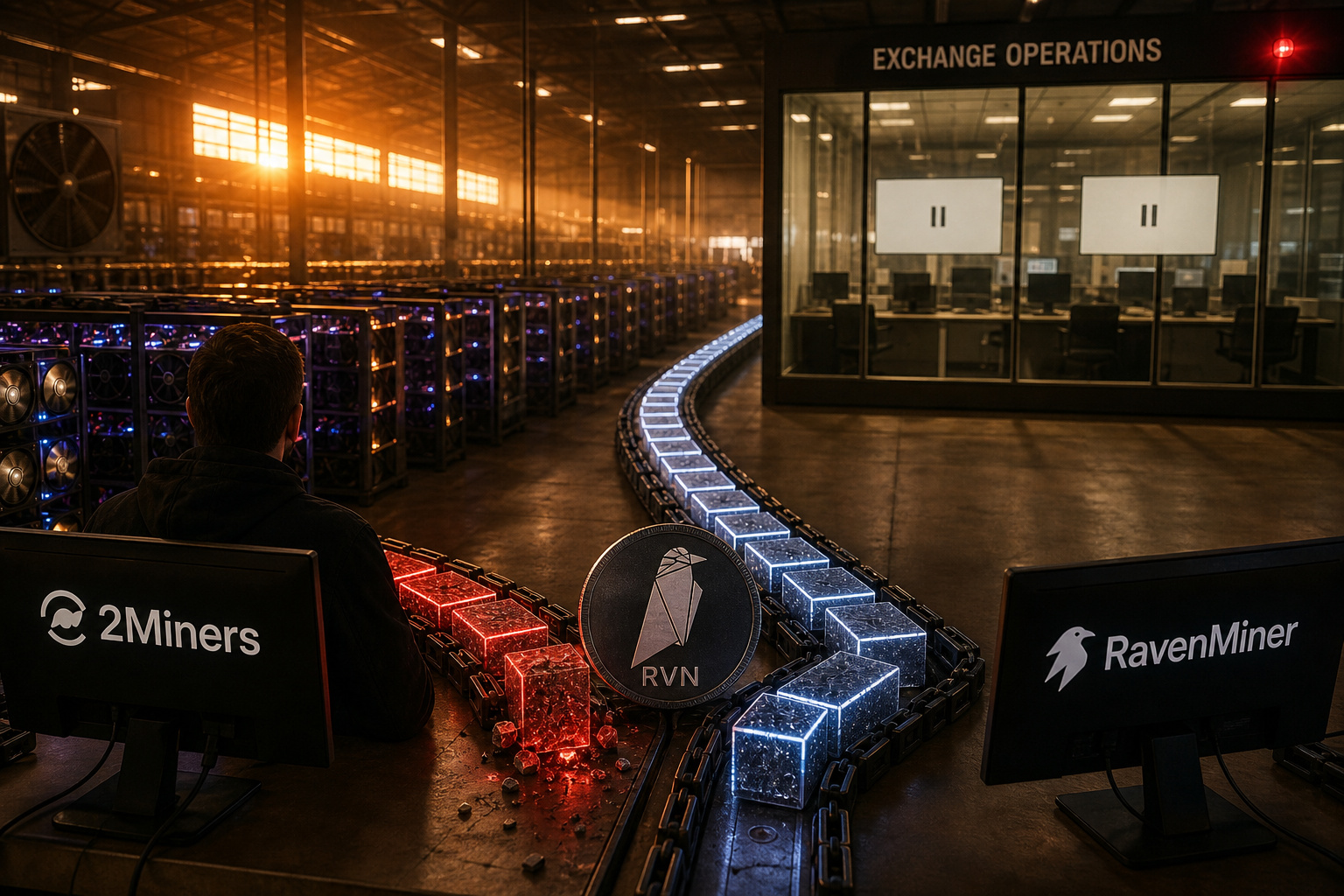
Ravencoin, the proof-of-work blockchain, said in an announcement that a critical consensus vulnerability has been exploited on its network, causing weak nodes to accept invalid blocks. The first known invalid block appeared at height 4,487,776. Mining pools 2Miners and RavenMiner, which together control a majority of the network's hashrate, have said they are mining a chain that starts at height 4,487,776 and excludes the exploited branch. If that chain becomes the dominant chain, Ravencoin could face a deep chain reorganization of roughly three days. The project advised exchanges to temporarily suspend RVN deposits and withdrawals until the network stabilizes. It also warned that transactions confirmed after height 4,487,775 should be considered at risk. Ravencoin said the notice is intended to improve transparency and risk awareness, and does not represent an endorsement of any rollback or recovery plan. The announcement was posted via the project's official account on the X social media platform.

2580
Ravencoin Flags Critical Consensus Bug, Warns of Possible 3-Day Deep Reorg
Bitcoin
Aug 10, 2026

BIP-110 falls behind Bitcoin main chain as debate shifts from soft fork to possible PoW change

Bitcoin entered the BIP-110 enforcement window at block height 961632 on Aug. 9, creating a live split between the main chain and a minority chain run by nodes enforcing the proposal. Those nodes began rejecting non-compliant blocks, including ones carrying non-monetary data transactions. But after a day, the BIP-110 chain had produced only blocks 961632 and 961633 and trailed the main chain by more than 200 blocks, leaving it far from the longest-chain consensus. The outcome matched the weak support seen before activation. Miner signaling was only about 2%, well below the 55% threshold cited in the article. Even so, supporters led by Bitcoin developer Luke Dashjr have continued discussing a new proof-of-work algorithm for the BIP-110 chain, a move that would take the dispute beyond a soft fork and into hard fork territory. In Bitcoin Knots Discord discussions, participants considered options including RandomX, KT256, BLAKE3, BLAKE2 variants, Scrypt and Autolykos v2. The fight has now widened into a governance dispute over whether miners, nodes or the broader community determine Bitcoin’s direction. Critics including Michael Saylor, Adam Back and F2Pool co-founder Wang Chun rejected the BIP-110 case, while proposal author Dathon Ohm and Dashjr argued that large mining pools had forced the chain into this position.

9510
BIP-110 falls behind Bitcoin main chain as debate shifts from soft fork to possible PoW change
BIP-110
Aug 9, 2026

BIP-110 Minority Chain Stalls; Supporters Weigh PoW Algorithm Switch

The BIP-110 minority chain ground to a halt after producing only blocks 961632 and 961633 following its fork at block height 961632. It inherited roughly 127.48 trillion in Bitcoin difficulty but attracted almost no SHA-256d hashpower; pre-fork miner support was around 0% to 2.6%. Supporters are now discussing changing the proof-of-work algorithm to break reliance on Bitcoin miners and SHA-256d hashing. Luke Dashjr has proposed selecting the final algorithm from a shortlist via a deterministic random process, with RandomX, KT256, BLAKE3 and Scrypt among the options. No PoW change has been enabled or approved yet, Bitcoin Knots has not committed to any adjustment, and the chain has still not resumed block production.

2320
BIP-110 Minority Chain Stalls; Supporters Weigh PoW Algorithm Switch
Total 35 items
Go topage