Mysten Labs
Oct 16, 2026

Mysten Labs names Kevin Boon as CEO while Evan Cheng shifts focus to CTO and new AI unit

Mysten Labs, the developer behind the Sui Layer 1 blockchain, has changed its top leadership, with company president Kevin Boon taking over as chief executive officer from Evan Cheng. Cheng will remain chief technology officer and will personally lead a newly created internal AI business unit, according to a public letter he published on Oct. 16 and a post on X. Boon previously served as Mysten Labs’ chief legal officer before being promoted to president. Cheng said he had planned for this transition when Boon was named president. The new AI division will have its own engineering and product development functions and is being structured to reduce reliance on outside parties. Cheng said the unit will follow the model of Mysten’s on-chain finance business group established this summer. The AI effort will focus on agent trust products and AI-native infrastructure, with products and services tied to Sui and Walrus. Walrus, Mysten’s decentralized storage protocol, went live on mainnet in March 2025. Cheng also highlighted Verifiable Agent Arbiter, an evidence layer developed with Google Cloud and announced on Oct. 6, which is designed to help enterprises prove that their AI agents acted within authorized limits.

1450
Mysten Labs names Kevin Boon as CEO while Evan Cheng shifts focus to CTO and new AI unit
Sui
Oct 16, 2026

AnyfloHQ rolls out business payments tool with instant fiat or stablecoin settlement

Odaily reported that Sui shared on X that @LolaOye introduced AnyfloHQ during Sui Basecamp. The product is designed to simplify stablecoin payment workflows for businesses. According to the post, it supports instant settlement in either fiat currency or stablecoins, while reconciliation is handled through a single ledger. The update did not include additional operational details, pricing, launch timing, or supported markets. The announcement focused on the core payment flow: businesses can settle transactions immediately and keep records in one unified system for reconciliation. The information was disclosed through Sui’s social media post and cited by Odaily as a brief news update.

970
AnyfloHQ rolls out business payments tool with instant fiat or stablecoin settlement
Sui
Oct 15, 2026

Alibaba Cloud integrates Sui Agent Payments for per-use USDC payments by agents

Sui said in a post on X that Alibaba Cloud is integrating its services with Sui Agent Payments. Under the setup described by Sui, agents will be able to make per-use payments in USDC within spending limits set by users. All payments will be settled on the Sui network. The announcement did not provide additional implementation details beyond the integration and payment flow. The update was reported by Odaily as a 7x24 news flash.

910
Alibaba Cloud integrates Sui Agent Payments for per-use USDC payments by agents
Sui
Oct 14, 2026

Scallop launches self-custodial browser wallet on Sui

Scallop, a lending protocol on Sui, has launched Scallop Wallet, a new browser wallet that is now available through the Chrome Web Store. The company said the product is self-custodial, meaning users manage their own assets within the wallet rather than relying on a third party to hold them. According to the official description, Scallop Wallet lets users manage assets, swap or buy crypto assets, compare lending rates across the Sui ecosystem, and track their positions in Scallop. Those functions are available within the same wallet interface. The launch adds a wallet product to Scallop’s existing presence in Sui-based lending and gives users a single place to handle several activities tied to the protocol and the broader ecosystem.

1430
Scallop launches self-custodial browser wallet on Sui
Sui
Oct 14, 2026

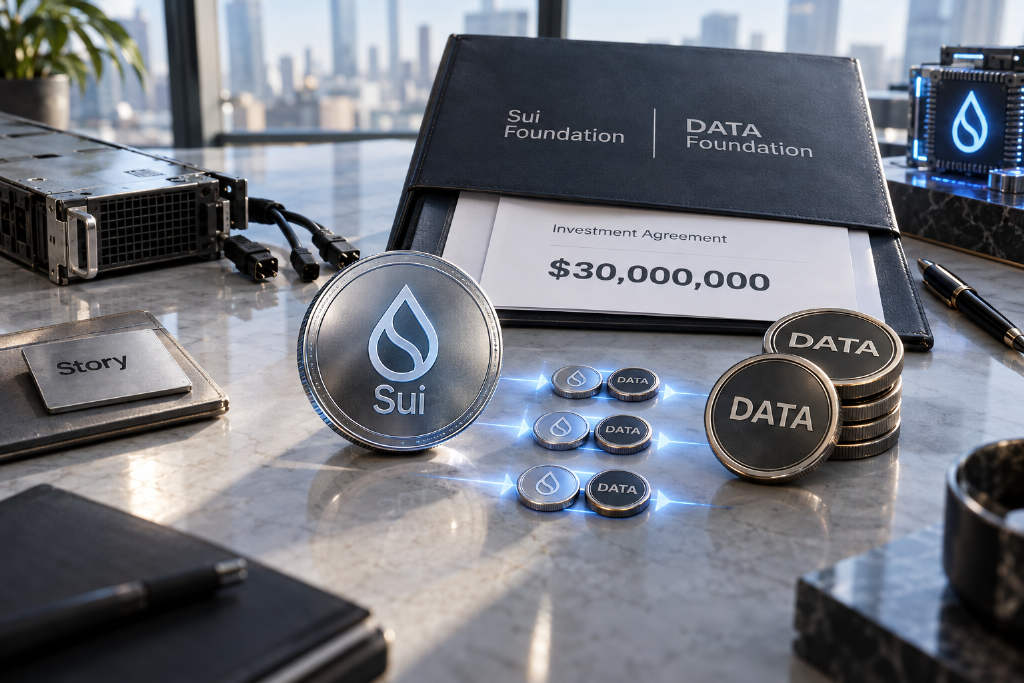
Sui commits $30 million to DATA as Story Protocol gives up its standalone chain

Sui Foundation and DATA Foundation said on Oct. 12 that Sui will invest $30 million in DATA Network, becoming its largest institutional holder, while PIP Labs and DATA Foundation will keep their existing stakes. The deal also sends DATA onto Sui as a native protocol and retires its standalone blockchain. The move marks another sharp turn for the project once known as Story Protocol, which was founded by SY Lee in 2022 and built by PIP Labs. Story started as an intellectual property blockchain, raised three rounds with participation from Andreessen Horowitz, and reached a $2.25 billion valuation in its August 2024 Series B. It later rebranded to DATA Foundation on June 25, 2026, shifting from programmable IP infrastructure to AI training data. Market reaction was immediate but brief. DATA rose from about $0.197 to $0.221 within two hours of the announcement, a gain of roughly 12%, while 24-hour trading volume expanded from around $10 million to more than $60 million. The token later slipped back to around $0.20. The announcement leaves several details undisclosed, including the form of Sui’s investment, the token source, and the purchase price. DATA will migrate to Sui on a 1:1 basis with unchanged total supply, while validators, staking, AMMs, and other contracts on the original chain will be phased out.

1620
Sui commits $30 million to DATA as Story Protocol gives up its standalone chain
Raoul Pal
Oct 14, 2026

Raoul Pal says most public chains are headed to zero, with only a few likely to survive

Investor Raoul Pal said hundreds of public blockchains launched in the last cycle have largely turned into ghost towns, and that many of the industry’s standard survival metrics fail to identify which networks can endure. In a post on X, he argued that competition among blockchains works like a platform market, where value tends to concentrate heavily in a small number of winners rather than spread evenly across the field. Pal said the pattern resembles the washout that followed the internet bubble, citing his earlier view from 2020 that around 80% of early venture projects eventually go to zero, 19% create some value, and just 1% capture most of the returns. He described blockchains as independent economies with their own GDP, money supply and monetary policy, then outlined four possible paths to survival, from becoming a self-sustaining economic system to operating as a specialized chain, a layer-2 network, or a chain backed by a centralized platform balance sheet. He also said that after stripping out price effects, the only metric he found linked to returns was capital velocity, and that the relationship was negative. Based on his analysis, Ethereum, Solana and Sui were the only layer-1 networks that preserved economic density during a downturn.

890
Raoul Pal says most public chains are headed to zero, with only a few likely to survive
Raoul Pal
Oct 14, 2026

Raoul Pal says most public blockchains are built to die, with only a handful likely to endure

Raoul Pal, founder of Real Vision, argues that the collapse of most public blockchains is not evidence of fraud but the expected outcome of a venture-style market where tokens are repriced in real time. In his view, the right question is not whether most chains will fail, but which ones can survive and how to identify them before price action makes the answer obvious. He compares the current shakeout to the aftermath of the internet bubble, when most projects disappeared and a small number of platforms captured nearly all long-term value. Pal frames general-purpose blockchains as economic systems rather than simple tokens or software companies. He says projects have only four viable paths: becoming a standalone onchain economy, dominating a vertical niche, operating as a layer-2 business on top of a layer-1, or, in BNB’s case, relying on the balance sheet of a centralized platform. Chains that fit none of those categories, he argues, are structurally weak and likely to trend toward zero, with low-float, high-FDV token launches often speeding up that process. He also rejects common crypto valuation tools such as fees, TVL and TVL/FDV as circular or misleading. Instead, he points to user economic density during drawdowns, stablecoin balances that keep growing in bear markets, and continued developer inflows as the signals that matter most. By his reading, Ethereum, Solana and Sui were the only three layer-1 networks in his dataset that held up on those measures through a down cycle.

900
Raoul Pal says most public blockchains are built to die, with only a handful likely to endure
DATA Network
Oct 12, 2026

DATA Network to move to Sui and phase out its own blockchain

DATA Network, previously known as Story, plans to retire its standalone blockchain and migrate its AI training data protocol to Sui, with the move backed by a $30 million investment from Sui Foundation. As part of the transition, Trace, the project’s onchain registry launched in June, will join the Sui ecosystem. Walrus, a decentralized storage platform already within that ecosystem, is set to become the default storage layer for applications run by DATA Foundation and its partners. The project said its current network will remain operational until the upgrade is completed, and that a detailed migration timeline along with a holder transition plan will be released before the upgrade. The move follows the project’s June shift away from its earlier Story Protocol identity, which had focused on intellectual property licensing, toward building what it described as a full stack for AI training data.

1560
DATA Network to move to Sui and phase out its own blockchain
Total 337 items
Go topage