Liquid
Nov 4, 2026

Liquid reserve backing restored as 4,270.54 BTC now supports matching L-BTC

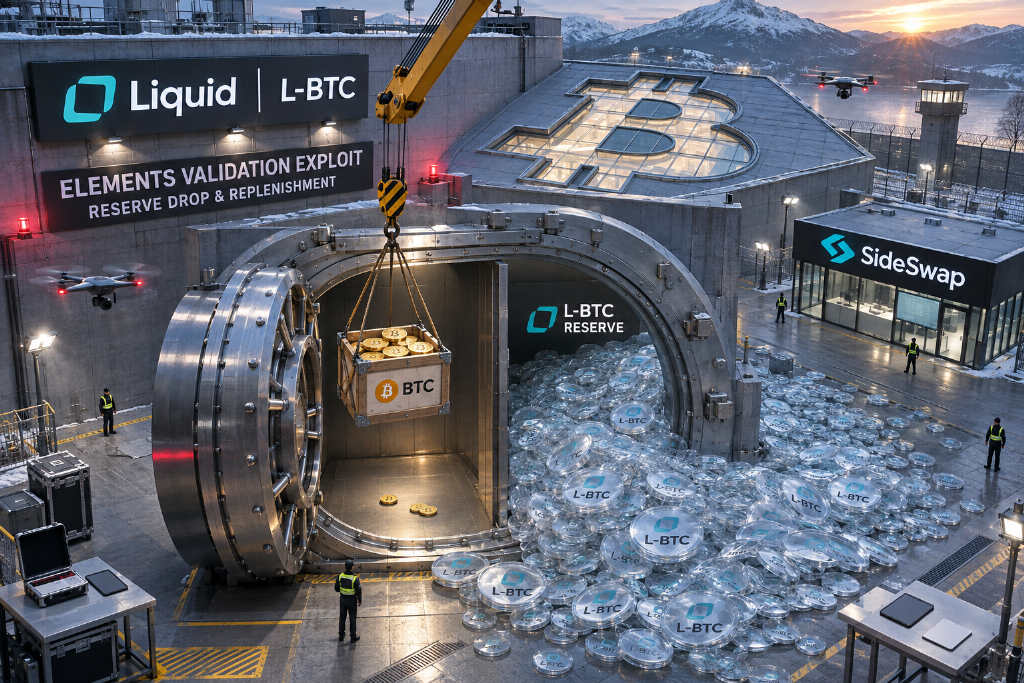
Liquid’s reserve backing has been restored after the shortfall created by the Sept. 6 exploit was fully covered, according to monitoring cited by Odaily and Bitcoin News. The incident stemmed from an Elements rangeproof verification flaw that let an attacker mint about 4,000 L-BTC without corresponding bitcoin reserves. That pushed backing down from roughly 4,205 BTC to 197 BTC. Most of the tokens were later returned. The remaining gap was closed with a final 250 BTC deposit made on Nov. 2. SideSwap now shows that 4,270.54 BTC backs an equal amount of L-BTC, indicating that full reserve support has been restored on that basis. Even so, direct redemption through the federation remains restricted. Users who want to exit still need to do so through swap or exchange service providers rather than redeeming directly through the consortium.
780
Liquid reserve backing restored as 4,270.54 BTC now supports matching L-BTC
Elements
Nov 4, 2026

Elements flaw let attacker mint about 4,000 L-BTC without Bitcoin backing

Bitcoin News said an attacker exploited a range proof verification flaw in Elements to mint about 4,000 L-BTC without corresponding Bitcoin reserves. The incident reduced backing reserves from about 4,205 BTC to 197 BTC. Most of the tokens were later returned, and the final 250 BTC deposited closed the gap. SideSwap now shows 4,270.54 BTC backing an equal amount of L-BTC. Direct redemption through the federation remains restricted, and users still need to exit through swap service providers. The report focuses on the reserve shortfall, the later restoration of backing, and the current redemption limits that remain in place.

670
Elements flaw let attacker mint about 4,000 L-BTC without Bitcoin backing
Liquid
Sep 10, 2026

Galaxy’s Alex Thorn says Liquid’s approved-address rule did not stop the bitcoin thieves

Alex Thorn, head of firmwide research at Galaxy Digital, said Liquid’s approved-address restriction did not prevent the Sept. 6 attackers from moving bitcoin off the sidechain. According to CertiK, the incident began when a software flaw let an attacker create about 3,998.5 L-BTC that had no bitcoin backing, then convert those tokens into real BTC through Liquid’s own withdrawal process. Unchained reported that the withdrawals drained about 95% of the bitcoin pegged into Liquid before the sidechain was frozen the same day. Liquid’s developer documentation says peg-outs require a Peg-out Authorization Key, or PAK, and states that only users with registered PAK entries can withdraw to Bitcoin. Thorn said on Unchained’s Uneasy Money podcast that the restriction did not actually bind the attackers because ordinary users often rely on intermediaries such as federation members or exchanges. He pointed to a workflow described in Liquid’s documentation and said SideSwap would accept a destination address and auto-forward withdrawn BTC to that address. CertiK attributed the exploit to ambiguous cache-key encoding in the rangeproof verification cache. Liquid and SideSwap both said the withdrawal system itself remained intact, and Liquid said no key, including SideSwap’s, had been compromised. The attackers have since returned 3,400 BTC and kept 598.5 BTC.

1690
Galaxy’s Alex Thorn says Liquid’s approved-address rule did not stop the bitcoin thieves
Liquid
Sep 8, 2026

Liquid Exploit Mints About 4,000 Unbacked L-BTC, Report Says

Liquid Federation said an attacker exploited a cache bug in Elements’ range-proof validation and minted about 4,000 L-BTC without reserve backing. The tokens were then exchanged for real BTC through SideSwap’s authorized peg-out route. Liquid’s functional entities treated the transactions as valid and released about 4,000 BTC from the federation reserve. Before the incident, Liquid held about 4,205 BTC, while its reserve fell to a low of 197 BTC before operations were suspended. The attacker, who identified as a white hat, has since returned 3,400 BTC. About 598.5 BTC remains outstanding. The report said no private keys were compromised and that the peg-out mechanism itself operated as designed. Liquid remains offline. Blockstream is preparing an emergency Elements v23.3.4 release and is working to restore the network with 1:1 Bitcoin reserve backing.

1850
Liquid Exploit Mints About 4,000 Unbacked L-BTC, Report Says
Liquid Network
Sep 7, 2026

Liquid gets 3,400 BTC back after on-chain exchange as white hats keep 598.5 BTC

Liquid Network recovered 3,400 BTC after a day of messages embedded in Bitcoin transactions, while the party described as white hats kept 598.5 BTC, roughly 15% of the consolidated amount, as an implied bounty. According to Bitcoin Magazine, the return transaction was confirmed at 16:09 UTC on Sept. 7 and sent the 3,400 BTC back to the labeled Liquid peg script address, with the remaining 598.5 BTC returning to the same white-hat-controlled address as change. The transaction followed a sequence of on-chain messages between the holder of the roughly 4,000 BTC and an address linked to Blockstream. Those messages included a request to contact Blockstream security, encrypted payloads, PGP-signed notes, and clear-text statements about patching bridge nodes before funds could be returned. Liquid’s last official statement, published Sunday, said the withdrawal happened through the SideSwap peg-out path, that the PAK itself was not compromised, that other issued assets were unaffected, and that the sidechain had been paused. As of the article’s publication, neither Liquid nor Blockstream had issued a new public statement on the 3,400 BTC return.

1420
Liquid gets 3,400 BTC back after on-chain exchange as white hats keep 598.5 BTC
Blockstream
Sep 7, 2026

About 4,000 BTC left Blockstream’s Liquid Federation wallet in exploit tied to peg-out flow

About 4,000 BTC, valued in the source report at roughly $320 million, left Blockstream’s Liquid Federation wallet on Sunday afternoon in what Protos described as a hack tied to Liquid’s peg-out process. The transaction carried 11 valid signatures from the federation’s 15-key setup, even though the LBTC used to redeem the bitcoin should not have existed. Liquid Network later said the sidechain was effectively paused, bridge nodes were disabled, and exchanges halted LBTC deposits and withdrawals. The report said the attacker still held 3,998 BTC by Monday morning and posted an on-chain OP_RETURN message identifying as whitehats. SideSwap, whose peg-out service processed the order, blamed faulty LBTC tied to a third-party Elements bug and said no SideSwap system was responsible. Mempool.space logged an unauthorized 4,019 BTC withdrawal, while Liquid’s official dashboard did not immediately reflect the loss. The article also pointed to recent Elements validation fixes, long-running discrepancies between Liquid-related dashboards, and criticism of the maintenance state of Liquid’s functionary codebase.

1560
About 4,000 BTC left Blockstream’s Liquid Federation wallet in exploit tied to peg-out flow
Liquid
Sep 7, 2026

Liquid attacker broadcasts return of 3,400 BTC, keeps 598 BTC after on-chain negotiation

The address that drained Blockstream’s Liquid federation wallet on Sunday has now broadcast a transaction returning 3,400 BTC to the federation while sending 598.49955894 BTC back to itself, leaving the attacker with roughly 15% of the 3,998.50 BTC originally withdrawn. According to The Defiant, the entire exchange between Blockstream and the attacker took place inside Bitcoin transactions through OP_RETURN messages, with Blockstream’s messages PGP-signed. The return transaction was still unconfirmed at 15:50 UTC Monday. It carries a 1,768-satoshi fee, a fee rate of 0.77 satoshis per virtual byte, and all 16 inputs are marked replace-by-fee. Earlier on Monday, the attacker wrote in plain text that it was "sending most back" to a specified address and asked, "is that ok." Blockstream later replied with a signed "Yes, thank you," followed by another signed message saying bridge nodes had been patched and it was safe to return the funds. SideSwap, whose peg-out authorization key was used in the incident, said a customer sent 4,000 L-BTC to its peg-out service and that Blockstream later determined the L-BTC had been created through a bug in Elements software. SideSwap said neither its key nor its systems were compromised.

1440
Liquid attacker broadcasts return of 3,400 BTC, keeps 598 BTC after on-chain negotiation
Liquid
Sep 6, 2026

Liquid Sidechain Halted After 3,998 BTC Leaves Federation Wallet

Blockstream’s Liquid sidechain has been paused after roughly 4,000 BTC left the federation wallet that backs L-BTC in circulation. The network said the withdrawals were made through the SideSwap Peg-out Authorization Key, or PAK, but added that the key itself was not compromised. Two transfers moved the funds to a single Bitcoin address, which later posted an onchain message identifying the sender as white hats and asking to be contacted onchain. Blockstream responded with an onchain message directing the party to security@blockstream.com. Liquid then disabled bridge nodes, told exchanges to pause L-BTC deposits and withdrawals, and said assets issued on Liquid, including USDT and DePix, were unaffected. The incident has raised questions because Liquid’s peg wallet uses an 11-of-15 multisig and peg-outs are also restricted by a PAK list that, according to Liquid documentation, takes three days to update. Commentators including JAN3 CEO Samson Mow and Ledger CTO Charles Guillemet weighed in as additional onchain messages appeared, including a Signal contact request sent to the address holding the funds rather than from it.

2120
Liquid Sidechain Halted After 3,998 BTC Leaves Federation Wallet