Bitcoin
2 months agoNews Editor

Paper says quantum resources for potential BTC and ETH attacks are more than 50% below Google’s prior estimate

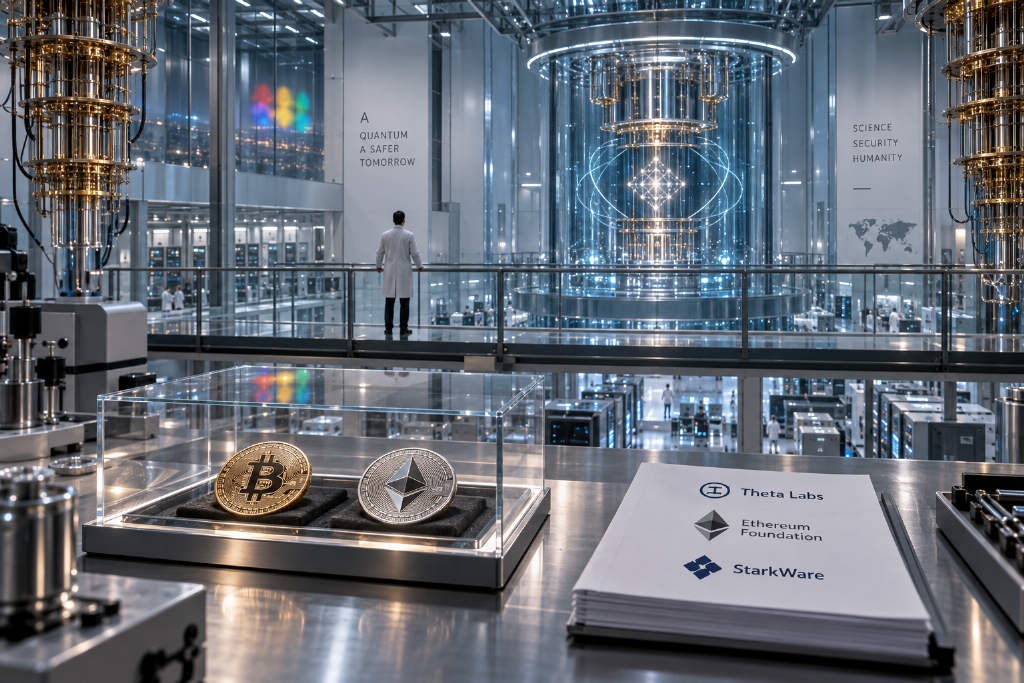
A new paper from researchers affiliated with Theta Labs, the Ethereum Foundation, StarkWare and other institutions says the resources needed for a key computational stage in potential quantum attacks on Bitcoin and Ethereum are now estimated at more than 50% below a figure previously published by Google Quantum AI. According to CoinDesk, the proposed quantum circuit design would require about 1,151 logical qubits and roughly 1.3 million Toffoli gate operations, for a combined score of around 1.5 billion. That compares with Google’s earlier figure of about 3 billion. The paper focuses on improving the point-addition component within Shor’s algorithm, which in theory could allow a sufficiently powerful quantum computer to derive a private key from a public key. Jieyi Long, CTO of Theta Labs and one of the paper’s main authors, said quantum attacks are not an immediate threat, but migration to quantum-resistant systems would take years and could not be left until after an attack occurs.
1100
Paper says quantum resources for potential BTC and ETH attacks are more than 50% below Google’s prior estimate
Starkware
3 months agoNews Editor

Starkware Completes Quantum-Resistant Bitcoin Transaction on Mainnet Without Soft Fork

Starkware, a blockchain technology company, has reported that a transaction using the quantum-resistant Bitcoin (QSB) scheme proposed by researcher Avihu Levy was mined on the Bitcoin mainnet on August 26. The entire process was conducted without a soft fork, a hard fork, or any change to consensus rules. According to the disclosure, the transaction consumed 10,000 satoshis and was processed through the Slipstream service of MARA Foundation. Because the transaction's format is non-standard, it is normally unable to propagate within Bitcoin's public mempool. The test involved several hours of GPU computation, with costs estimated at around $150 to $200. QSB utilizes hash-based quantum-resistant spending conditions and also applies signature trial mining in order to lower the risk of quantum attacks. Even so, the scheme still requires users to actively migrate their funds, and it cannot provide protection for assets whose public keys have already been exposed. Starkware CEO Eli Ben-Sasson continues to support the introduction of a protocol-level solution through a soft fork. The details were covered by Bitcoin.com News.

1410
Starkware Completes Quantum-Resistant Bitcoin Transaction on Mainnet Without Soft Fork
Bitcoin
3 months agoNews Editor

Starknet Foundation demonstrates first quantum-safe Bitcoin transaction on mainnet

Bitcoin Magazine reported that the Starknet Foundation has carried out what it described as the first post-quantum-resistant Bitcoin transaction on the Bitcoin mainnet. The transaction was mined this week and, according to the report, did not require a soft fork, a hard fork, or any upgrade to Bitcoin Core. Damian Chen, vice president of growth at the Starknet Foundation, presented the transaction at Bitcoin Asia in Hong Kong on Thursday and said the approach could help secure Bitcoin funds that may be exposed to future quantum attacks. The method was created by StarkWare researcher Avihu Levy and relies on generating millions of signature candidates until one meets a structural condition that avoids exposing vulnerable cryptographic material while the transaction is waiting to be confirmed. Because the format is non-standard, the transaction could not enter the public mempool and had to be sent directly to a miner. It was mined through mining company MARA’s Slipstream service. The report also said debate continues across the Bitcoin sector over when software upgrades will be needed as quantum computing develops.

1300
Starknet Foundation demonstrates first quantum-safe Bitcoin transaction on mainnet
StarkWare
3 months agoNews Editor

StarkWare says first quantum-resistant Bitcoin transaction has been executed

StarkWare has announced that the first quantum-resistant Bitcoin transaction has been successfully executed, according to a report by The Block. The company said the transaction was carried out using a method designed to add another layer of protection for assets on Bitcoin. StarkWare’s Avihu Levy used a signature grinding technique to protect public key data while also making sure the transaction remained secure in Bitcoin’s mempool. The approach, as described in the report, is intended to introduce a second layer of security for asset protection. No additional technical details, transaction size, or timing beyond the announcement were disclosed in the provided report.

1130
StarkWare says first quantum-resistant Bitcoin transaction has been executed
StarkWare
3 months agoNews Editor

StarkWare executes first quantum-safe transaction on Bitcoin mainnet

StarkWare said it has successfully executed the first quantum-safe transaction on the Bitcoin mainnet, a step the company described as significant for blockchain efforts to build resistance against future quantum threats. The announcement points to a security issue that has drawn growing attention across the crypto sector: the possibility that advances in quantum computing could one day weaken existing cryptographic protections used by cryptocurrency networks. According to StarkWare, the latest transaction shows progress toward addressing that risk on Bitcoin itself rather than in a test setting. The company also said there is an urgent need to develop quantum-resistant solutions that are both scalable and cost-effective. The update was cited by Crypto Briefing and carried by Techub News.

1310
StarkWare executes first quantum-safe transaction on Bitcoin mainnet
StarkWare
3 months agoNews Editor

StarkWare co-founder backs Ethereum’s move toward STARKs, but says key points were missed

StarkWare co-founder and CEO Eli Ben-Sasson said he agrees with Ethereum’s decision to move in the direction of STARKs, described here as hash-based SNARKs, but argued that the framing left out two important points and included one misleading claim. In a post on X, he said the debate between STARKs and SNARKs has been going on for years, with much of the related research previously led by StarkWare and funded by the Ethereum Foundation. He also said small binary fields were introduced to the zero-knowledge proof field in the 2018 ZK-STARK paper, rather than being original to Binius and Flonk. Ben-Sasson added that prime-field STARKs do not require large primes, pointing to Stwo’s use of the 31-bit prime field M31 as an efficient example. He further argued that binary-field multiplication performs poorly on GPUs, while multiplication over small prime fields such as M31 is more efficient, which he said could create hard-to-overcome challenges for GPU designs built on binary fields.

1700
StarkWare co-founder backs Ethereum’s move toward STARKs, but says key points were missed
Token Unlocks
3 months agoNews Editor

Weekly Token Unlocks: YZY to Release 120M Tokens Worth $35.7M, Starknet Unlocks 130M

This week's token unlock roundup covers two projects. YZY, the token issued by Kanye West, will unlock 120 million tokens with a value of roughly $35.73 million, the largest release in this batch. Starknet, an Ethereum Layer 2 network built on zk-STARKs technology, will unlock 130 million tokens worth about $3.19 million. Starknet uses STARK proofs to validate transactions and computations without requiring every network node to verify each operation, reducing computational load and boosting throughput. Its parent company StarkWare was founded in 2018 and is headquartered in Israel, with Starknet and StarkEx as its main products. Detailed unlock curves for both projects are published in the images below.

2520
Weekly Token Unlocks: YZY to Release 120M Tokens Worth $35.7M, Starknet Unlocks 130M
Total 58 items
Go topage