StepFun2026-10-17 07:47:45StepFun releases open weights for Step 5 Preview, a 600B MoE model with 1 million-token contextStepFun, an AI startup, has released the open weights for its flagship Step 5 Preview model, with FP8 and BF16 checkpoints now available on Hugging Face and ModelScope. The model uses a sparse mixture-of-experts architecture with 600 billion total parameters and activates 27 billion parameters per token. It supports up to 1 million tokens of context and is positioned for long-horizon agent tasks, including code generation, document analysis, and financial workflows. According to the details cited by Techub News, running the model requires data center-grade GPUs. The FP8 version needs either four B300 GPUs or eight H200 GPUs. In StepFun’s own benchmark testing, the model scored 67.7 on DeepSWE v1.1 and 66.4% on the FrontierFinance financial benchmark. The report said its performance is close to GLM-5.3 and Kimi K3, while trailing GPT-6 Astra and Claude Opus 5. The item cited MarkTechPost as the source of the benchmark details.220
OpenRouter2026-10-08 12:47:17OpenRouter lists StepFun’s new Step 5 Preview modelOpenRouter has added a new model, StepFun: Step 5 Preview, according to Techub News. The model runs on a sparse mixture-of-experts architecture and has 600 billion total parameters, with 27 billion active parameters. Techub said it was built for agent-focused workloads and stands out in software engineering and other professional task settings. The update marks a new listing on the model aggregation platform rather than a broader product rollout described in detail. No additional launch information, pricing, or availability terms were disclosed in the source brief.220
StepFun2026-09-21 06:40:16StepFun unveils Step 5 Preview with 600 billion parameters and a 1 million-token context windowStepFun has introduced Step 5 Preview, its flagship artificial intelligence model built as a sparse mixture-of-experts system with 600 billion total parameters and roughly 27 billion parameters activated per token. The model supports a context window of up to 1 million tokens and can take text, image, and video inputs, according to Techub News. StepFun said the model is aimed at agent workloads in software engineering, professional knowledge, and finance, while lowering task costs without giving up a comparable level of intelligence. The company is making the model available through a hosted API and the StepFun platform. An open-weight self-hosted version is scheduled for release on Oct. 15, 2026. Third-party evaluator Artificial Analysis gave Step 5 Preview a score of 44 on its Intelligence Index, compared with a median score of 24 for models in the same price range. API pricing is listed at $1 per million input tokens and $2.7 per million output tokens. StepFun also shared benchmark results for FrontierFinance and DRACO, along with examples showing H100 kernel optimization in a 24-hour experiment and model capability gains from automated post-training.640
StepFun2026-09-20 02:10:49StepFun unveils Step 5 Preview, with full model weights set for Oct. 15 releaseStepFun has released its flagship model, Step 5 Preview, and said the full model weights will be made available on Oct. 15. The model uses a sparse mixture-of-experts, or MoE, architecture with 600 billion total parameters while activating 27 billion parameters per inference. It supports a 1 million-token context window and multimodal image-text input, while its API and Studio access are already fully open. Artificial Analysis had completed its benchmark run ahead of the launch. In its Intelligence Index, Step 5 Preview scored 44 points, matching Kimi K3 Max. Artificial Analysis also measured the model at roughly 100 tokens per second, with a per-task cost of $0.71, compared with $2 for Kimi K3 Max. StepFun highlighted the model’s performance on long-running tasks. In one experiment, Step 5 Preview autonomously optimized an H100 GPU kernel for as long as 24 hours by rewriting code, running tests, comparing results, and iterating. After about 22 hours, it reached 508 TFLOPS, versus 493 TFLOPS for Claude Opus 5 in the same test. In another 24-hour experiment, the model designed post-training data on its own and improved Qwen3-30B-A3B’s AIME24 accuracy from 53.3% to 60%, matching Claude Opus 5 while using fewer labeled tokens.750
StepFun2026-09-19 16:15:43Step 5 preview appears on Artificial Analysis before launch, matching Kimi K3 Max with far lower output pricingStepFun has not officially announced Step 5, but a preview version has already surfaced on Artificial Analysis. The listing describes Step 5 Preview as a multimodal reasoning model with roughly 600B total parameters, 27B active parameters per inference, image input support, and a 1 million-token context window. In Artificial Analysis’ latest Intelligence Index, the model scored 44, the same as Kimi K3 Max. On Terminal-Bench 4.0, Step 5 Preview posted 33% versus 13% for Kimi K3, while both models scored 59% on SciCode. Pricing on the page shows Step 5 Preview at $1 per million input tokens and $2.7 per million output tokens, compared with $3 and $15 for Kimi K3. That puts Step 5’s output cost at less than one-fifth of K3’s, while the cost of running the full Intelligence Index is about one-quarter of K3’s, based on Artificial Analysis figures. The report noted that Artificial Analysis had already completed its evaluation through the StepFun API, even though Step 5 has not yet been formally unveiled. The listed parameters and pricing were also described as not being the company’s final official figures.500
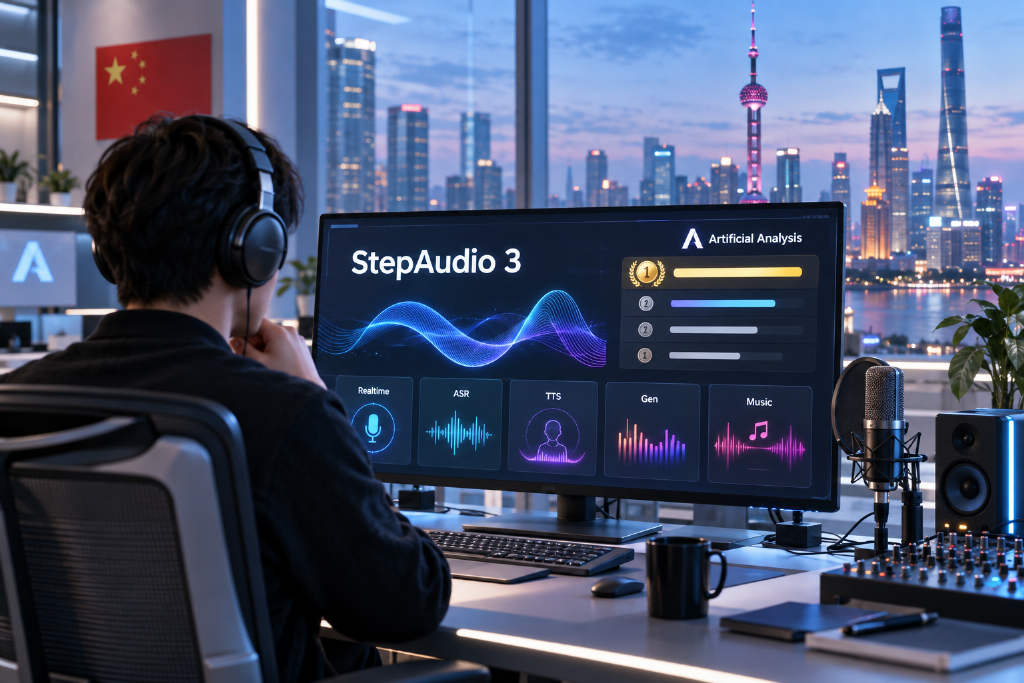
StepFun2026-09-15 08:06:02StepFun launches StepAudio 3, tops two real-time voice benchmarksStepFun has released StepAudio 3 and rolled out five voice models at once: Realtime, ASR, TTS, Gen, and Music. In two voice evaluations tracked by Artificial Analysis, StepAudio 3 Realtime ranked first in both categories. It scored 98.9% in Conversational Dynamics, ahead of Qwen Audio 3.0 Realtime Plus at 98.4% and GPT-Realtime-2 High at 95.3%. It also posted 99.7% in Speech Reasoning, taking the top spot there as well. According to the benchmark descriptions cited in the source, Conversational Dynamics measures how well a model handles pauses, turn-taking, user interruptions, and short acknowledgements, while Speech Reasoning tests whether a model can directly understand audio and complete reasoning tasks. In ASR, StepAudio 3 recorded a 1.7% WER on Artificial Analysis' non-streaming speech recognition leaderboard, tying for first with Fun-Realtime-ASR-preview. StepAudio 3 Gen also supports one-shot generation of vocals, sound effects, ambient audio, and music, with scene-level arrangement. All five models have now been added to StepFun's voice product lineup.790
Moonshot AI2026-08-08 01:55:26Moonshot AI restructures ownership, brings in state-backed investors as it seeks approval for Hong Kong IPOMoonshot AI is reorganizing its corporate structure and adding several state-backed investors as it seeks regulatory approval for a Hong Kong listing, according to the Financial Times. The Chinese AI startup may need to unwind its existing red-chip structure before going public because its core business had previously been controlled by offshore entities and funded in U.S. dollars through overseas investors. Chinese regulators have imposed restrictions on offshore listings by some tech companies with overseas structures, a factor that has led several AI firms, including Moonshot AI and StepFun, to pause IPO preparations. The report said Moonshot AI converted its mainland operating entity from a limited liability company into a joint-stock company last week, a key procedural step toward a listing. The company is also working with investment banks and legal advisers on how to transfer offshore investor holdings to an onshore entity, though the final arrangement has not been determined. Recent financing rounds valued the company at about $30 billion in one round and are expected to lift that figure to $50 billion after another. BlockBeats had previously reported market speculation that Moonshot AI could file for a Hong Kong IPO as early as this month and raise about $3 billion, but the company said on Aug. 3 that the claim was inaccurate.2670
StepFun2026-08-04 08:52:16StepFun splits smartphone unit into standalone company as it pushes model and agent-device strategyStepFun is pursuing two strategic tracks internally, according to a Huxiu Tech report cited by ChainCatcher: one centered on large language models and another focused on agent-driven devices. Its smartphone business has been moved into a standalone company called Zhiyue Xingchen, with a team that has Huawei and Honor backgrounds taking the lead. Ni Jiayue, the company’s terminal president, is overseeing the effort. The report said StepFun’s first agent smartphone, STEPX Neo, was shown during WAIC, though the company did not disclose pricing or a mass-production timeline. Huxiu also reported that StepFun is assembling an overseas commercialization team and plans to sell large-model APIs abroad, mainly voice models. The smartphone line is also part of that overseas sales plan. Chairman Yin Qi had previously explored an “AI + car” route at Qianli Technology, formerly Lifan Technology. This time, the company is treating smartphones as the first piece of its terminal strategy, aiming to build a closed loop spanning models, operating systems, and devices. The phone runs the Step AOS agent operating system, and the report said the business model ultimately returns to Token consumption. StepFun also continues model partnerships with 60% of China’s leading smartphone brands, covering an installed base of more than 42 million devices. As of publication, the company had not commented.1900