
Qianli Technology
Oct 27, 2026

Qianli Technology unveils AI-powered 4D millimeter-wave radar with 10 TOPS NPU

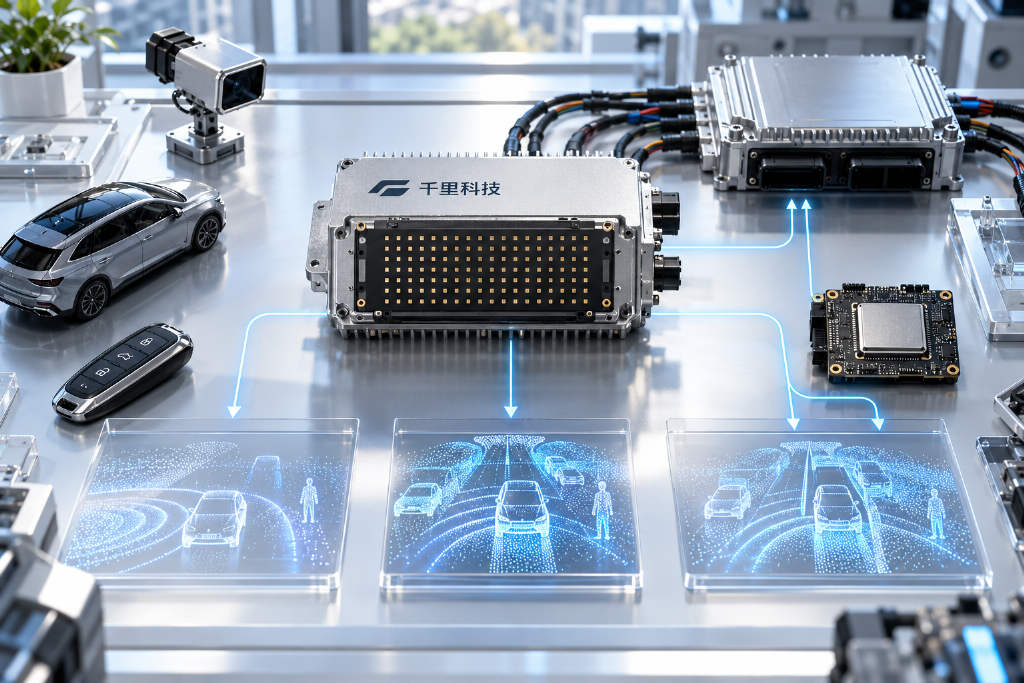
Qianli Technology has launched an AI-integrated 4D millimeter-wave radar equipped with a 10 TOPS NPU, adding local perception capabilities to the sensor itself. The company said the product supports three operating modes: a local edge mode that processes data on the radar and outputs structured perception results, a satellite architecture mode that sends raw data at high speed to a central domain controller for multi-source early fusion, and a compatibility mode that runs both paths at the same time. According to the release, the radar uses an end-to-end model across the full chain from antenna design to point-cloud output. Qianli Technology said this delivers a 10x increase in point-cloud density, a 40% improvement in detection range, and a 95% ghost-target elimination rate. The design is aimed at vehicle systems spanning L2 to L4 functional levels, as well as the transition period toward centralized EE architectures. The company is led by Yin Qi, while its affiliated company StepStar provides AI model support. Quantum Bit described the launch as an extension of the "AI + physical terminal" concept into autonomous-driving sensors, with model-driven iteration reshaping the underlying sensor architecture.

380
Qianli Technology unveils AI-powered 4D millimeter-wave radar with 10 TOPS NPU
StepFun
Jul 18, 2026

StepFun and Shanghai Qizhi Institute to launch agent research institute

StepFun and the Shanghai Qizhi Institute said on July 18 that they have entered into a formal partnership to jointly establish an advanced research institute focused on intelligent agents. According to BlockBeats, the two sides will work together on research covering agent networks, economic principles and AI Safety, while studying core theory, key technologies, standards systems and industrial models for the Agent era. The partners also introduced what they called five major global questions for the age of intelligent agents. These questions span five dimensions: rights of action, responsibility and order, safety paradigms, economic foundations, and human-machine symbiosis. They framed the initiative as a response to the foundational issues human society will need to address as agents enter the real world at scale. Alongside the research partnership, StepFun unveiled the StepStar talent program, which will recruit outstanding talent in the intelligent agent field worldwide. The company said the program is designed to bring together researchers with long-term vision and original thinking, support long-horizon exploration of frontier questions in the agent sector, and help turn original ideas into key technologies and real-world applications.

2100
StepFun and Shanghai Qizhi Institute to launch agent research institute
