Policy Regulation
Nov 4, 2026

Swift joins ERC-3643 Association as on-chain bond compliance framework aligned with Swift standards goes live

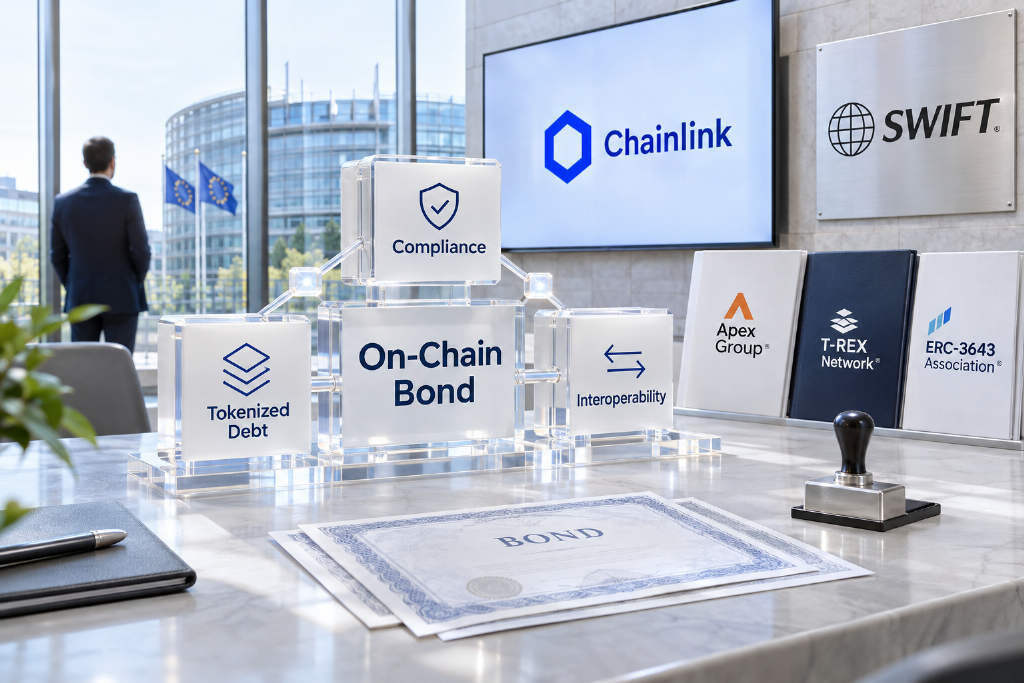
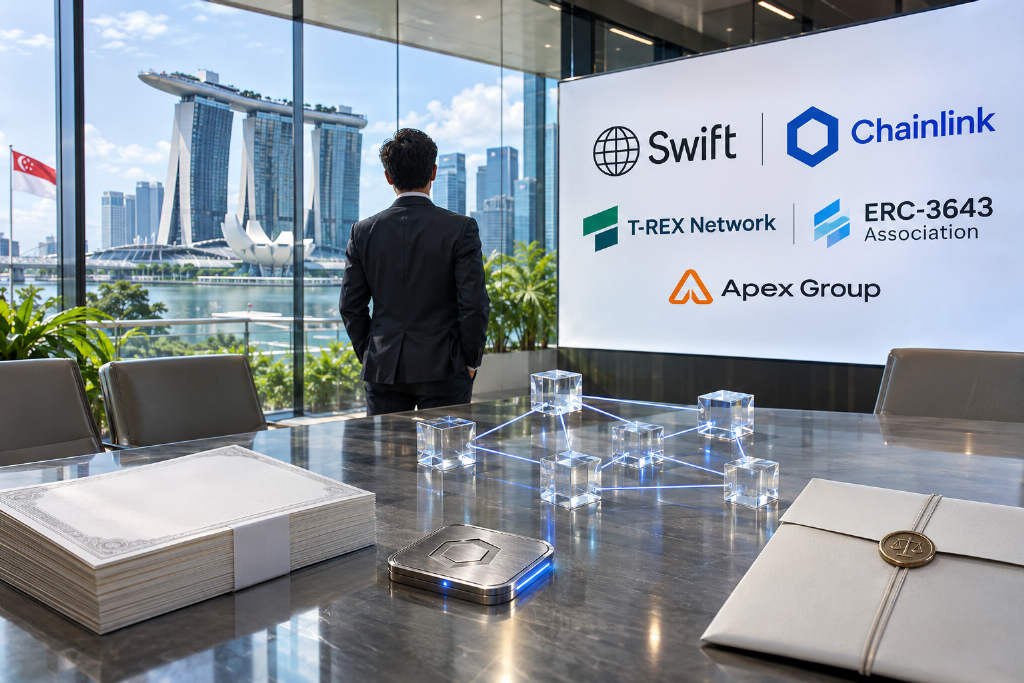
A modular compliance framework for on-chain bonds aligned with Swift standards has been launched by Apex Group, Chainlink, T-REX Network, and the ERC-3643 Association. The setup combines regulated asset servicing, ERC-3643 asset-level identity, eligibility and transfer rules, along with Chainlink Cross-Chain Interoperability Protocol (CCIP) and the Automated Compliance Engine (ACE). According to the announcement, this allows compliance requirements to be deployed once and reused across multiple blockchains. As part of the initiative, Swift has joined the ERC-3643 Association. The participating groups also plan to showcase an end-to-end digital asset workflow at the Singapore FinTech Festival.

660
Swift joins ERC-3643 Association as on-chain bond compliance framework aligned with Swift standards goes live
Apex Group
Nov 4, 2026

Apex Group and Chainlink back modular compliance framework for onchain bonds

Apex Group, Chainlink and organizations focused on compliant tokenization have introduced a modular compliance framework for onchain bonds, according to a Techub News brief citing Finextra. The framework is aligned with Swift standards and is designed to connect established practices from traditional financial markets with programmable compliance tools and interoperable blockchain infrastructure. Participants named in the initiative include T-REX Network and the ERC-3643 Association. The announcement centers on how bond issuance and related processes onchain can be structured around compliance requirements while remaining compatible with standards used in mature financial markets. The brief did not disclose additional technical specifications, launch timelines or product-level details beyond the participating groups and the framework’s alignment with Swift.

720
Apex Group and Chainlink back modular compliance framework for onchain bonds
OpenTrade
Oct 29, 2026

Former Swift CEO Lazaro Campos becomes OpenTrade chairman

Former Swift CEO Lazaro Campos has joined stablecoin firm OpenTrade as chairman, according to CoinDesk. The London-based company said it has reached $300 million in assets locked and is processing more than $1 billion in annual transaction volume. The appointment comes after OpenTrade completed a $17 million raise, adding a senior financial infrastructure executive to its board as the company reports growth in both locked assets and transaction activity. The report identifies OpenTrade as a stablecoin firm based in London and ties the board appointment to the company’s latest disclosed operating figures.

890
Former Swift CEO Lazaro Campos becomes OpenTrade chairman
Gate Money
Oct 29, 2026

Gate Money cuts fees for USD same-name accounts and withdrawals

Gate Money has revised the fee schedule for its U.S. dollar same-name accounts, according to an official announcement cited by ChainCatcher. The service will continue to offer free account opening, while the monthly account management fee has been reduced from 2 USDT to 1 USDT. The withdrawal fee for U.S. dollars has also been lowered from 50 USDT per transaction to 25 USDT, marking a 50% cut for both charges. The company also said users at VIP 5 level and above will receive a full waiver on account management fees. Gate Money currently supports cross-border deposits and withdrawals via SWIFT for four fiat currencies: USD, EUR, GBP, and AED. Eligible users can open a U.S. dollar bank account under their own name with one click and use the Gate App for fund transfers, asset conversion, yield management, and daily payments. In addition, Gate Money has launched a limited-time account-opening campaign running until 16:00 on Nov. 11 (UTC+8). Users who register, complete identity verification, open a USD same-name account for the first time, and finish a valid bank transfer may receive a random reward ranging from 2 USDT to 100 USDT. Specific terms remain subject to the official announcement.

730
Gate Money cuts fees for USD same-name accounts and withdrawals
Chainlink
Oct 26, 2026

Alea says bank-built blockchains are turning fragmentation into a business tailwind for Chainlink

Alea Research argues that tokenization is not pushing finance toward a single shared blockchain. The report says the opposite is happening: banks are building their own tokenized deposit chains, Swift is rolling out a shared ledger with 17 banks, and the Depository Trust & Clearing Corporation, or DTCC, is already running production-grade tokenized securities activity across Besu and Canton. In that setup, every new chain creates another connection point that institutions must secure while keeping control of private keys, compliance rules, and internal risk processes. That is where Alea places Chainlink. The report says Chainlink Runtime Environment, or CRE, and CCIP 2.0 are becoming core infrastructure for linking bank systems to multiple blockchains without giving up control over signing and policy enforcement. It points to DTCC’s collateral workflow, where CRE is set to support eligibility checks, valuation, margining, settlement, and post-trade processes on the planned Collateral AppChain in the fourth quarter. The report also highlights distribution through existing bank software channels, including Bottomline and Infosys. Alea further says Chainlink’s Payment Abstraction mechanism is creating a direct path from protocol revenue to LINK accumulation. As of Sept. 30, the reserve held 6.05 million LINK, up 34.3% in the quarter, with weekly Thursday deposits continuing to add to the balance.

1330
Alea says bank-built blockchains are turning fragmentation into a business tailwind for Chainlink
stablecoins
Oct 16, 2026

Borderless says median cost of sending a $200 remittance through stablecoin rails is 1%

A third-quarter report from stablecoin payments network Borderless.xyz said the median cost of sending a $200 remittance through stablecoin payment rails was 1%, or $2. Using World Bank data as a benchmark, the report compared that with a 6.36% median cost, or $12.72, for traditional remittance channels. On that basis, stablecoin-based remittances were about 84% cheaper. The comparison used Borderless pricing from the third quarter of 2026 and World Bank data from the same period in 2025. The report also broke out figures for emerging markets, where costs in Sub-Saharan Africa were 2.9% for stablecoin transfers versus 8.46% for traditional transfers, and 1.25% versus 5.64% in Latin America. For business payments, a $10,000 stablecoin transfer into the euro area cost as little as $26 with the cheapest provider and $52 at the median provider, versus $135 to $150 for a traditional international wire, including transfer fees and a 1% FX spread. Borderless also reported settlement times of minutes to local bank accounts and listed success rates across PIX, SPEI, PSE and SINPE. Separately, Standard Chartered said stablecoin transaction volume is still rising and projected the market would reach $2 trillion by 2030.

1170
Borderless says median cost of sending a $200 remittance through stablecoin rails is 1%
stablecoins
Oct 16, 2026

Report says stablecoin remittances are about 84% cheaper than traditional transfers

Stablecoin-funded remittances remain far cheaper than traditional money transfers, especially in emerging markets, according to a new third-quarter report from Borderless.xyz. The report says sending a $200 remittance through stablecoin payment rails carries a median cost of 1%, or $2, versus 6.36%, or $12.72, for traditional remittances based on World Bank data. That puts the stablecoin route at roughly 84% lower in cost, though the comparison uses Borderless pricing from the third quarter of 2026 and World Bank figures from the same period in 2025. The report also points to lower costs for business payments. A $10,000 transfer to the eurozone funded by stablecoins can cost as little as $26 with the lowest-cost provider, or $52 at the median provider across corridors. A traditional international wire for the same amount costs $135 to $150, including transfer fees and an assumed 1% FX margin. Borderless also found that payouts into local bank accounts can settle within minutes on networks such as Brazil’s PIX, Mexico’s SPEI and Colombia’s PSE, while completion rates differ widely across those systems.

980
Report says stablecoin remittances are about 84% cheaper than traditional transfers
A7
Oct 13, 2026

Russia’s A7 to launch A7 International on Oct. 13 for USDT-based trade settlements

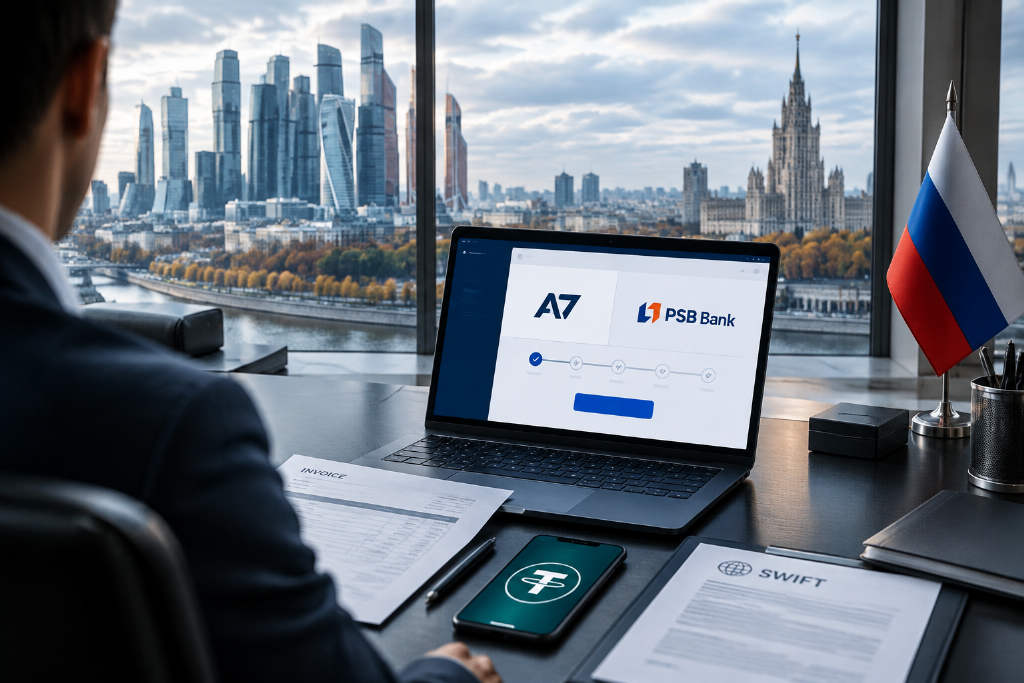
Russia’s international settlement system A7, created by Bank PSB, is set to launch A7 International on Oct. 13. The service is aimed mainly at foreign trade operators, though individuals will also be able to use it, with a fixed fee of 0.3%. A7 International will let users pay counterparties’ foreign-currency invoices in USDT, after which the funds will be delivered in the required currency through a standard SWIFT bank transfer. PJSC Bank PSB Chairman Petr Fradkov and A7 Chief Executive Officer Ilan Shor are scheduled to present the product at 13:13 on Oct. 13. A7 said it focuses on international trade payments and settlements and was established in 2024 with the participation of PSB Bank. The company said it is building payment infrastructure in more than 100 countries. Its products include international payments, digital financial assets and promissory notes. A7 said it serves 15,000 clients and processes about 2,000 transactions a day. In 2025, about 19% of Russian companies’ cross-border trade settlements were handled through A7, and in October that year it received an AA(RU) credit rating with a stable outlook from ACRA.

940
Russia’s A7 to launch A7 International on Oct. 13 for USDT-based trade settlements
Total 98 items
Go topage