GTA 6
Nov 5, 2026

GTA 6 preload moved up to Nov. 10, with download size reaching 212GB

Rockstar has moved up digital preloads for Grand Theft Auto VI by two days, setting the new start date at Nov. 10 instead of the previously announced Nov. 12. The company said the preload file may require as much as 212GB of storage, depending on the device. In Taiwan, PlayStation 5 users can begin downloading at 12:00 a.m. local time on Nov. 10, while Xbox Series X|S users will have to wait until 8:00 a.m. the same day because Xbox is using a global launch time tied to GMT. The game is scheduled to launch on Nov. 19 for PS5 and Xbox Series X|S, with no PC version announced. Rockstar and Take-Two also confirmed that the physical edition does not include a disc. Instead, it comes with a download code inside the box, and retail copies will not be available until Nov. 12. That means buyers of either version will still need to download the full game. The announcement has also drawn attention to storage limits across current consoles, especially for lower-capacity models such as the 512GB Xbox Series S.


510
GTA 6 preload moved up to Nov. 10, with download size reaching 212GB
Policy Regulation
Nov 5, 2026

Taiwan solar names gain after Democrats take Congress as market eyes a U.S. green policy rebound

Taiwan’s solar stocks outperformed after Democrats won control of both chambers of the U.S. Congress in the midterm elections, fueling expectations that support for renewable energy policy in the United States could strengthen again. On a day when Taiwan equities fell sharply, Giga Solar, United Renewable Energy, Gwo Hwa Energy and TSEC posted stronger share performance, with Giga Solar and United Renewable Energy already moving ahead with module manufacturing plans in the U.S. According to a report cited from Commercial Times, investors linked the election result to a potentially friendlier policy setting for renewables, low-carbon infrastructure and grid upgrades. The report also said U.S. renewable energy stocks moved higher after the vote. Giga Solar said its first 500MW phase in the U.S. is fully loaded, while an additional 1GW phase entered mass production in October. United Renewable Energy, together with Sino-American Silicon Products, plans a 1GW U.S. module plant that is scheduled to begin production next year. Still, market participants cautioned against assuming an immediate policy shift. Trump has two years left in office, and rising electricity demand from AI data centers may be difficult to meet with renewables alone. That leaves open the possibility that future U.S. energy policy could develop along both renewable and nuclear tracks rather than relying on green energy alone.

560
Taiwan solar names gain after Democrats take Congress as market eyes a U.S. green policy rebound
Policy and Regulation
Nov 4, 2026

Taiwan temple case puts focus back on religious foundations and crypto in money laundering probes

A money laundering investigation in Yilan has renewed scrutiny of how religious organizations are treated in Taiwan’s anti-money laundering framework. Prosecutors said a father and son linked to Donglin Temple in Dongshan Township are suspected of misappropriating donations from followers and laundering funds through purchases of gold, silver, and virtual assets. The pair were ordered detained without visitation on Nov. 3, and the case has not yet been indicted. The case surfaced alongside a broader policy question: whether religious entities are especially vulnerable to abuse. Taiwan’s 2024 National Risk Assessment classified 201 nationwide religious foundations as “higher risk,” the same rating used in the 2021 edition. The report cited anonymous donations and some exposure to high-risk countries or regions, but it did not provide statistics on the share of money laundering cases involving religious groups and did not separately assess local temples. The report also kept the virtual asset sector at “very high” vulnerability and the jewelry and precious metals trade at “high.” At the same time, religious groups are not listed as regulated entities under Article 5 of Taiwan’s Money Laundering Control Act, while virtual asset service providers and gold shops are covered under the law.

460
Taiwan temple case puts focus back on religious foundations and crypto in money laundering probes
stablecoin debit cards
Nov 4, 2026

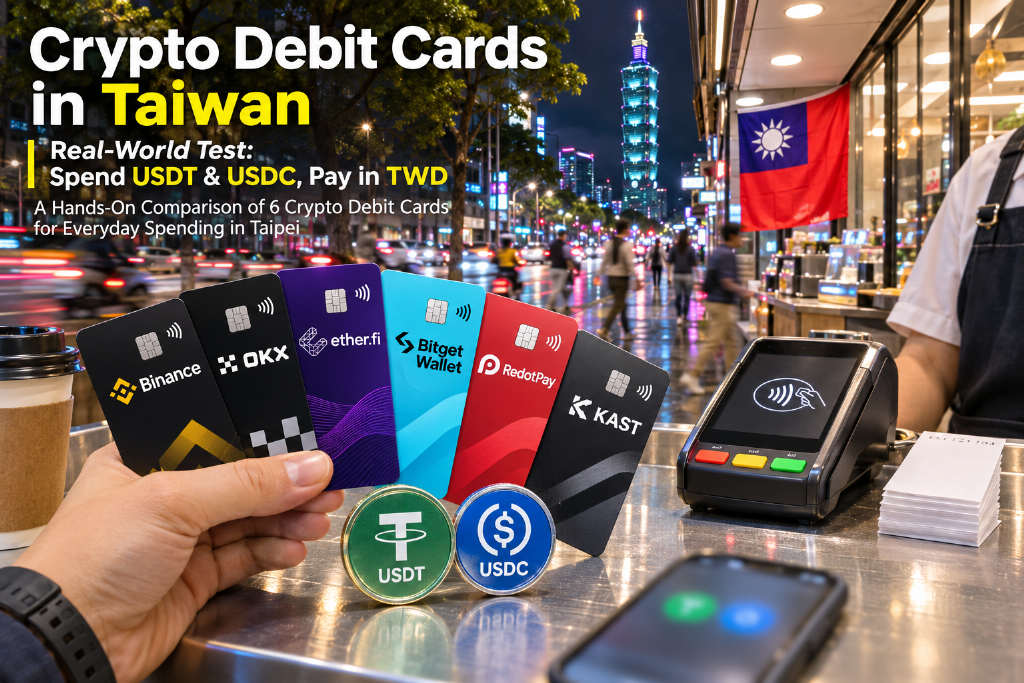
Taiwan U-card comparison reviews 6 stablecoin debit cards for TWD spending in 2026

ABMedia has published a detailed comparison of six stablecoin-funded debit cards widely discussed by users in Taiwan: Binance Card, OKX Card, Ether.fi, Bitget Wallet Card, RedotPay, and KAST. The report, based on official documentation and tests conducted by ChainNews, compares annual fees, issuance fees, foreign exchange charges, cashback structures, mobile wallet support, and physical card availability as of Nov. 2, 2026. The article’s main takeaway is that TWD spending costs cannot be judged by reward rates alone. In one ChainNews test, a NT$1,527 purchase made with Binance Card ended up costing about 3% more than first selling USDT for TWD on a local exchange and then paying in cash. The report also notes that most U cards are debit cards rather than credit cards, usually settle in U.S. dollars, and may charge FX or conversion fees when used in Taiwan. Paymentscan data cited in the piece shows tracked U-card spending reached about $1.37 billion in October 2026 across 12.94 million transactions and roughly 363,000 active addresses, up from $464 million a year earlier. ABMedia says the market is likely larger because exchange-issued cards such as Binance Card are not fully captured in that dataset.

330
Taiwan U-card comparison reviews 6 stablecoin debit cards for TWD spending in 2026
Bank SinoPac
Nov 3, 2026

Sinopac hit by 427 suspicious transfers totaling over NT$40 million

Taiwan’s Bank SinoPac was hit by a large-scale unauthorized transfer incident, according to a report by CNA cited by ChainCatcher. A preliminary investigation found 427 suspicious transactions, with each transfer worth about NT$100,000. The total amount involved exceeded NT$40 million. The incident affected 419 customers. Funds linked to the suspicious transfers were all sent to a single account at Taipei Fubon Bank. That account has been temporarily frozen. The report did not disclose further details on how the transfers were carried out or whether the affected customers have recovered the funds. The case was described as a large-scale account anomaly involving Bank SinoPac in Taiwan.

360
Sinopac hit by 427 suspicious transfers totaling over NT$40 million
TSMC
Nov 3, 2026

TSMC prices NT$14.8 billion green bond for green building and environmental spending

Taiwan Semiconductor Manufacturing Co. (TSMC) has priced its fourth unsecured straight corporate bond of year 115, structured as a green bond, with a total issuance size of NT$14.8 billion. The deal is split into two tranches: NT$12.4 billion in five-year notes carrying a fixed annual coupon of 2.30%, and NT$2.4 billion in 10-year notes at 2.42%. Both tranches are issued at par with a face value of NT$10 million per bond. Taishin Securities is serving as lead underwriter, while Taipei Fubon Commercial Bank is acting as trustee. TSMC said the proceeds will be allocated to green buildings and environmentally related expenditures as it continues expanding advanced process capacity and advancing its ESG and carbon-reduction plans. The bonds do not include conversion, exchange, or equity subscription features, meaning they are plain-vanilla debt instruments with no dilution effect on existing shareholders or earnings per share. ABMedia said the issuance follows green bond standards tied to the International Capital Market Association’s Green Bond Principles and TPEx rules in Taiwan.

470
TSMC prices NT$14.8 billion green bond for green building and environmental spending
Bank SinoPac
Nov 3, 2026

Sinopac users report unauthorized NT$100,000 transfers, with no official confirmation yet

Multiple Bank SinoPac users in Taiwan said on Nov. 3 that NT$100,000 was transferred out of their accounts without their authorization, with the funds reportedly sent to accounts at Taipei Fubon Bank. The claims were posted by users on Threads and PTT, and had not been publicly confirmed by Bank SinoPac as of publication. One user said the transfer was authenticated through facial verification even though they had not opened the banking app, while another said customer service acknowledged a transfer record but could not explain how it happened. The report also noted that Bank SinoPac’s published rules require non-designated transfers to be made on a previously bound mobile device, and FIDO biometric verification must also be enabled on a bound phone. Users were advised to review transaction records, verify which phones are linked to their accounts, lower daily transfer limits if needed, and report any suspicious activity to the bank, the 165 anti-fraud hotline, and local police. Authorities and related institutions had not issued public statements at the time of writing.

440
Sinopac users report unauthorized NT$100,000 transfers, with no official confirmation yet
Binance
Nov 2, 2026

Binance rolls out post-hack campaign, but the 100 USDC voucher only offsets trading fees

Binance has launched a Community Appreciation Campaign after its hot wallet hack on Oct. 30 and the reopening of withdrawals on Nov. 1, when users withdrew about $4.4 billion on the first day back. The campaign runs until 07:59 Taiwan time on Nov. 22, but it is not a cash compensation plan tied to the hack. Binance had already said losses from the incident would be covered by its SAFU fund and company capital. The promotion includes three parts: a 100 USDC rebate voucher, a 20 million USDC trading prize pool, and boosted yields on selected stablecoin wealth products. The voucher is not credited directly to user balances. Instead, it rebates 30% of spot trading fees, after referral commissions are deducted, and pays the amount in USDC the next day. The trading pool requires at least $10,000 in cumulative eligible volume, with rewards capped at 4,000 USDC per user. Yield boosts apply only to new subscriptions made after the campaign starts and are subject to quota limits. Taiwan is not listed among the explicitly excluded jurisdictions, though Binance says eligibility still depends on regional restrictions and reserves the right to verify user location and disqualify participants.

640
Binance rolls out post-hack campaign, but the 100 USDC voucher only offsets trading fees
Total 181 items
Go topage