Bitcoin
Aug 14, 2026

Public Bitcoin Miners Cut Hashrate as AI and HPC Revenue Overtake Mining at Some Firms

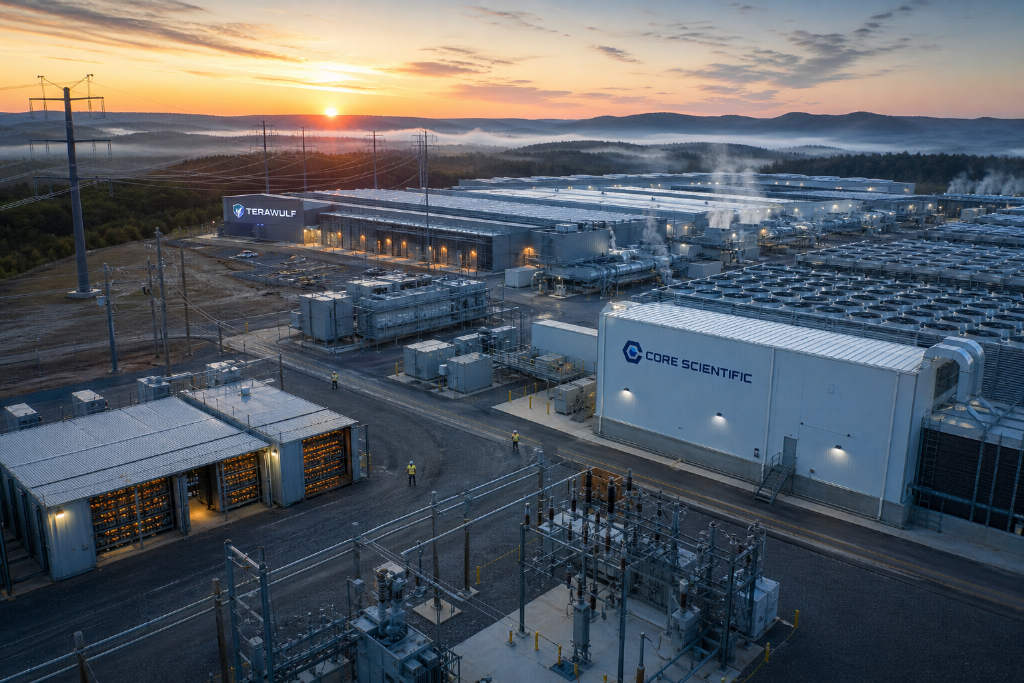
Publicly listed Bitcoin mining companies reduced their combined operating hashrate by 13.4% from 2025 Q4 to 2026 Q2, a steeper decline than the 10.6% drop recorded across the broader Bitcoin network over the same period, according to BlocksBridge Consulting’s latest Miner Weekly. Excluding Bitdeer, the pullback was much sharper, with hashrate falling 21.2% from 324.6 EH/s to 255.9 EH/s. The report says the shift was not driven by a collapse in Bitcoin’s price. Instead, several large miners have been reallocating power capacity and data center infrastructure toward AI data center and high-performance computing, or HPC, workloads. Financial results from Core Scientific and TeraWulf show how far that change has progressed: in the second quarter, both companies generated more revenue from AI- or HPC-related business lines than from Bitcoin mining. Core Scientific posted $136.7 million in AI hosting revenue versus $27.5 million from mining, while TeraWulf reported $31.9 million in HPC leasing revenue and $12.8 million from mining. The broader question now is how far this reallocation of energy, facilities, and capital will go, and what it means for the economics and valuation framework of public Bitcoin miners.
2040
Public Bitcoin Miners Cut Hashrate as AI and HPC Revenue Overtake Mining at Some Firms
Bitcoin miners
Aug 9, 2026

Bitcoin miners’ AI pivot faces a tougher Wall Street test as earnings show who has revenue and who is still building

Bitcoin miners have spent the past year pitching artificial intelligence and high-performance computing as the next phase of their business. The latest earnings season shows that investors are no longer rewarding the theme on rhetoric alone. Blocksbridge Consulting said the average absolute stock move tied to early AI business announcements once reached 24.1%, but comparable disclosures now trigger moves of about 10.2%. At the same time, the economics of AI and HPC hosting have improved, with annualized revenue per megawatt rising from roughly $1.67 million to about $1.9 million. A review of five major miners shows sharply different stages of execution. MARA is still in buildout mode, with AI/HPC contributing almost no revenue. Core Scientific has already shifted most of its revenue mix toward hosting, while TeraWulf’s HPC leasing business has become its main revenue source. Hut 8 has commercialized its first gigawatt-scale AI campus and lined up large project financing. CleanSpark has signed a $6.6 billion lease tied to its Sandersville project, but AI revenue has yet to arrive. Across the group, high capital spending, wider losses and long construction timelines remain common. The market focus has moved to tenant quality, delivery milestones and whether signed capacity can turn into real cash flow.

2900
Bitcoin miners’ AI pivot faces a tougher Wall Street test as earnings show who has revenue and who is still building
Bitcoin miners
Aug 7, 2026

Bitcoin Miners Pile Into AI, But Wall Street Cools on Valuations

According to MarsBit's market analysis, Bitcoin mining companies are collectively pivoting toward AI and high-performance computing (HPC) infrastructure builds. However, the valuation enthusiasm that accompanied this shift is now cooling on Wall Street. Investors are shifting their focus to hard evidence: actual revenue contributions, project delivery capabilities, and cash flow generation. The ongoing earnings season has brought this divergence into sharp relief. Core Scientific and TeraWulf have advanced far enough that AI-related business now dominates their revenue. In contrast, MARA and CleanSpark remain in the construction phase, having yet to record any income from their AI ventures. The market's yardstick for measuring the success of this transformation is moving away from narrative-driven speculation and toward verifiable, quantitative metrics. The title itself asks a pointed question: who is swimming naked when the tide of hype recedes? In other words, as the sector matures, companies will be judged solely on execution and financial discipline. MarsBit's analysis highlights that the reporting season is a critical checkpoint for distinguishing between miners with real AI revenue and those still relying on promises. The key takeaway: while the mining-to-AI pivot continues, the market is now rewarding only concrete progress and penalizing those who lack tangible results. This analysis touches on the key developments that are determining which miners are genuinely building substantial businesses and which are still living on promises.

2500
Bitcoin Miners Pile Into AI, But Wall Street Cools on Valuations
TeraWulf
Aug 5, 2026

TeraWulf Posts $44.8M Q2 Revenue as HPC Leasing Hits 71% of Total

TeraWulf reported Q2 2026 revenue of $44.767 million, with HPC leasing contributing $31.932 million, or roughly 71% of total revenue. The company has 102 MW of revenue-generating IT capacity live at its Lake Mariner site in New York, with 336 MW under construction. It closed the acquisition of Kentucky's Muskie Data Campus, securing up to 1 GW of power, and signed a 20-year lease with Anthropic for about 401 MW at its Justified campus, with an initial contract value of roughly $19 billion. TeraWulf also agreed to sell its 50.1% stake in the Abernathy JV for $530 million in cash and reaffirmed its annual target of 250-500 MW of newly contracted IT capacity.

3190
TeraWulf Posts $44.8M Q2 Revenue as HPC Leasing Hits 71% of Total
TeraWulf
Aug 5, 2026

TeraWulf reports $44.8 million in Q2 revenue and discloses roughly $19 billion Anthropic lease deal

Bitcoin miner TeraWulf reported $44.8 million in revenue for the second quarter of 2026, with $31.9 million coming from high-performance computing leasing, or about 71% of the total. The company said it held about $3 billion in cash and restricted cash, which it said would support projects under construction and future expansion. At Lake Mariner, revenue-generating critical IT capacity stood at 81 megawatts as of June 30 and increased to 102 megawatts after CB-3 was delivered in early July. TeraWulf said that milestone also satisfied conditions tied to Google providing $600 million in credit support for Fluidstack’s lease obligations. The company also outlined several strategic developments, including a roughly $19 billion lease agreement with Anthropic through the Justified campus in Kentucky, the acquisition of the gigawatt-scale Muskie data center campus, and a power service and related infrastructure agreement with Kentucky Utilities for up to 1 gigawatt. In addition, TeraWulf agreed to sell its interest in the Abernathy joint venture for about $530 million and reiterated its target of signing 250 to 500 megawatts of incremental critical IT capacity each year.

2300
TeraWulf reports $44.8 million in Q2 revenue and discloses roughly $19 billion Anthropic lease deal
Total 49 items
Go topage