Thailand
Sep 1, 2026

Thailand adopts crypto Travel Rule, adds checks for self-custodial wallets

Thailand’s Securities and Exchange Commission has finalized new Travel Rule requirements for the country’s digital asset sector, bringing self-custodial wallets into the compliance perimeter. Under the new framework, digital asset operators must collect information on parties involved in crypto transfers and verify ownership or control of self-hosted wallets when customers send funds to or receive funds from them. The rules take effect on Feb. 27, 2027, giving firms close to six months to build systems for transmitting, receiving and monitoring transaction data. Operators will also need to retain information accompanying each digital asset transfer for at least five years and provide records for regulatory review. The SEC said the rules are intended to reduce the risk that digital asset operators could be used for money laundering and terrorist financing. The final framework follows two rounds of public consultation this year, beginning with proposed principles in March and a draft notification in June, with the regulator saying most stakeholders backed the proposals. The move comes as Thailand is also weighing broader access to other regulated crypto products, including a proposal to let intermediaries offer certain overseas-listed crypto derivatives to retail investors and draft rules covering spot Bitcoin and Ether exchange-traded funds, along with requirements for foreign digital asset custodians used by crypto investment funds.

870
Thailand adopts crypto Travel Rule, adds checks for self-custodial wallets
Thailand
Sep 1, 2026

Thailand SEC Proposes Retail Access to Certain Offshore Crypto Derivatives

Thailand's Securities and Exchange Commission (SEC) has proposed letting intermediaries offer retail investors certain digital-asset derivatives traded overseas. Under the draft plan, eligible products would need to resemble crypto derivatives already traded locally, matching underlying assets, tenor, leverage and settlement terms, and must be listed on exchanges that use central counterparty clearing and are overseen by regulators belonging to recognized international bodies. Products that fall short would be open only to institutional investors. The SEC said institutions are better equipped to assess and manage complex, high-risk instruments. Current rules only allow intermediaries to serve retail and high-net-worth clients when offshore derivatives are similar to domestic products; the regulator argues the wide variation in overseas crypto derivatives calls for bespoke rules. The consultation is part of Thailand's broader effort to bring crypto-linked products into the regulated capital market. The SEC designated cryptocurrencies and digital tokens as permissible derivative underlyings on March 5 and is in talks with the Thailand Futures Exchange over contract specifications. The public consultation runs until Sept. 30; no implementation date has been announced.

1210
Thailand SEC Proposes Retail Access to Certain Offshore Crypto Derivatives
United States
Aug 31, 2026

U.S. weighs new AI export curbs to block China from renting chip compute through third countries

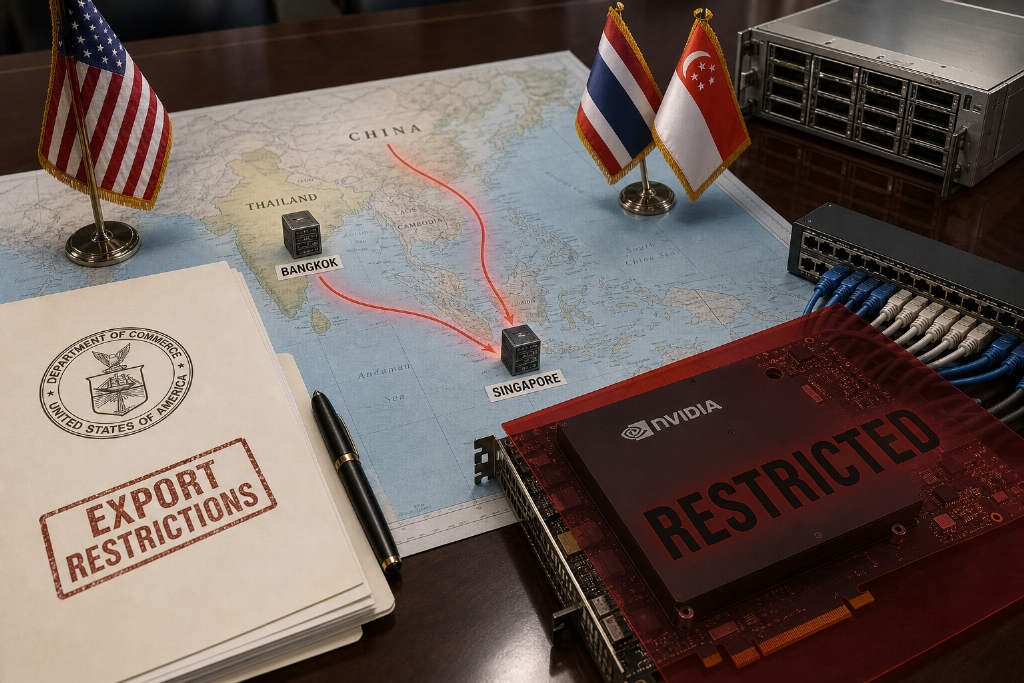
The Trump administration is drafting a new set of AI export control rules aimed at closing a gap that has allowed Chinese users to access U.S. chip compute by renting cloud servers in third countries such as Thailand and Singapore, according to The Information. The U.S. Commerce Department could send a draft to industry groups for comment as early as September. Current controls, built around rules issued in 2022, mainly target the physical export of advanced AI chips and semiconductor manufacturing equipment, including EUV tools, leaving remote access through overseas data centers in a gray area. The report says a dispute tied to Moonshot AI’s Kimi K3 model helped push the effort forward after White House Office of Science and Technology Policy Director Michael Kratsios accused the company in July of distilling U.S. models through Nvidia-equipped servers in Thailand. Even if a rule is written, its legal footing may be challenged, as one Baker McKenzie lawyer told The Information that the Commerce Department is traditionally set up to regulate shipments of goods rather than remote logins to servers. The report also notes that KYC-style checks by cloud providers remain another possible route, though a related due diligence rule from the Biden era is also not being enforced.

1770
U.S. weighs new AI export curbs to block China from renting chip compute through third countries
Binance
Aug 19, 2026

Binance sets 2026 Blockchain Week in Bangkok with $19 early-bird tickets

Binance said its 2026 Binance Blockchain Week will take place on Nov. 28-29, 2026, at the Queen Sirikit National Convention Center in central Bangkok, bringing the exchange’s flagship event back to Asia after editions in Singapore, Istanbul, Paris and Dubai. The company said the two-day gathering will bring together thousands of developers, institutional investors, fintech leaders and policymakers to discuss the next stage of digital asset development as traditional finance and crypto draw closer. The event will carry the theme “EVOLVE,” which Binance said reflects a maturing industry in 2026. Topics listed by the company include bitcoin’s continued expansion in institutional markets, stablecoins as payment infrastructure, the institutional evolution of DeFi, tokenization of real-world assets, tokenized stocks, cross-border payments, AI integration and regulatory frameworks that can support responsible scaling. Binance Co-CEO Richard Teng and Co-Founder and Co-CEO Yi He are expected to speak, alongside Eowyn Chen, SB Seker, Catherine Chen and Thomas Gregory. Binance also said early-bird tickets are now on sale for $19. The material was provided by Binance and was first published by Blockcast.

2380
Binance sets 2026 Blockchain Week in Bangkok with $19 early-bird tickets
Policy and Regulation
Aug 7, 2026

Dow Protocol denies OKX Ventures backing as U.S. Senate delays Clarity Act vote to September

A busy news cycle from Aug. 6 to Aug. 7 brought a mix of crypto regulation, market structure, corporate disclosures, and AI-linked developments. Dow Protocol said claims that OKX Ventures had invested in the project were false and said a list of investors would be released this week without OKX Ventures on it. The U.S. Senate, meanwhile, decided to delay a vote on the Clarity Act until September, extending uncertainty around a major federal crypto bill. Outside Washington, Thailand confirmed a five-year capital gains tax exemption on crypto trades executed through Thai SEC-licensed venues from Jan. 1, 2025 through Dec. 31, 2029. MetaMask introduced a self-custodial AI wallet that lets agents execute on-chain transactions within user-defined limits, and Wintermute registered a broker-dealer subsidiary with the U.S. Securities and Exchange Commission and FINRA. The update set also included Binance Alpha’s AGT and AIA blind box airdrop, Cipher Digital’s sale of 1,619 BTC at a realized loss, a Chainalysis report on more than $30 million in violent robbery losses targeting crypto holders in the first half of 2026, Bernstein’s renewed $140 target on Circle, and several funding, hardware, and security stories tied to the broader AI sector.

3400
Dow Protocol denies OKX Ventures backing as U.S. Senate delays Clarity Act vote to September
Thailand
Aug 6, 2026

Thailand Confirms Crypto Trading Capital Gains Tax Exemption Through 2029

Thailand’s Ministry of Finance has confirmed a five-year capital gains tax exemption for cryptocurrency trading, running from Jan. 1, 2025 to Dec. 31, 2029. The policy applies only to trades executed through exchanges, brokers or dealers licensed by Thailand’s SEC. Mining and staking income will still be taxed, while the ministry said the move could generate about $1 billion a year in tax revenue through higher market activity, foreign investment and domestic spending.

2090
Thailand Confirms Crypto Trading Capital Gains Tax Exemption Through 2029
Total 53 items
Go topage