Solana
Nov 2, 2026

Solana reaches 1,000 days without a network-wide outage

Techub, citing U.Today, reported that the Solana network has gone 1,000 days without a full network-wide outage. The project had previously said the network maintained 100% uptime. The report also revisited Solana’s earlier instability, noting that the chain had suffered multiple full outages in its early period due to traffic surges, bugs, and abnormal block propagation. In a separate incident, Solana said a routing failure at a major infrastructure provider caused validators representing about 29% of staked SOL to go offline, though block production did not stop. The update focuses on network reliability and distinguishes between validator disruption and a chain-wide halt.

700

Solana reaches 1,000 days without a network-wide outage
elizaOS
Nov 2, 2026

elizaOS founder is reverse-engineering Hyperliquid’s closed node, report says

Principia Research said elizaOS founder Shaw is reverse-engineering Hyperliquid’s closed node on GitHub. The effort has been running for six days and has drawn 46 contributors so far, but none of its 96 verification checkpoints has been cleared yet. At the same time, data from Hyperliquid’s public API shows the network has 27 active validators. Of those, five foundation-operated nodes control 47.4% of the staked share. The top three validators together account for 36%, or more than one-third of the total. Those figures have sparked discussion outside the project over how decentralized the Hyperliquid network is. The update was cited by Odaily in a 7x24 newsflash and attributed to Principia Research.

1050
elizaOS founder is reverse-engineering Hyperliquid’s closed node, report says
XRP Ledger
Nov 2, 2026

XRP Ledger token-permission amendment expected to go live Wednesday

An amendment related to token permissions on the XRP Ledger is expected to be activated on Wednesday, according to ChainCatcher. The proposal has so far received support from 33 of 35 trusted validators, putting it in position for activation. At the same time, a separate proposal designed to block unapproved token holders is still under review and has not yet moved into the activation stage. The update points to progress on one governance change while a related but independent measure remains pending. No additional activation details were provided in the source report.

420
XRP Ledger token-permission amendment expected to go live Wednesday
Solana
Nov 2, 2026

Solana validator relations lead warns of unpatched Ubuntu vulnerability

Tim Garcia, head of validator relations at the Solana Foundation, warned validators about CVE-2026-98432, saying the flaw has been fixed in the Linux kernel but remains unpatched on Ubuntu. His notice was directed at validators running Ubuntu systems. Garcia said those operators should apply temporary mitigations for now. The steps he listed were blocking inbound TCP packets that contain IPv4 options through nftables, disabling Multipath TCP, or MPTCP, and disabling TCP request socket migration. The warning was posted on X and focused on operational precautions for validators until Ubuntu addresses the issue.

860
Solana validator relations lead warns of unpatched Ubuntu vulnerability
Solana
Nov 2, 2026

Anza tells Solana validators to mitigate critical Linux flaw

Anza has urged Solana validators to take immediate precautions over a critical Linux vulnerability affecting Ubuntu operators. According to TheDefiant, node operators were told to put temporary safeguards in place while waiting for a patched kernel. The guidance included filtering incoming traffic and disabling two networking features. The report focused on operational steps for validators rather than broader market effects, and the currently available information did not specify the names of the two networking features or provide additional technical details about the flaw. The notice centers on short-term risk reduction for infrastructure running on Ubuntu until an official kernel fix becomes available.

720
Anza tells Solana validators to mitigate critical Linux flaw
Ethereum
Oct 29, 2026

Teku and Besu update Docker images to address weak certificate key risk

Ethereum validator clients Teku and Besu have updated their Docker images to address a risk tied to weak certificate keys, according to Techub News, which cited Crypto.news. The issue affects some Ethereum validator setups and centers on connections to external services. For operators, the main question is whether their software could accept forged certificates. The update is aimed at reducing that exposure in affected environments. No further technical details, scope figures, or remediation timeline were disclosed in the source brief.

670
Teku and Besu update Docker images to address weak certificate key risk
Ethereum
Oct 29, 2026

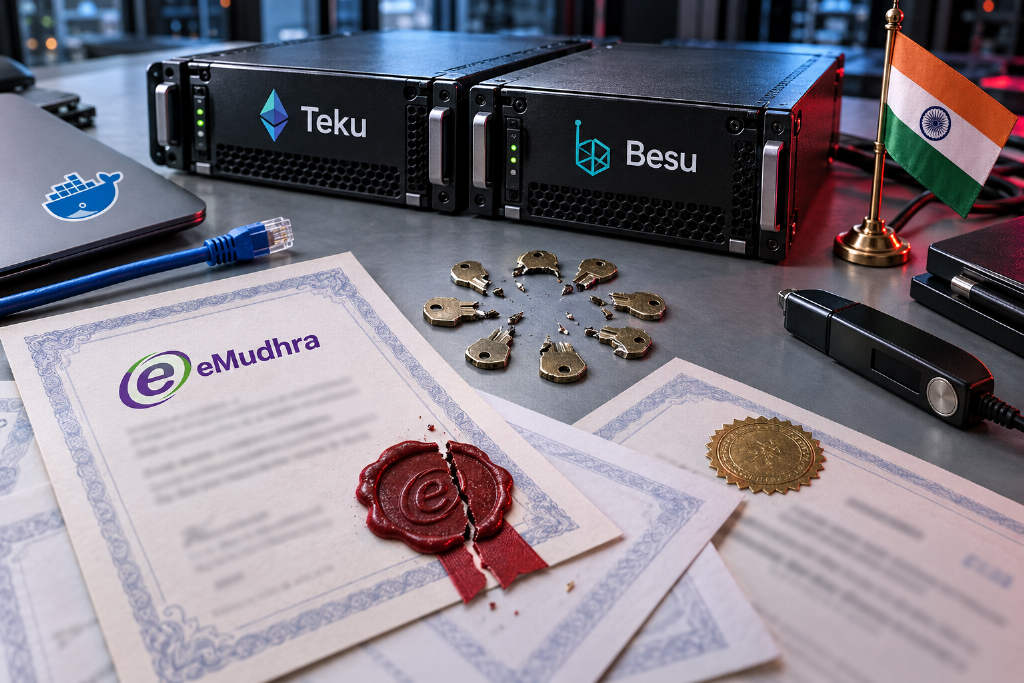
eMudhra certificate flaw affects Ethereum clients Teku and Besu

An encryption security flaw tied to Indian certificate authority eMudhra has affected Ethereum clients Teku and Besu, according to ChainCatcher. Researchers said private keys for eight intermediate certificate authorities under eMudhra may be derivable because of insufficient randomness. That could let an attacker forge certificates and trick unpatched software into trusting malicious services. Teku has released version 26.1.3 and Besu has released version 26.1.2, with both removing trust in the affected certificates from their Docker images. The reported risk includes potential man-in-the-middle attacks that could cause some validators to send block fee rewards to an attacker-controlled address, with higher exposure in certain setups using an external signer. Teku said Ethereum mainnet Teku nodes running the default configuration are not affected and do not need to take action. It also said there have been no reports of the flaw being exploited so far. Operators running Teku or Besu directly on hosts without Docker may need to update Java and its trusted certificate store manually, while those still using unsupported Java 26 need to migrate to Java 25.

850
eMudhra certificate flaw affects Ethereum clients Teku and Besu
Ethereum
Oct 29, 2026

EIP-8450 update proposes quantum-resistant key registration for Ethereum validators

An updated version of EIP-8450 proposes a quantum-resistant public key registration mechanism for Ethereum validators. The design uses hash-based cryptography and includes leanXMSS keys and a VRF root. The update specifies that registration and rotation of quantum-resistant keys must be authorized by a BLS signing key. It also adds a delay of at least one Epoch for key changes, along with replay protection. The proposal has not been deployed and remains in the Draft stage. This update focuses on how validators could register and replace post-quantum keys under a defined authorization and timing framework, while keeping the proposal at an early stage in Ethereum’s standards process.

820
EIP-8450 update proposes quantum-resistant key registration for Ethereum validators
Total 224 items
Go topage