WAGMI

Dolores Resea
2026-08-26 05:15:58

Dolores Research launches WAGMI Bench, an open-source benchmark for AI trading agents

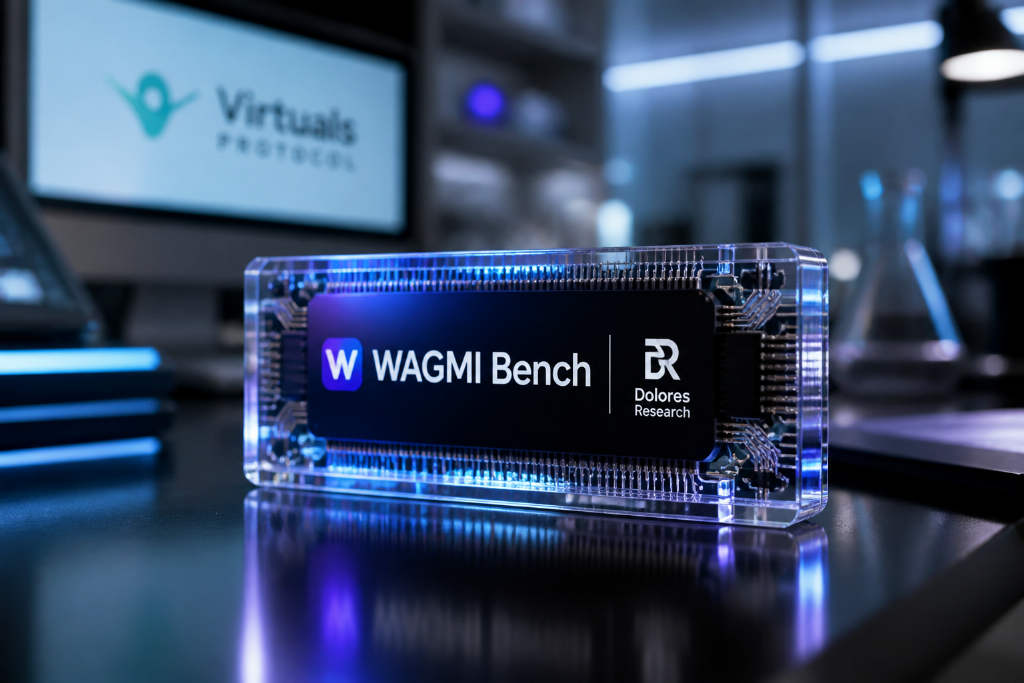
Dolores Research, an AI research company, has released WAGMI Bench, an open-source benchmarking framework designed to evaluate the performance of AI trading agents built on Virtuals Protocol. The framework is intended to standardize how these agents are assessed, giving the sector a more consistent basis for comparison. According to the brief carried by Techub News and attributed to Crypto Briefing, the release is aimed at improving transparency in financial markets while also supporting continued innovation around AI-driven trading systems. The announcement centers on evaluation standards rather than a product launch for end users, positioning WAGMI Bench as infrastructure for testing and measurement within the Virtuals Protocol ecosystem.

280
Dolores Research launches WAGMI Bench, an open-source benchmark for AI trading agents
crypto ventur
2026-08-19 09:34:34

Crypto VC after the unwind: fast token exits fade as investors move toward revenue, buybacks and longer holding periods

A long-form piece published by TechFlowPost argues that crypto venture capital is not disappearing after the speculative boom. It is being repriced. The article says the market now shows a split between strong top-line industry data and weak early-stage liquidity: institutions hold more than $175 billion in crypto assets through exchange-traded products, onchain projects generated $11 billion in fees over the last 12 months, and the sector logged $8.6 billion in M&A plus 11 IPOs. Yet Galaxy Research data cited in the piece shows only eight new VC funds launched last quarter, the lowest level since 2020, while quarterly investment fell to $4 billion, or roughly $16 billion annualized, about half of 2021’s $31 billion pace. The authors trace the problem to a crypto funding model built around early token listings and quick liquidity rather than durable business value. They argue that many token models failed because projects lacked real business models and token holders had no legal claim on operating income. In their view, the industry is now moving toward structures that tie revenue to tokens, including buybacks, while also reopening other exit routes such as acquisitions and IPOs. The article identifies three sectors that have already reached sustainable product-market fit: stablecoins, prediction markets and onchain perpetuals. It also points to tokenized Treasuries, tokenized equities, machine payments, onchain credit and compliance infrastructure as areas where early-stage opportunities may now be forming. The broader conclusion is that crypto investing is shifting away from broad thematic betting and toward specialized, patient capital focused on business quality, regulation and long holding cycles.

460
Crypto VC after the unwind: fast token exits fade as investors move toward revenue, buybacks and longer holding periods
TABEI
2026-07-30 05:51:06

TABEI to host Trustworthy AI Hackathon in Taipei from Aug. 29 to 31 with prizes starting at $12,000

The Taiwan Association for Blockchain Ecosystem Innovation, or TABEI, will host the Trustworthy AI Hackathon in Taipei from Aug. 29 to 31, with total prize money starting at $12,000 and applications open until Aug. 5. The event will take place at N24 Taipei Ark in Nangang and will accept up to 20 teams. This year, individual applications are allowed for the first time, and selected participants without a team will be matched before the competition into groups of three to five. The written screening stage does not require a prototype. Instead, applicants will be evaluated on a problem statement and a proposed solution, each capped at 300 words. According to ABMedia, the event is built around the theme “Building the trust layer for the AI-Agent economy,” focusing on questions of identity, authorization, revocation, and auditability as AI agents begin to query systems, place orders, submit documents, and sign on behalf of people and organizations. Organizers said the technical foundation for these issues overlaps with areas long developed by blockchain and privacy communities, including decentralized identifiers, verifiable credentials, selective disclosure, zero-knowledge proofs, federated learning, and differential privacy. Two prior discussion sessions, held on June 5 and July 16, produced six challenge tracks covering manufacturing and trade, digital payments and finance, medical insurance, government services, inclusive finance, and supply-chain compliance.

1410
TABEI to host Trustworthy AI Hackathon in Taipei from Aug. 29 to 31 with prizes starting at $12,000
South Korea
2026-07-22 02:34:25

South Korea opens Digital Asset Basic Act talks as Hanwha becomes Securitize’s largest shareholder

A broad set of regulatory, fundraising and market-structure developments shaped the crypto sector over the past 24 hours. South Korea formally opened discussions on the second phase of its Digital Asset Basic Act, with stablecoin oversight at the center of the agenda, while Hanwha Group emerged as the largest shareholder in tokenization platform Securitize. In Russia, lawmakers advanced and then passed a bill establishing rules for crypto market participants and cross-border trade, though the measure still requires presidential sign-off. In the U.S., the Securities and Exchange Commission cleared Ionic Digital’s registration statement ahead of its planned July 28 Nasdaq direct listing, received Grayscale’s registration filing for a Worldcoin ETF, and sued Mining Automatic and Zan Shaikh over an alleged $22 million crypto mining investment fraud. Elsewhere, spot Bitcoin and Ether ETFs posted fresh net inflows, Nigeria set up a virtual asset coordination framework, Pakistan created a virtual asset investigation unit, and Arcus launched 24/7 tokenized stock trading and a perpetuals beta on Robinhood Chain.

1290
South Korea opens Digital Asset Basic Act talks as Hanwha becomes Securitize’s largest shareholder