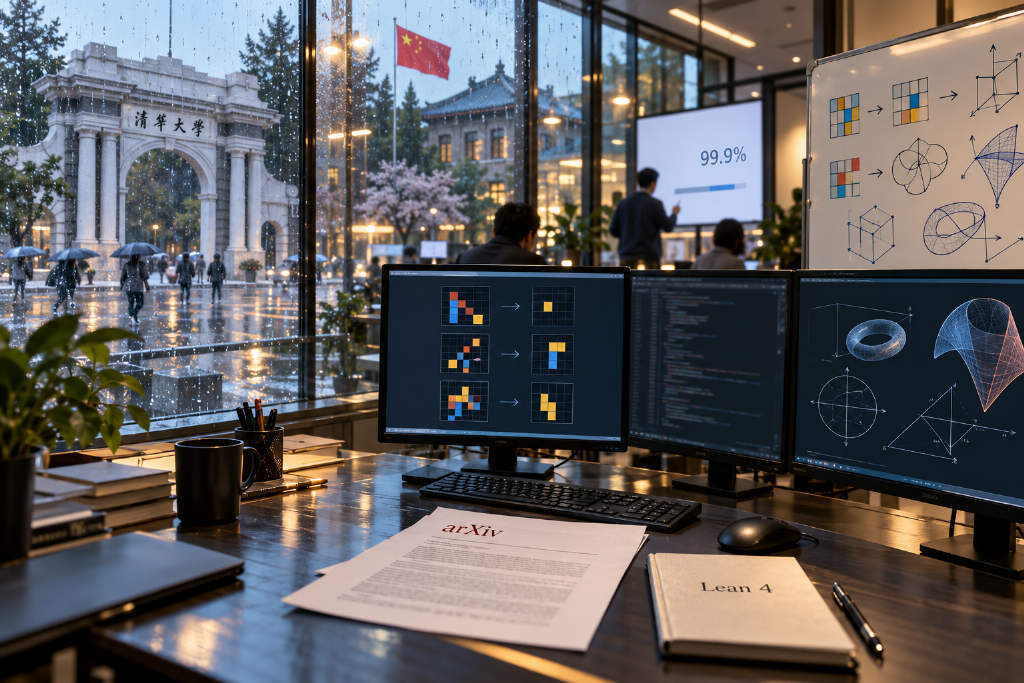
Tsinghua team led by Andrew Yao unveils AWM, scoring 99.9% on ARC-AGI-3
A research team from Tsinghua University led by Andrew Yao and Yuan Yang has introduced the Algebraic World Model, or AWM, a system designed to help AI move from observation and experimentation to mathematical abstraction of how the world works. According to the team, AWM achieved a 99.9% score on the ARC-AGI-3 benchmark while using an average number of actions equal to 43% of the human baseline. The framework follows a three-step process: it first explores phenomena and writes hypotheses in Python code, then tests those hypotheses against new observations to extract general rules, and finally formalizes the rules in Lean 4 for mathematical proof. For unsolvable tasks, the Opus 5.5-based version of AWM reportedly needed only two attempts to prove that no solution existed and to identify the number of steps required to win. The research team includes co-first authors Pan Guancheng of Zhejiang University and Tan Qixin of Tsinghua’s Yao Class, with Yuan Yang and Turing Award winner Andrew Yao serving as advisors. The paper has been posted on arXiv, and the project homepage has also been released.