Zeiss

Jensen Huang
2026-09-15 05:12:06

Jensen Huang says China could develop advanced lithography systems by 2030

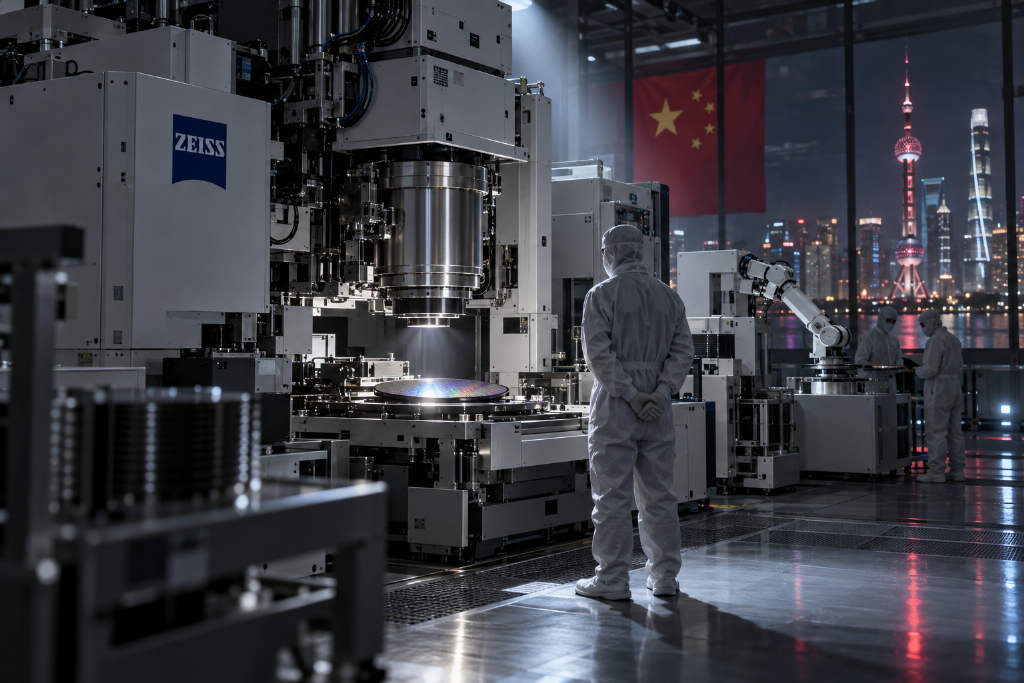
NVIDIA CEO Jensen Huang said at the All-In Summit that China could build its own advanced lithography systems by 2030. He also said that once the technology is mature, China has strong large-scale manufacturing capacity, making it only a matter of time before domestically made equipment enters local wafer fabs. His view was more optimistic than a recent estimate from Carl Zeiss SMT executive Frank Rohmund, who said China may still need about 15 years to develop a domestic EUV lithography machine. Zeiss is a core supplier of optical systems for ASML’s EUV tools. The distinction matters, though: the host’s question referred to “advanced lithography systems” and did not specifically limit the discussion to EUV, and Huang did not clarify that he was talking about EUV in his reply.

580
Jensen Huang says China could develop advanced lithography systems by 2030
Huawei
2026-09-08 04:08:52

Huawei Coordinates Domestic DUV Lithography, Yuliangsheng Targets 12 Units by Year-End

According to the Financial Times, Huawei is deepening its role in China's domestic DUV lithography supply chain, coordinating suppliers, fabs, and equipment makers. Shanghai Yuliangsheng, the fastest-moving player, has its DUV machine tested at SMIC and Huawei's own lines, with a plan to produce 12 units by end of 2026. However, the equipment still relies on Zeiss lenses and faces a high-power light source bottleneck. Huawei has invested in Zhiqi Photonics and Keyi Hongyuan to address these gaps.

800
Huawei Coordinates Domestic DUV Lithography, Yuliangsheng Targets 12 Units by Year-End
Artificial In
2026-08-27 09:50:09

In the AI era, craftsmanship still matters — but only after the product direction is right

A commentary republished by MarsBit from Tencent Research Institute argues that artificial intelligence is not making craftsmanship obsolete, but it is changing where precision creates value. The piece contrasts two production logics now unfolding at the same time. One is built on large models, rapid prototyping, and low-cost experimentation, where founders can test multiple ideas in days and let user feedback decide what survives. The other still depends on years of refinement, whether in industrial parts, specialty materials, or high-risk systems where tiny errors carry outsized consequences. The article says the old prestige attached to patience, focus, and perfection assumed that the product category itself would remain relevant. Once technology shifts the ground, quality alone cannot save a product whose market is disappearing. It uses examples from consumer electronics, cameras, combustion engines, Germany’s industrial base, and Japan’s manufacturing culture to argue that many firms struggle not because they lack engineering depth, but because they optimize inside an aging framework. At the same time, the piece rejects the idea that AI only rewards speed. It points to semiconductor materials, advanced optics, medical devices, aviation engines, nuclear equipment, and food safety as areas where MVP logic cannot replace deep reliability and exactness. Its conclusion is that AI changes craftsmanship from a moral ideal into a resource-allocation discipline: move fast where direction is uncertain, and go deep where the bottleneck truly sits.

860
In the AI era, craftsmanship still matters — but only after the product direction is right