AI
Sep 14, 2026

Two high school students use AI to push forward an open problem linked to June Huh’s Lorentzian polynomial work

A research result circulating in UCLA’s math community has drawn unusual attention: two high school students, Aayush Bathija and Prince Rohatgi, working under UCLA postdoctoral scholar Daniel Soskin, posted a 75-page paper on arXiv titled Bounded Ratios for Lorentzian Polynomials. The report says the paper advances a problem tied to work by June Huh, the 2022 Fields Medalist, in a direction that had not previously been completed. The paper focuses on a technical question inside Lorentzian polynomial theory: which ratios formed from polynomial coefficients stay uniformly bounded, which can grow without limit, and, when a bound exists, what the sharp bound is. According to the report, the paper’s main structural theorem extends earlier quadratic results to arbitrary degree and gives a full criterion based on discrete convexity conditions. The story also stands out because of how the work was done. The authors wrote in the acknowledgments that Claude Opus 5 and GPT-5.6 Sol were core tools in the project, used for computation, proof ideas, and editing support. They also stated that some AI suggestions were useful while others were misleading, and that all computations were independently verified by the authors, who take responsibility for the paper’s contents. The timing added another layer of debate, coming just a day after a public letter signed by 25 Fields Medalists warning about AI’s impact on mathematics.


1670
Two high school students use AI to push forward an open problem linked to June Huh’s Lorentzian polynomial work
Eureka
Sep 4, 2026

Eureka meta-agent framework pushes a Riemann Hypothesis-related bound to 99.55% of a theoretical threshold

A joint academic team from Guangdong University of Technology, South China Normal University, Shanghai Jiao Tong University, Duke University and other institutions has introduced Eureka, an AI framework designed to build task-specific agent architectures on the fly instead of relying on a fixed system design. The paper argues that long-horizon scientific work often breaks rigid agent setups because research paths change, proofs fail, and verification requirements differ from one problem to another. In the reported tests, Eureka completed 170 recursive long-cycle tasks, produced 3,948 verifiable certificates, and recorded no false self-confirmation or fake task completion. On a Riemann Hypothesis-related line of inquiry, the system expanded the applicability of a key certificate on the local Weil quadratic form positivity route from a≤1/4 to a≤69/200, or 0.345, which the paper says reaches 99.55% of the first theoretical barrier on that path. In theoretical physics, the framework generated five structural findings while reconstructing parts of theory space. The authors also reported a 57.8% drop in core workspace context burden, a 65.38% reduction in repeated computation, and consistency between parallel and sequential execution across 16,000 tasks. The work is available on arXiv as 2608.19047.

1070
Eureka meta-agent framework pushes a Riemann Hypothesis-related bound to 99.55% of a theoretical threshold
AI
Aug 19, 2026

Paper argues AI layoffs create a demand trap, with automation tax as the only fix

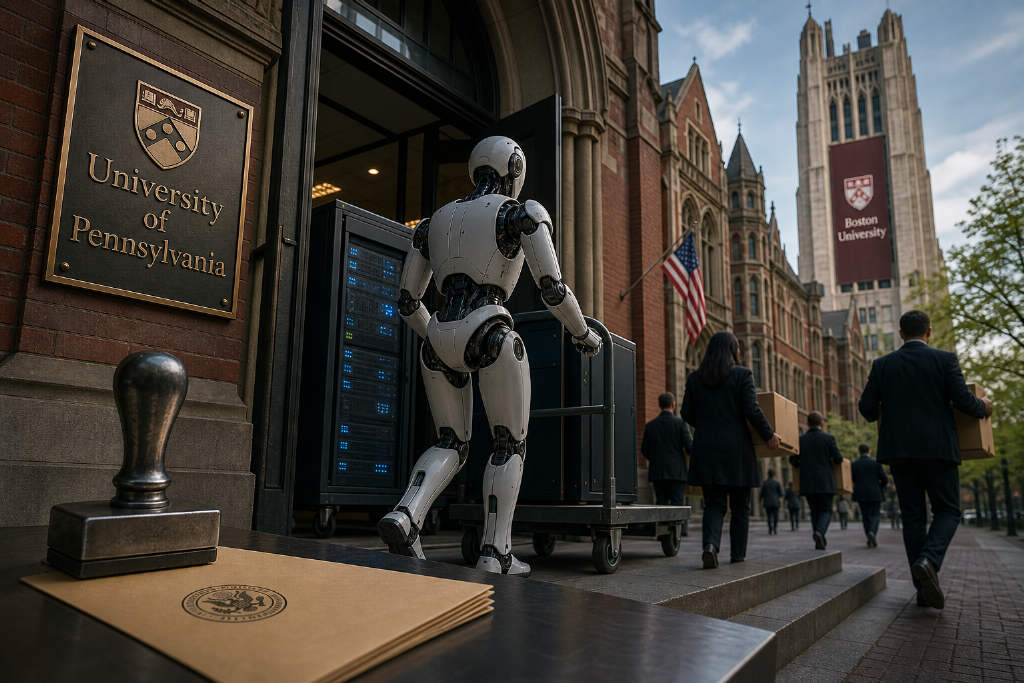
A theoretical economics paper posted on arXiv by University of Pennsylvania researcher Brett Hemenway Falk and Boston University professor Gerry Tsoukalas argues that AI-driven layoffs can push the broader economy into a destructive feedback loop. The paper, titled The AI Layoff Trap and published on March 21, 2026, says firms capture the full savings from replacing workers with AI, while the lost spending power of displaced workers is spread across the entire market. That setup, the authors argue, gives each company a strong incentive to automate even when collective over-automation hurts both labor and firms. The paper models a market with N identical companies and shows that each firm bears only 1/N of the demand loss caused by its own layoffs. It expresses the degree of over-automation as ℓ(1-1/N)/k, where ℓ is the demand loss caused by each displaced worker and k is the friction cost of adopting AI. According to the authors, the gap widens as competition increases and as AI becomes cheaper and easier to deploy. The paper also reviews policy tools often discussed in the AI labor debate, including UBI, retraining, employee profit-sharing, capital gains taxes, and negotiation, and concludes that none of them eliminate the problem at the margin. In the model, only a Pigouvian tax on automation changes firms’ incentives directly. The authors add that the paper is a theoretical exercise rather than an empirical measurement of the current labor market.

1670
Paper argues AI layoffs create a demand trap, with automation tax as the only fix
arXiv
Jul 27, 2026

unslop study flags rising AI-style text on arXiv, with computer science at 65% and math at 0.7%

A study by unslop has sparked debate over how much academic writing on arXiv now carries detectable AI-style language. The team examined 12,750 papers across 10 disciplines from January 2023 to July 2026, using pre-ChatGPT papers from 2021 and 2022 as a baseline. It found that the overall flag rate was stable at 0.4% in the control period, then climbed sharply after ChatGPT’s release, reaching 32% in the latest full quarter and nearly 39% at a peak in early 2026. The disciplinary gap was wide. Computer science posted the highest flagged rate at 65%, followed by quantitative biology at 56.3%, electrical engineering at 51.3%, and economics and finance at 47%. Mathematics stood at 0.7%, though the report says that figure is hard to interpret because the detector relies on prose patterns and may struggle with formula-heavy papers. The report also stresses that the tool detects AI-like writing traits, not authorship in a strict sense. It cannot tell whether a paper was lightly polished by an LLM or written extensively by one. The original article also cited Stanford research showing growing LLM use in peer review and paper abstracts, especially in faster-moving and more competitive fields.

1390
unslop study flags rising AI-style text on arXiv, with computer science at 65% and math at 0.7%
Total 13 items
Go topage