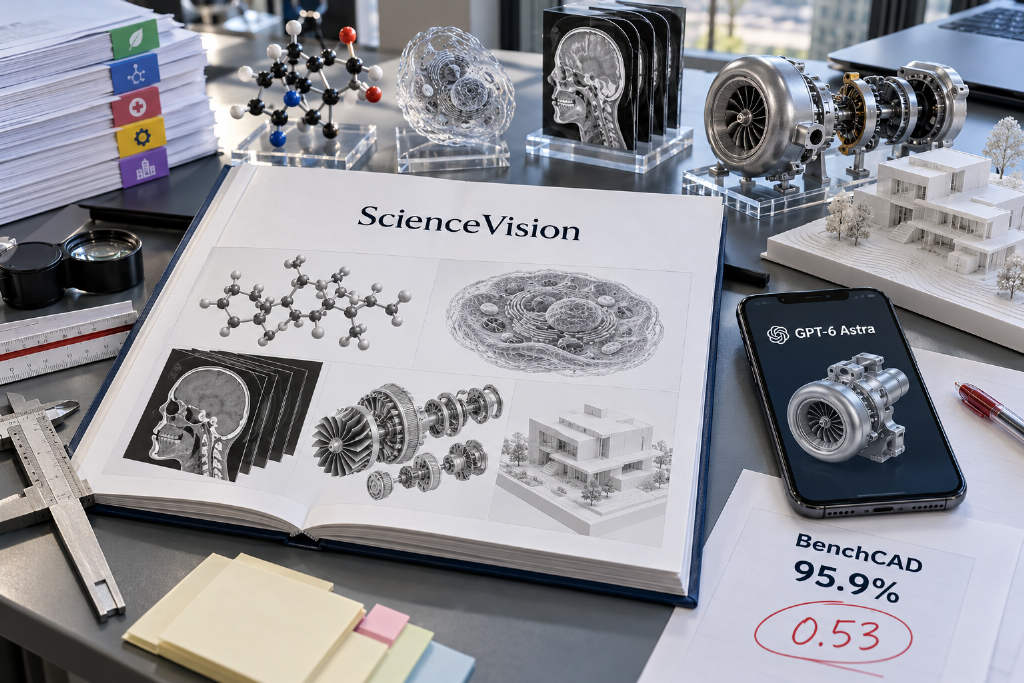
ScienceVision benchmark puts GPT-6 Astra’s 3D scientific reasoning score at 0.53 despite a 95.9% BenchCAD result
A new benchmark called ScienceVision is challenging the idea that strong CAD demos translate into real 3D scientific understanding. The system, developed by UniPat AI and visual reasoning lab Elorian AI, spans biology, chemistry, medical imaging, mechanical CAD, and architecture, covering 22 subfields and 250 tasks built from real 3D data. Models are asked to inspect, measure, and analyze scientific objects through workflows modeled on how domain experts actually work. The top result in the current ranking came from GPT-6-Astra with Codex, which scored 0.53 out of 1. That stands in sharp contrast to the 95.9% score often cited for GPT-6 Astra on BenchCAD. ScienceVision’s authors argue that looking like CAD is not the same as understanding geometry, structure, and scientific constraints. No model led across all five disciplines. GPT-6 Astra topped architecture, mechanical CAD, and chemistry, while Claude Fable 5.1 led biology and Claude Opus 5.5 led medical imaging. The benchmark also compares three evidence settings: raw 3D data, raw data plus interactive inspection tools, and six fixed 2D renders. Scores remained low across the board, and gains from interactive tools were small. The project involved 66 experts and 482.98 hours of work, with deterministic grading rather than model-based judging.