SpaceX
Aug 5, 2026

SpaceX shares reverse after earnings as AI revenue tops space business but spending surge hits stock

SpaceX shares swung sharply after its latest earnings report. The stock finished regular trading up 9.43% at $125.33, then fell more than 8% in after-hours trading, briefly dropping to about $114.6. The report showed that quarterly AI revenue reached $2.561 billion, topping the company’s space business revenue of $962 million by more than 2.6 times. Total revenue came in at $7.814 billion, above the market expectation of $6.93 billion, while AI revenue also beat analysts’ estimate of $2.18 billion. The problem for investors was not the top line. Capital expenditure surged to $18.37 billion, far above the roughly $13.22 billion analysts had expected, with $15.83 billion of that tied to AI investment. According to the report, SpaceX has been expanding its compute leasing business after redirecting data center capacity that had originally been intended for Grok. The company also said it had agreed to acquire coding tool Cursor. SpaceX currently divides its business into space, AI and connectivity, with Starlink generating $4.2 billion in revenue and remaining the only consistently profitable segment.

2270
SpaceX shares reverse after earnings as AI revenue tops space business but spending surge hits stock
Goldman Sachs
Aug 4, 2026

Goldman Sachs Puts 2026 Global AI Investment at $1.019 Trillion, Above the Market’s $800 Billion Benchmark

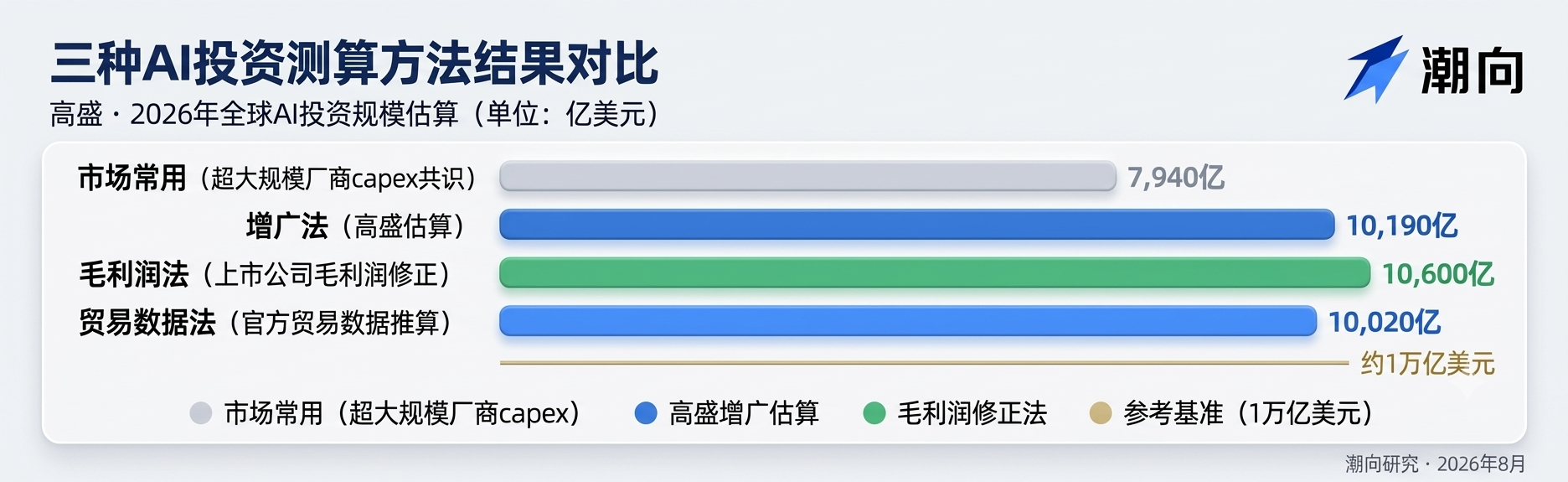
Goldman Sachs said in an Aug. 2 global economics report that the market’s commonly cited $800 billion figure for 2026 hyperscaler capital expenditure understates the scale of worldwide AI investment and overstates how much of that spending is actually taking place in the United States. After adjusting for private companies, non-U.S. firms, pre-existing spending and the geographic split of projects, the bank estimated 2026 global AI investment at roughly $1.019 trillion, including about $581 billion in the U.S. The report said the widely used benchmark misses around $200 billion of global AI investment while overstating U.S. domestic AI investment by roughly the same amount. Goldman also used two separate cross-checks — one based on forecast revisions to gross profits at AI-related listed companies, and another based on national accounts and trade data — and said the results converged around the same conclusion: global AI investment is nearing $1 trillion and U.S. AI investment is close to $600 billion. Looking ahead, Goldman expects AI investment to rise as a share of GDP. It projected the ratio for the U.S. at 1.8% in 2026, 2.5% in 2027 and 2.8% in 2028. For the world economy, it forecast 0.9%, 1.3% and 1.4% over the same period.

2440
Goldman Sachs Puts 2026 Global AI Investment at $1.019 Trillion, Above the Market’s $800 Billion Benchmark
Citi
Aug 3, 2026

Citi says cloud giants are monetizing AI faster than capex is rising

Citi said in a July 31 research note that second-quarter data from Microsoft, Amazon, Google and Oracle is challenging a market narrative that heavy AI infrastructure spending would crush profit margins. The four cloud vendors posted a combined $103.8 billion in quarterly revenue, up 50% year over year, accelerating from 41% in the prior quarter. According to the note, revenue growth is now outpacing the rise in capital expenditures, suggesting that AI investment has moved beyond a pure cash-burn phase. Azure revenue growth accelerated to 43%, AWS to 37%, Google Cloud to 82%, and Oracle Cloud Infrastructure to 92%. Citi also highlighted improving monetization metrics, including AWS AI annualized revenue rising from $15 billion to $25 billion in one quarter and Google reporting token usage growth of 37.5% quarter over quarter to 22 billion per minute. The bank kept Buy ratings on Microsoft, Amazon, Google and Oracle, with price targets of $600, $350, $447 and $330, respectively. Citi argued that operating leverage is helping offset pressure from depreciation and expansion, while growing backlog at AWS, Google Cloud and Microsoft points to sustained AI demand and stronger revenue visibility in coming quarters.

3820
Citi says cloud giants are monetizing AI faster than capex is rising
UBS
Aug 2, 2026

UBS says storage could take 73% of hyperscaler capex by 2027, reaching $761.3 billion

UBS said spending on storage is rising quickly as demand from AI GPU vendors and hyperscale cloud providers accelerates and average selling prices for storage products move higher. The bank estimates that the world’s top 11 hyperscale cloud service providers will spend a combined $1.0403 trillion in capital expenditures in 2027, with $761.3 billion of that going to storage, lifting storage’s share to 73%. UBS also outlined a steep climb in overall capex and storage spending over the next two years. Total capex is projected to rise from $504 billion in 2025 to $873.9 billion in 2026 and then to $1.0403 trillion in 2027. Over the same period, storage spending is expected to jump from $72.8 billion to $335.7 billion and then to $761.3 billion, with year-over-year growth of 361% in 2026 and 127% in 2027. By product, UBS expects HBM, DDR and NAND spending all to increase sharply, while average prices per Gb or GB also move up. The bank added that storage makers will need to expand capacity to meet demand, though fab space, equipment delivery times and labor constraints remain major bottlenecks.

2760
UBS says storage could take 73% of hyperscaler capex by 2027, reaching $761.3 billion
AI
Jul 30, 2026

RockFlow breaks down the AI chip selloff as pricing resets across semis

Volatility in U.S. semiconductor stocks has picked up sharply since July, and RockFlow argues the move should not be read as a simple collapse of the AI trade. In its latest market analysis, the research team says AI demand still looks intact: Nvidia GPUs remain tight, HBM orders are still full, cloud companies are still spending on AI infrastructure, and data center buildouts have not stopped. What has changed, in RockFlow’s view, is the market’s pricing framework. Investors are no longer willing to pay up solely for distant AI upside, and the period of buying anything tied to AI without discrimination has largely passed. The note says the current drawdown is forcing investors to sort semiconductor holdings by type rather than treat the entire AI chain as one basket. RockFlow groups relevant names into four categories: “toll-taking” assets such as TSMC, shovel-selling leaders such as Nvidia, cyclical high-beta names including parts of memory, equipment and optical module suppliers, and pure narrative stocks with weak fundamentals. The report also argues that higher cloud capex is no longer an automatic positive. Markets now want clearer evidence that spending by Microsoft, Google, Meta and Amazon can turn into durable, high-quality revenue and justify the pressure on free cash flow. That leaves earnings season as a tougher test than many investors expect, with guidance, monetization and return on investment all under closer scrutiny.

2150
RockFlow breaks down the AI chip selloff as pricing resets across semis
Microsoft
Jul 30, 2026

Microsoft’s capex reset wins over the market, while Meta’s spending surge eats into cash flow

WhiteLine Daily, published by WuBlockchain, argues that Microsoft has not actually reduced spending, even though its 2026 capital expenditure figure appears lower. The drop mainly comes from an accounting change: the company extended the estimated useful life of data centers and office buildings from 15 years to 25 years, which shifts more future data center leases from finance leases to operating leases. Because finance leases count toward capex and operating leases do not, Microsoft’s 2026 capex figure moved from about $190 billion to $175 billion, while management still said actual investment plans were unchanged and FY2027 capex would continue to rise year over year. The report says investors are willing, for now, to accept that explanation because Microsoft’s earnings release came with supporting numbers. Azure grew 43%, next-quarter guidance was about 45%, commercial RPO reached $678 billion, Copilot paid seats topped 30 million, quarterly operating cash flow was $55.4 billion, and free cash flow came in at $19.6 billion. At the same time, the piece notes that not all RPO converts into near-term revenue and that Microsoft’s cloud gross margin fell to 65%. Meta, by contrast, still posted healthy ad growth, but much of its cash generation was absorbed by capex and rising costs. WhiteLine Daily says that in a high-rate environment, the near-term AI trade still looks more like sector rotation than a broad new bull run.

2250
Microsoft’s capex reset wins over the market, while Meta’s spending surge eats into cash flow
Bank of America
Jul 27, 2026

BofA says DRAM pricing, Google capex could keep the memory upcycle running longer

Bank of America’s July 24 research note argues that the memory-chip cycle may last longer than many investors fear, driven by stronger-than-expected DRAM pricing, rising procurement tied to Google’s data-center spending, and a potentially important earnings event for Samsung on July 30. Channel checks cited by the bank show July PC DRAM contract prices rising 15% to 20% from June, with third-quarter average selling prices seen up 30% to 40% quarter over quarter, well above TrendForce’s 13% to 18% forecast. Spot prices also continued to climb, with DRAM prices up another 2% to 3% this week. BofA also highlighted trade data from Asia. South Korea’s semiconductor exports reached $22.1 billion in the first 20 days of July, up 181% year over year, while China’s June memory imports hit a record $32 billion, up about 250% and accounting for 54% of the country’s total chip imports. On the demand side, internet analyst Justin Post expects Google’s capex to rise to $200 billion in 2026 and $300 billion in 2027, versus $91 billion in 2025, implying memory-chip purchases in 2027 could be more than 50% above 2026 levels. BofA said Samsung’s July 30 earnings call could be the next major catalyst, with possible announcements on buybacks, earlier dividend payments, and a more upbeat outlook for the second half and for 2027.

2300
BofA says DRAM pricing, Google capex could keep the memory upcycle running longer
Google
Jul 23, 2026

Google shares fall more than 7% after company lifts 2026 capex forecast to as much as $205 billion

Google shares fell more than 7% on Thursday after the company raised its capital expenditure forecast for the year from a previous $190 billion to a range of $195 billion to $205 billion, according to MSX.COM data. The move put fresh attention on how expensive the artificial intelligence race in Silicon Valley is becoming, with the full cost still far from clear. Google is the first major technology company to report quarterly earnings, while Meta, Microsoft and Amazon are scheduled to release results next week. The four companies had already disclosed in April that they could collectively spend as much as $725 billion on AI development this year. If Google’s revised spending plan is any indication, that figure could rise further by the end of next week. Even so, the return on those investments remains uncertain. Thomas Montero, a senior analyst at an investment firm, said Google’s larger spending plan was “not satisfying,” adding that a rising interest-rate environment and continued supply-demand tightness in AI infrastructure may be making the idea of funding such expansion indefinitely through cash flow less attractive.

1570
Google shares fall more than 7% after company lifts 2026 capex forecast to as much as $205 billion
Total 26 items
Go topage