Circle2026-09-28 04:11:21Circle starts hiring in South Korea as it builds out its stablecoin presenceCircle is moving to expand its stablecoin ecosystem efforts in South Korea and has opened a local hiring process for a senior management role, according to a job posting released on Sept. 28. The company is recruiting a Senior Director of Ecosystem Growth in South Korea as a full-time position tied to its market entry work in the country. The role includes helping shape Circle’s South Korea market entry strategy, tracking regulatory developments, and supporting the company’s sales and business development teams with local market and compliance-related information. The position is also expected to help determine business pipeline priorities and the sequence of market entry efforts. Circle said the hire should have deep knowledge of stablecoins, decentralized finance, and institutional financial services. The job scope also covers research into trends across South Korea’s payments sector, digital asset capital markets, and institutional use cases, while building ties with financial firms, digital asset companies, market participants, and ecosystem partners in the country. The role will also feed local demand back to Circle’s product, solutions, and operations teams.410
Wang Yishi2026-09-19 15:31:42OneKey founder Wang Yishi on crypto, AI security, Bybit and why growth has no ceilingIn a long-form interview on Blockchain 100, OneKey founder Wang Yishi traced his path from a civil engineering student buying Bitcoin on Taobao in 2013 to building a hardware wallet company in crypto. He said his first reason for buying BTC was simple: the price was rising. From there, he moved through ByteDance and Bixin before going all in on the industry. Wang said OneKey’s first major user wave came during DeFi Summer in 2020, when large users moved on-chain and wanted a safer and easier alternative to browser wallets and the more cumbersome Ledger setup. He argued that open source and verifiability mattered more over time than asking users to simply trust a product. He also spent significant time on security. Wang said AI has sharply reduced the time needed to find and chain vulnerabilities, citing work by OneKey’s Anzen Labs that took one engineer two weeks instead of two to three senior researchers working for two months. On the Bybit $1.5 billion theft, he described a case where the multisig contract, cold wallet and Ledger device each appeared sound on their own, but a compromised Safe frontend engineer and blind signing created the conditions for the loss. The interview also covered OneKey’s paid trial-based hiring process, AI-assisted hardware testing with robotic arms, and Wang’s idea of giving his child an early pool of capital to lose and learn from before adulthood.610
Samsung2026-09-18 15:10:47Samsung US job posting names stablecoins as a Samsung Wallet payments partnership focusSamsung Electronics America is hiring a senior manager for business development tied to Samsung Wallet payments in New York, and the job listing explicitly includes stablecoins as one of the partnership areas. The posting places stablecoins alongside issuers, payment companies, fintech firms, and buy now, pay later providers, indicating that the company is treating the category as part of its broader payments strategy for the wallet product. According to the listing, the role will cover Samsung Wallet payment business development, go-to-market planning, and partner management. Responsibilities also include negotiating commercial terms, data usage, and product requirements, as well as helping bring new features to market. The hiring notice adds a concrete business development layer to Samsung’s previously stated roadmap for the wallet. Earlier this July, Samsung said at its Galaxy Unpacked event that Samsung Wallet would support stablecoins in the future. The latest job posting shows that stablecoins are now being framed in practical partnership terms rather than only as a forward-looking product plan. The item was cited by Digital Asset.540
Samsung Elect2026-09-18 15:26:27Samsung lists stablecoins in Samsung Wallet payments role as it hires in New YorkSamsung Electronics America has posted a New York job opening tied to Samsung Wallet’s payments business, and the role explicitly includes stablecoins in its partnership scope. According to the Sept. 18 listing cited by BlockBeats, the company is hiring a senior manager to lead business development for Samsung Wallet payments. The position covers the wallet’s vision, strategy and execution, while its payments partnership remit spans issuers, payments, fintech, stablecoins and buy now, pay later services. The job also includes go-to-market planning, managing existing partnerships, negotiating commercial terms, data usage and product requirements, and working with product, marketing, analytics and legal teams on new feature launches. The hiring notice follows Samsung’s earlier disclosure at its July Galaxy Unpacked event that Samsung Wallet is planned to support stablecoins in the future. At that event, Samsung also said it would launch the Galaxy Card in the United States with Barclays and Visa.470
OneKey2026-09-18 01:37:12OneKey founder Yishi Wang on AI-driven security, the Bybit hack, and how hardware wallets stay aliveOneKey founder Yishi Wang used a wide-ranging interview to map out how he entered crypto, how OneKey found its first users during DeFi Summer, and why he thinks AI has sharply compressed the timeline for both attackers and defenders. Speaking with Beca in an interview published by MarsBit, Wang said he first bought Bitcoin in 2013 while studying civil engineering, then later moved from ByteDance into crypto after deciding the industry offered faster feedback loops and a stronger personal conviction. He said OneKey’s early traction came in 2020, when larger on-chain users wanted hardware protection but found existing wallet setups cumbersome. Wang argued that local user experience improvements and open-source design helped OneKey win those users. He also described mistakes during the company’s growth phase, including nearly a year of product shortages and what he called premature design and over-optimization. A large part of the discussion focused on security. Wang said AI has cut the time needed to build a full attack chain from roughly two months with two or three senior researchers to two weeks with one security engineer in one recent case handled by OneKey’s Anzen Labs. He also walked through his reading of the $1.5 billion Bybit theft, saying the failure was not in the multisig contract, cold wallet, or Ledger device itself, but in a compromised Safe frontend engineer and a blind-signing flow that failed to show the real action being approved.860
Policy and Re2026-09-09 08:31:08SCOPED-Hiring paper flags hidden unfairness in multi-agent LLM hiring decisionsA paper accepted to the EMNLP 2026 Main Conference introduces SCOPED-Hiring, a process-aware fairness diagnosis framework for large language model (LLM) multi-agent systems used in hiring. The study argues that similar final hiring rates across groups do not necessarily mean the decision process was fair. Candidates can still face uneven burdens in the form of extra doubt, lower intermediate scores, added scrutiny, and different investigative standards. Using controlled resume variants and a two-stage hiring committee made up of role-based agents, the researchers recorded more than 311,000 structured decision trajectories. Across GPT, Gemini, and Qwen backends, they found that risks visible through process, pathway, interaction, and system design were much stronger than those visible from final outcomes alone. In the paper’s measurements, process-aware O/P/E/D signals showed average diagnostic significance 4.52x, 4.66x, and 2.74x higher than outcome-focused S/C signals. The team also tested a diagnosis-driven repair method called Fair Skills. In controlled experiments, the intervention reduced total stratified fairness burden by 72.3% while changing final hiring rates by only 1.86 percentage points, with output validity above 99.7%.1100
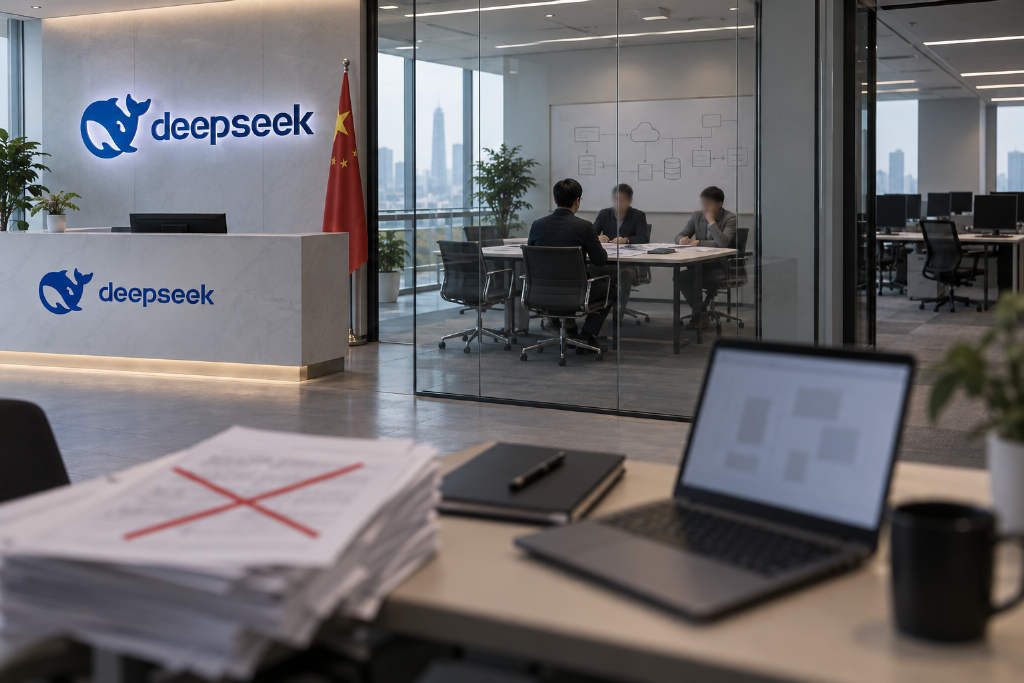
DeepSeek2026-09-09 07:49:08DeepSeek revamps experienced-hire interviews, drops ACM-style coding tests for system designDeepSeek has overhauled its interview process for a large social hiring push covering 150 roles, replacing ACM-style coding questions in written tests for experienced hires with system design exercises. According to company executive Cui Tianyi, the new format is aimed at senior engineers with real production experience rather than fresh graduates who excel at competitive programming. Algorithm design questions will now accept clear reasoning or pseudocode instead of full runnable code, multiple-choice sections have also been adjusted toward senior candidates, and the overall interview timeline will be shortened. The change does not apply to campus recruitment, which will continue to use a process similar to the previous one. That effectively separates DeepSeek’s assessment systems for experienced hires and graduates. The move follows repeated criticism of the company’s hiring process online, including complaints that test content did not match job seniority and that interview scheduling could be inconsistent across teams. The report says the redesign shifts evaluation away from handwritten algorithms and toward engineering judgment in real-world scenarios, such as handling constraints, making architectural trade-offs, locating failures, and measuring results. The adjustment has also sparked debate online, with some backing the reduced focus on ACM-style questions in the AI era while others questioning whether the company’s stated focus on engineers with 2 to 10 years of experience amounts to a softened age filter.310
Foresight2026-09-08 12:00:00Hiring Signals Shift Toward Problem-Finding and AI Workflow ExecutionForesight said the key signals employers need to identify in hiring are changing. In its view, the focus is moving toward how a person identifies problems, begins using AI to execute workflows, and ultimately gets things done. The brief highlights a change in how candidates may be assessed in the AI era. Rather than centering only on older screening markers, the emphasis described here is on problem discovery, practical use of AI in workflow execution, and the ability to deliver an outcome. The source did not provide further details beyond that framing.350