Uniswap
Nov 7, 2026

Uniswap Confirms V4 Hooks Support for Elysium, Mainnet Expected Nov. 9

Uniswap has confirmed that it will support V4 Hooks on Elysium, a Hyperliquid Layer 2 project, according to Odaily. The feature will allow developers to build customizable liquidity pools with dynamic fee structures and custom trading logic. Elysium’s mainnet is expected to officially launch on Nov. 9. V4 Hooks are the specific functionality referenced in the announcement, while dynamic fees and custom trading logic are the two use cases identified for developers. The confirmation links Uniswap’s V4 Hooks support with the Elysium project and its planned mainnet launch. No additional launch details were provided in the source item. The report identifies Elysium as a Hyperliquid Layer 2 project and states that the mainnet launch is expected on Nov. 9. The information was published by Odaily in its market analysis category.

700
Uniswap Confirms V4 Hooks Support for Elysium, Mainnet Expected Nov. 9
Variational
Nov 5, 2026

Variational says mainnet is close as trading API heads for public launch later this month

Variational founder and CEO Lucas Schuermann said on X that the company shifted a large share of its development resources in mid-September toward protocol security reviews and optimization work. He said the effort includes additional audits of the codebase and operating processes, along with AI-assisted penetration testing and red-team exercises. Schuermann added that the public mainnet is now close. He also said Variational’s trading API has already been opened to a small group of whitelisted alpha testers and is scheduled for a broader public release later this month. According to the post, the team is still on track for its token generation event, or TGE, this year, as well as a major partner announcement previously referenced in an update on the project’s tokenomics. Schuermann said more updates will start to arrive from the latter part of this month.

650
Variational says mainnet is close as trading API heads for public launch later this month
Circle
Nov 4, 2026

Circle says it completed genesis mint of 10 billion ARC tokens for Arc network

Circle disclosed the latest progress on the Arc network, saying it has completed the genesis mint of 10 billion ARC tokens. The company said this makes it the first publicly listed company to mint a network token for a new Layer 1 blockchain. According to the update, ARC will be used for network security, utility, and governance, while Arc plans to transition to a proof-of-stake, or PoS, model in 2027. Arc’s public mainnet went live on Sept. 16 and drew more than 100 institutions and ecosystem builders on its first day, with native USDC integration already in place. Circle also outlined the project’s next development priorities, which will focus on PoS, privacy, and scalability. On the ecosystem side, the Arc developer community has grown to more than 75,000 Arc House members and 10,000 Architect ambassadors, while more than 1,200 projects were built during the private mainnet stage.

770
Circle says it completed genesis mint of 10 billion ARC tokens for Arc network
Tria
Nov 3, 2026

Tria launches AI agent perpetuals trading with non-withdrawal keys

Tria said on Oct. 30 UTC that it has rolled out an AI agent feature for perpetual futures trading, with support for Hyperliquid and Decibel. The setup uses dedicated trading keys that can open and close positions but cannot authorize withdrawals. Those keys can also be given an expiry time or revoked. Whether a trade needs approval depends on how the connected tool is configured. Tria’s API documentation also states that both supported venues connect to live mainnet markets rather than testnets. It adds that environment settings only change fee routing and do not switch users into a simulated market. The update was cited by NewsBTC and later carried by Techub News.

630
Tria launches AI agent perpetuals trading with non-withdrawal keys
Jito
Nov 2, 2026

Jito names first outside BAM node operators, with broader mainnet validator access targeted for early Q1 2027

Jito has identified the first outside operators for its BAM nodes, naming Triton One, Bitwise, and SOL Strategies. The three firms are starting with testnet onboarding, according to The Defiant. Jito also set a longer-term access target for the broader validator set: any mainnet validator is expected to be able to access the system in early Q1 2027. The update points to a phased rollout, with external participation beginning in testnet before wider availability on mainnet. The announcement centers on Solana infrastructure and validator access rather than token price or market activity. No additional technical details, performance figures, or deployment milestones were disclosed in the source material beyond the operator names, the testnet onboarding stage, and the early Q1 2027 target for broader mainnet validator access.

910
Jito names first outside BAM node operators, with broader mainnet validator access targeted for early Q1 2027
GenLayer
Nov 2, 2026

Internet Court lets AI agents sign contracts with humans as GenLayer eyes mainnet launch next month

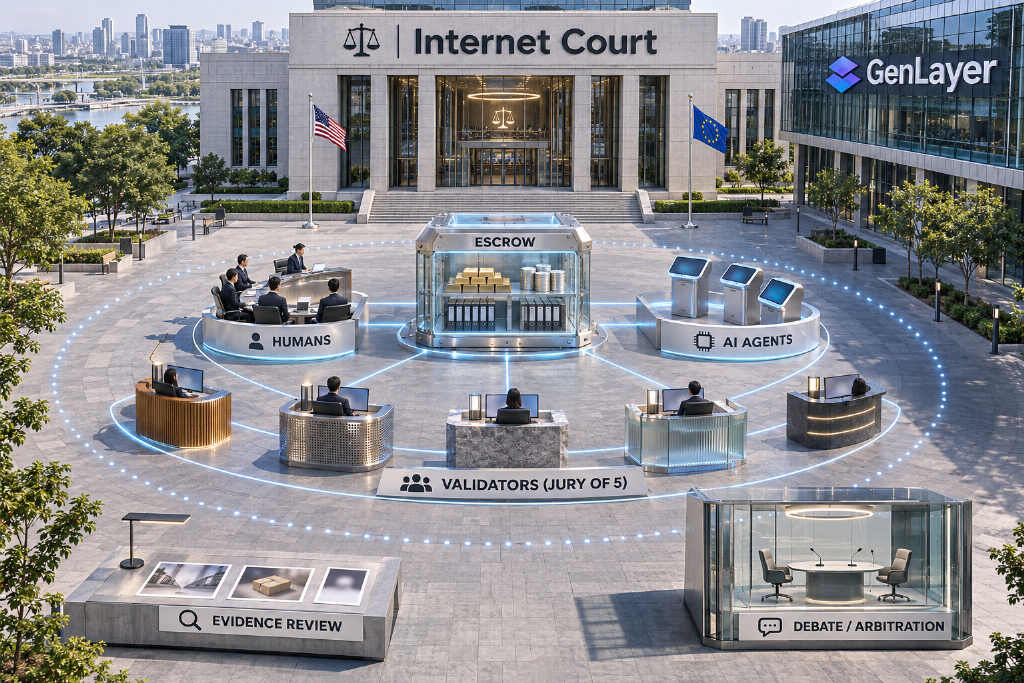
Internet Court, a dispute resolution protocol built on GenLayer, now allows AI agents to enter contracts with human users, with funds held in escrow until performance is confirmed and payment is released. The protocol has been in testing for the past year and is currently handling about 12,000 rulings per day. It has already been used to verify user-uploaded photos for Collective Memory and to settle disputes on argue.fun, with a mainnet launch expected next month. Disputes are reviewed by a randomly selected five-member jury of GenLayer validators, each running different AI model families such as Claude, Gemini, ChatGPT, and DeepSeek. Initial rulings are made by simple majority within minutes, while appeals can expand the panel to 11, 23, or as many as 1,500 AIs. Finality is usually reached within 30 minutes and can take up to around three hours. The system draws on Condorcet’s jury theorem in an attempt to reduce the bias of any single model through independent assessments. The Internet Court open alliance has 35 members, including ZKsync, NEAR, Consensys, and UMA. GenLayer co-founder and CEO Albert Castellana said the technology could speed up prediction market dispute rulings, while warning that AI judgment is still not reliable enough to detect deepfakes or resolve neighborhood boundary disputes.

420
Internet Court lets AI agents sign contracts with humans as GenLayer eyes mainnet launch next month
Ethereum
Nov 2, 2026

ENS Drops Namechain Plan as More Crypto Projects Move Core Activity Back to Ethereum L1

Ethereum Name Service has rolled out ENS v2 directly on Ethereum mainnet, abandoning the Layer 2 path it had spent years preparing through its planned Namechain rollup. The move is part of a wider pattern described in the source article: a growing list of crypto projects are stepping back from dedicated L2 deployments, shelving custom chain plans, or shutting down live networks and returning core contracts to Ethereum L1. The article ties that shift to Ethereum’s higher block gas ceiling in 2025, which rose from 30 million to 60 million and pushed L1 transaction fees lower, while the cost of operating an app-specific chain has become harder to justify. It cites ENS, Synthetix, Superseed, Trueo, ShapeShift, Blast, Nillion, and Abstract as examples. At the same time, projects are not simply moving every function back on-chain. A common design pattern is emerging: custody, ownership, and settlement stay on Ethereum L1, while matching, computation, or other heavy tasks run off-chain or in cheaper environments. The piece also points to Ethereum Economic Zones and the idea of ephemeral rollups as efforts to redraw the boundary between L1 and L2 rather than erase it.

1260
ENS Drops Namechain Plan as More Crypto Projects Move Core Activity Back to Ethereum L1
Phase
Oct 29, 2026

Phase launches mainnet with $45 million backing from Unlimit founder

Phase, a blockchain project built around smartphone-based support for AI services, has launched its mainnet and secured a $45 million funding commitment from Unlimit founder Kirill Eves. The company told Cointelegraph it has no outside investors, and said the commitment is enough to fund its first two years of development plus another two years of runway. Alongside the network launch, Phase introduced Phase Proxy, a service that routes AI agents’ web requests through internet connections shared by smartphone users. The project argues this setup can help agents avoid restrictions commonly applied to automated traffic from data centers. Users who join through the Phase app can earn PHASE tokens by validating blocks and sharing connectivity. Eves said current flagship smartphones can deliver roughly 35–45 TOPS of AI performance, enough to run smaller open-weight AI models locally. Phase also said it plans to launch AI computing services in November, add a model-routing service in the same month, build its own model, and expand beyond smartphones to desktops, servers and GPUs. Part of the revenue would be used to buy PHASE on the open market for node rewards.

650
Phase launches mainnet with $45 million backing from Unlimit founder
Total 211 items
Go topage