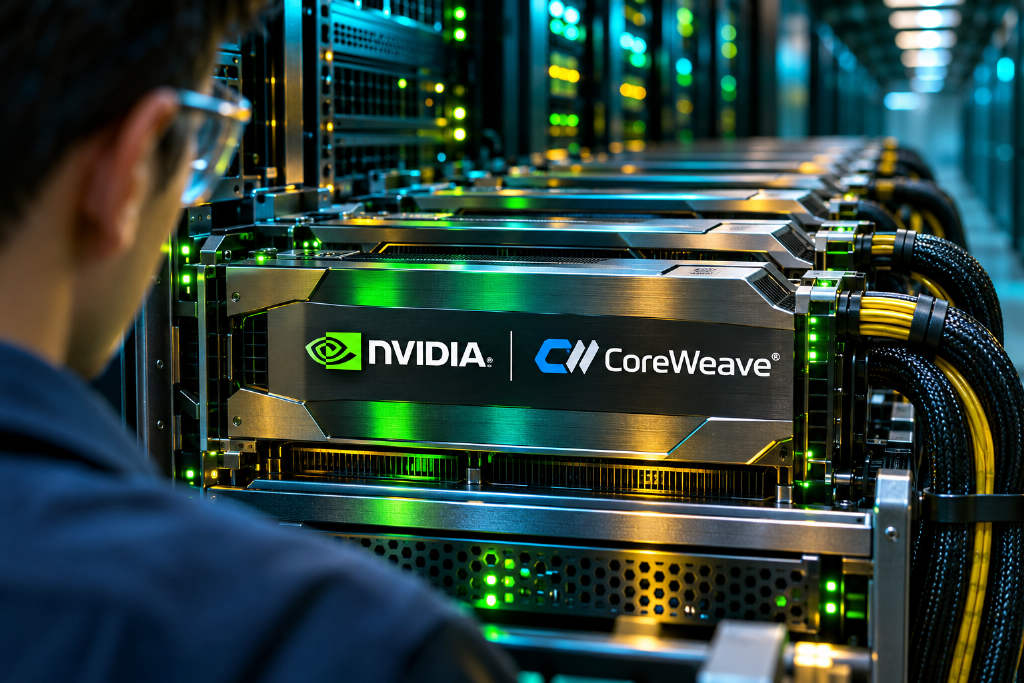
Nvidia-Backed CoreWeave Jumps 24.7% as Earnings Spotlight AI Compute Demand and Circular Finance Risks
CoreWeave, the cloud provider heavily backed by Nvidia, surged 24.7% on Wednesday, reigniting AI-related trading after weeks of selling as it reported a sharp jump in demand for the costly computing hardware behind the artificial intelligence boom. The company posted $3.66 billion in third-quarter revenue, up 168% year-on-year, and raised its 2026 sales forecast to a range of $13 billion to $13.3 billion. The results helped lift Nvidia and other AI infrastructure names including Nebius, IREN, Oracle and Applied Digital, with the broader tech market also catching a bid as the Nasdaq gained 1.6%. CoreWeave buys Nvidia GPUs, installs them in data centers and rents that capacity to firms building or running AI models, such as OpenAI, making its rapid revenue growth a key data point that businesses are still willing to pay for AI compute. Nvidia’s ties go far beyond a standard supplier relationship: in January it invested another $2 billion in CoreWeave at $87.20 per share, as part of a plan to build more than 5 gigawatts of AI data-center capacity by 2030 and to roll out new Nvidia technologies including its Rubin platform and Vera CPUs across CoreWeave’s infrastructure. Nvidia also has a $6.3 billion initial agreement to buy unused CoreWeave capacity through April 2032, creating a loop in which Nvidia sells hardware, funds a major buyer of that hardware, and commits to purchasing some of the resulting cloud services. Critics have dubbed this “circular finance,” noting that overlapping financial relationships between Nvidia, OpenAI and CoreWeave make it harder to gauge independent market demand. CoreWeave reported a $132.5 billion revenue backlog, more than 1.7 gigawatts of active power capacity at the end of September, and expects about $9 billion in customer prepayments and deposits over the next three months, which could ease its immediate borrowing needs at a time when investors are wary of debt-funded AI data centers. Bernstein analysts described the quarter as “about the best quarter we could have asked for,” according to Reuters, but warned that CoreWeave would be among the firms hit hardest if the current shortage of AI compute capacity starts to ease. The Nvidia partnership does not eliminate risks from newer processors undercutting older GPUs, constraints on electricity and construction, higher borrowing costs, or a potential oversupply of AI compute that would pressure the rental prices CoreWeave earns.