npm

vercel
2026-08-28 17:34:10

Vercel Open-Sources vgpu, a TypeScript WebGPU Library Purpose-Built for AI Agent Shaders

Vercel has open-sourced vgpu, a TypeScript WebGPU library developed in-house and designed specifically for AI agent shaders. The project targets the full lifecycle of shader development and deployment, according to a summary via MarkTechPost. With vgpu, .wgsl shader files are treated as importable modules rather than raw text. A unified API sits on top, which means the same shader code can execute across three distinct environments: a browser canvas, a headless Node.js process, and CI snapshot testing setups. The library is published to npm under the MIT license. There is no account requirement, no quota, and no inference fee. Vercel also packages a CLI tool, an llms.txt file, and a hosted read-only MCP server endpoint, all of which reinforce the "AI agent-first" positioning. In addition, the repo includes a deterministic simulation adapter, so tests can run in environments without a GPU. The announcement was covered by Techub News, citing MarkTechPost as the original source.

230
Vercel Open-Sources vgpu, a TypeScript WebGPU Library Purpose-Built for AI Agent Shaders
AllScale
2026-08-21 02:54:07

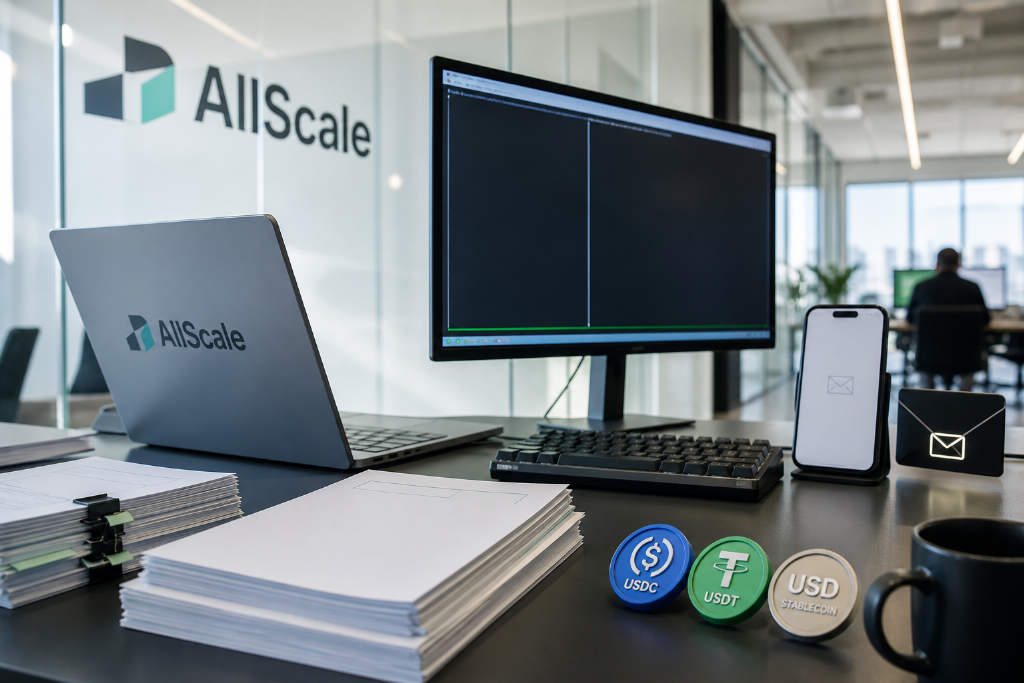
AllScale launches CLI tool for stablecoin payments, invoicing and reconciliation

AllScale, a self-custodial stablecoin digital bank, has released the AllScale CLI, a command-line tool that lets users handle stablecoin collections, payouts and reconciliation from a terminal after a one-time installation. According to the company’s official X account, the collection flow allows users to send itemized invoices to any valid email address with a single command, with support for USDT and USDC. Recipients do not need to register in advance or establish a prior business relationship. On the payout side, users approve spending limits once, including a per-transaction cap, total budget and expiration period, after which scripts can run unattended. Each payout creates and funds a Claim Link, so recipients do not need to provide a wallet address. AllScale said the process is idempotent, meaning failed tasks in the middle of execution will not trigger duplicate payments. The company also said every command prints JSON to standard output and returns 13 documented exit codes, allowing scripts or AI agents to branch automatically without checking screenshots of web pages. The package is now available on npm under @allscale/cli.

500
AllScale launches CLI tool for stablecoin payments, invoicing and reconciliation
Grok Bot
2026-08-13 07:08:46

Grok Bot first look: how a cloud-based AI agent takes over everyday digital chores

Matt Palmer, head of developer experience and education at Cursor, outlined how Grok Bot works in an early beta write-up, describing it as an AI agent with its own always-on cloud computer. Rather than acting only inside a chat window, the system can open webpages and apps, access files, take screenshots, reuse browser sessions, and hand control back to the user when it hits login walls such as SSO, 2FA, captchas, or payments. Palmer said the setup felt closer to what a personal agent should actually be, compared with earlier tools that required too much deployment work, account management, and constant maintenance. The article breaks the product into several parts: persistent cloud execution on a Linux VM, layered memory across users, agents, and projects, trigger-based automation through messages, schedules, Slack, and git events, plus integrations with the same connectors and skills used by Cursor, including Notion, Slack, GitHub, MCP servers, Cursor Cloud Agents, and GitHub MCP. Palmer also described guardrails such as natural-language rules, a separate review agent, and allow/block lists. He gave examples ranging from demo generation and internal content monitoring to grocery comparison across Instacart and Amazon delivery, and DoorDash group-order navigation. After several weeks of use, he said the system had gradually earned his trust.

2530
Grok Bot first look: how a cloud-based AI agent takes over everyday digital chores
npm supply-ch
2026-08-05 03:52:02

SlowMist Warns of Large-Scale npm Supply-Chain Attack on Keyv/Cacheable Ecosystem

SlowMist disclosed on August 5 that it has detected a large-scale npm supply-chain attack affecting the Keyv/Cacheable ecosystem. Attackers have published more than 2,000 malicious package versions, including keyv@6.0.0. Keyv is a widely used key-value storage abstraction layer supporting Redis, SQLite, PostgreSQL, MongoDB and other backends, with roughly 127 million weekly downloads, creating potentially broad downstream supply-chain risk. The attack closely resembles the Shai-Hulud npm worm campaign, indicating strong automation and self-propagation. Potential malicious behaviors include credential theft, environment variable exfiltration, CI/CD secret leakage, remote payload delivery, and lateral movement through compromised development environments. SlowMist recommends security teams immediately identify and remove affected versions, upgrade to verified safe versions, review dependency lock files and build logs, monitor anomalous outbound connections, rotate potentially exposed credentials, and rebuild environments from trusted sources if compromise is suspected.

1020
SlowMist Warns of Large-Scale npm Supply-Chain Attack on Keyv/Cacheable Ecosystem
OpenAI
2026-07-29 08:26:17

OpenAI open-sources Codex Security tooling layer, detailing setup, scans, CI integration and cost pitfalls

OpenAI has released the GitHub repository for Codex Security under the Apache-2.0 license, but the open-source code covers only the tooling layer used to trigger scans, manage findings and integrate with CI. The underlying service that reads code, reproduces vulnerabilities in isolated environments and generates patches still runs on OpenAI’s own servers, so access still requires an OpenAI login and Codex Security permissions. According to the documentation cited in the source article, Codex Security remains in research preview and is available to ChatGPT Pro, Business, Edu and Enterprise users, with some enterprise accounts also needing admin approval. The article walks through environment requirements, install commands, dry-run validation, model configuration, SARIF export and CI usage, then highlights five common pitfalls: max-cost not acting as a hard cap, output directories being blocked if placed inside a repository, API keys taking precedence over ChatGPT login in non-interactive contexts, Python 3.10 needing tomli, and MCP being limited to read-only metadata rather than live scans. It also covers local scan history in SQLite, false-positive handling, scan comparison, batch scanning across GitHub repositories, and the related TypeScript SDK APIs.

1430
OpenAI open-sources Codex Security tooling layer, detailing setup, scans, CI integration and cost pitfalls
Anthropic
2026-07-28 06:43:56

Claude Code source leak exposes 513,000 lines after npm publishing error

Anthropic’s Claude Code CLI tool accidentally exposed about 513,000 lines of TypeScript source code on March 31 after a publishing configuration mistake, according to a Techub News report citing Cryptobriefing. The issue stemmed from an npm release that incorrectly included source map files that were not meant to be public, exposing nearly 2,000 internal files. The report said Anthropic’s follow-up DMCA takedown request also hit roughly 8,100 unrelated GitHub repositories by mistake. At the same time, malicious actors have started setting up fake repositories to distribute malware, attempting to lure developers into cloning infected code. Anthropic said the incident was caused by human error rather than a security flaw. The company also said no sensitive user data or credentials were exposed in the leak. The episode has turned attention to supply-chain risk for developers using public code hosting and package distribution channels, especially when attackers move quickly to exploit confusion around a widely discussed tooling incident.

1210
Claude Code source leak exposes 513,000 lines after npm publishing error