Federal Reserve
Nov 7, 2026

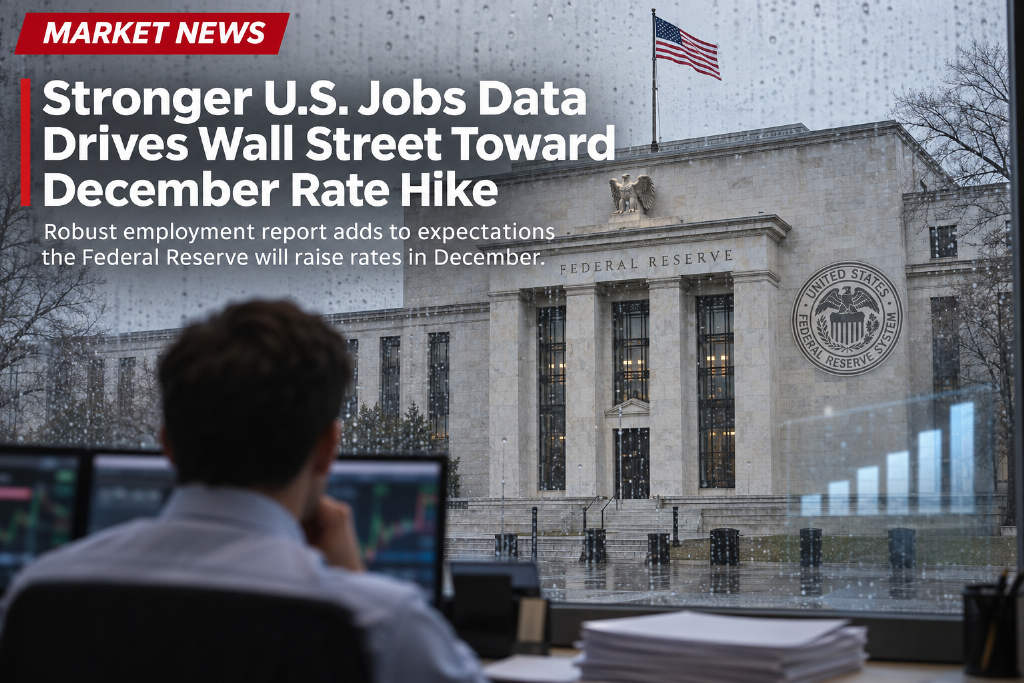
Strong October Jobs Report Pushes Fed December Rate-Hike Odds to 85%

A stronger-than-expected US October jobs report has lifted market expectations for a Federal Reserve rate hike in December. Nonfarm payrolls rose by 165,000, well above the 70,000 increase expected on Wall Street, while the unemployment rate fell to 4.1% and labor-force participation rose to 61.9%. Average hourly earnings increased 0.4% month on month, faster than in September and above expectations. Traders raised the implied probability of a 25-basis-point December hike to about 85%, from roughly 75% before the report. Several Wall Street investors said the data gives the Fed more room to tighten policy, though inflation, energy prices and financial-market conditions remain unresolved variables. The report also showed that August and September payrolls were revised up by a combined 84,000. Employment gains were concentrated in professional and business services, health care, transportation and warehousing, and manufacturing, while leisure and hospitality payrolls declined. Analysts cited a rise in involuntary part-time work as a structural weakness. Attention is also turning to the sell-off in AI-related assets. Journalist Nick Timiraos said the data did not change the Fed’s assessment of growth and inflation, but argued that any effect from the AI sell-off on financial conditions could influence the December debate.

450
Strong October Jobs Report Pushes Fed December Rate-Hike Odds to 85%
AI investment
Nov 7, 2026

Bitmine Chair Tom Lee Says the AI Investment Boom Is Far From Over

Tom Lee, chairman of bitcoin treasury company Bitmine, said in an interview with CNBC that the AI investment boom is far from over. He said the growing use of tokens could keep driving demand for computing resources higher, potentially tightening computing capacity again and pushing related prices upward. Lee also said bottlenecks in AI infrastructure could return as a focus for the market. Across many U.S. states and local communities, officials welcome the economic gains tied to AI investment but are also seeking to promote investment on their own terms and strengthen AI safety regulation.

550
Bitmine Chair Tom Lee Says the AI Investment Boom Is Far From Over
U.S. regulation
Nov 7, 2026

Maxine Waters Announces Bid to Lead House Financial Services Committee

Democratic Rep. Maxine Waters of California has announced her bid to become chair of the U.S. House Financial Services Committee. In a letter to Democratic lawmakers, Waters outlined a policy agenda that includes strict but fair rules for compliant crypto companies and closer scrutiny of the digital asset industry. She also plans to pursue legislation addressing the impact of artificial intelligence on the financial system and the broader economy. Her agenda covers oversight of private equity, consumer fees, credit reporting and reforms to mortgage finance. Waters has served as the committee’s top Democrat since 2013. Democrats are expected to decide key committee positions in the coming weeks. Illinois Democratic Rep. Sean Casten has also announced a bid for the chairmanship. His agenda likewise includes crypto, prediction markets and emerging risks linked to artificial intelligence, along with stronger oversight of fraud targeting businesses and consumers.

360
Maxine Waters Announces Bid to Lead House Financial Services Committee
GENIUS Act
Nov 4, 2026

GENIUS Act does not remove state licensing requirements for stablecoin-related firms

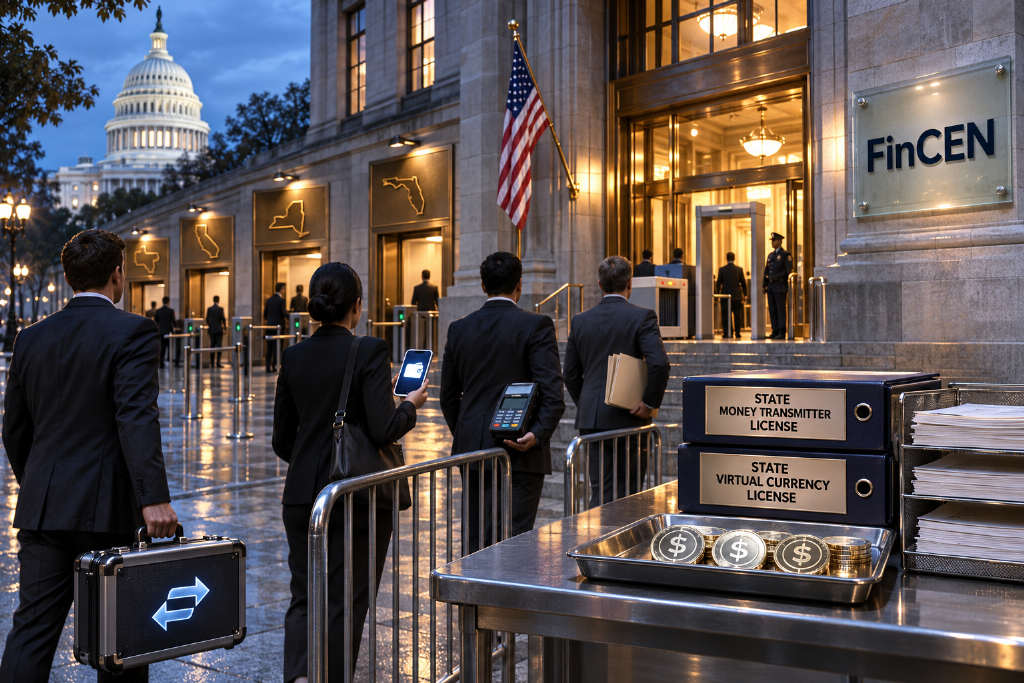
The GENIUS Act creates a federal framework for payment stablecoin issuance, but it does not broadly remove money transmission rules for every business that handles stablecoins. According to Bitcoin.com News, exchanges, wallets, payment processors, and remittance companies may still need to register with the Financial Crimes Enforcement Network, or FinCEN, as money services businesses and obtain state-level money transmission or virtual currency licenses. Whether a license is required depends on the role a company plays in receiving, controlling, exchanging, or transmitting customer value, and on which entity performs each function. The report also said approval for an issuer, or federal registration with FinCEN, does not automatically satisfy other federal obligations or state licensing requirements. While the GENIUS Act includes a state law preemption arrangement for certain approved issuers, that treatment does not extend as a blanket exemption to third parties such as exchanges, distributors, wallets, or payment companies. Because states define virtual currency activity, exemptions, and licensing regimes differently, firms still need to assess requirements based on their business model and where they operate.

610
GENIUS Act does not remove state licensing requirements for stablecoin-related firms
OKX
Nov 4, 2026

56 U.S. listed companies object to OKXICE tokenized stocks, leaving only 13 without objections

OKXICE, the joint venture between crypto exchange OKX and Intercontinental Exchange, is running into resistance not from regulators but from the issuers whose shares it wants to tokenize. In a Nov. 2 update, the company said 56 firms had objected to the listing of tokenized versions of their stocks, up from the original pool of 62 companies. The objecting group includes Amazon, Tesla, SpaceX and Nvidia, and together represents more than $31 trillion in market value, or about 42% of total U.S. equity market capitalization. As of publication, 13 companies had not filed objections, including Apple, Strategy, Robinhood, Coinbase, Palantir, Circle, Securitize, BitGo, ServiceNow, GE Vernova, Boeing, Home Depot and Super Micro Computer. Under the U.S. Securities and Exchange Commission’s stock-tokenization innovation exemption policy, listed companies can object within 30 days after receiving written notice from a third-party tokenization platform. If OKXICE sent notices on Oct. 4, the company would be left with only 13 tokenized U.S. stocks it could list. The article argues that issuers’ concerns center on three issues: fragmented pricing and liquidity, weaker visibility into trading activity, and reputational risk if tokenized trading on third-party venues malfunctions or diverges from the underlying shares. It also says the deeper conflict is over control and economics, with issuers showing more interest in tokenization models they can lead themselves, rather than supporting independent crypto platforms.

680
56 U.S. listed companies object to OKXICE tokenized stocks, leaving only 13 without objections
U.S. midterms
Nov 4, 2026

Midterms shift control in Washington, setting up a new policy path for crypto

CoinDesk reported that the U.S. midterm elections have broken Republican dominance across all three branches of government, with Democrats moving toward majorities in both the Senate and the House. As control of Congress changes hands, the crypto industry is expected to face a different policy direction. The report frames the election outcome as a political turning point in Washington, one that could reshape how the sector is handled at the congressional level. No further policy details were provided in the source summary, but the central takeaway is clear: the balance of power is shifting, and crypto is bracing for what comes next as lawmakers take up a new configuration on Capitol Hill.

580
Midterms shift control in Washington, setting up a new policy path for crypto
U.S. midterms
Nov 4, 2026

Early U.S. Midterm Results Leave Control of Congress Unsettled, With Crypto Policy in Focus

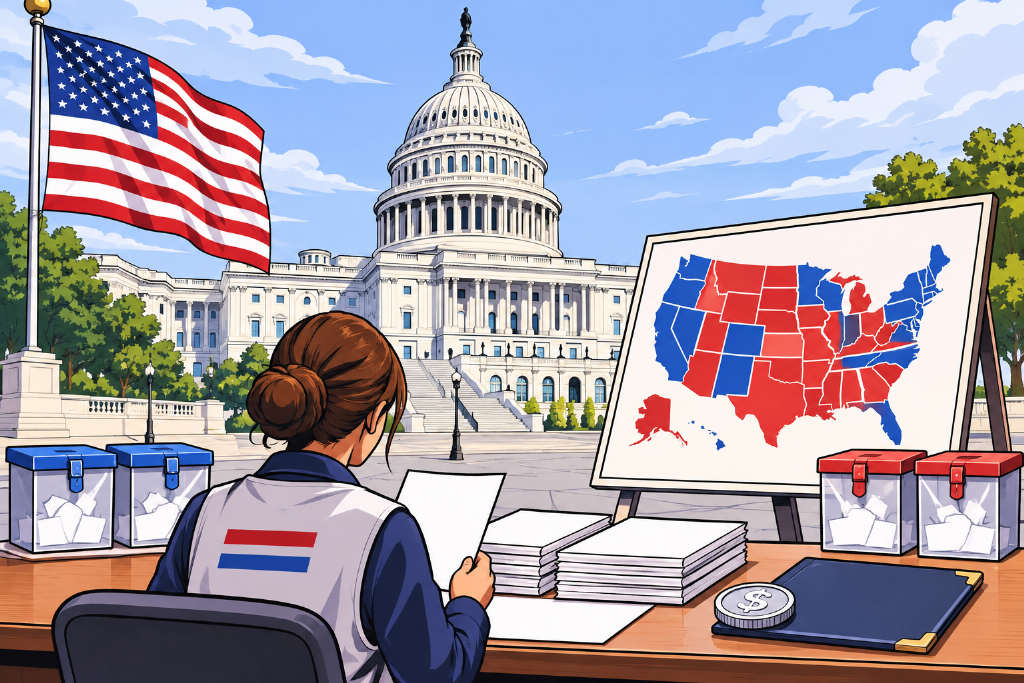
The 2026 U.S. midterm elections are underway, with voters deciding all 435 seats in the House of Representatives and 35 seats in the Senate, a contest that will shape the balance of power for the rest of President Donald Trump’s term. As of about 8 p.m. Eastern Time on Nov. 3, early results had begun to come in. Roughly 10 Senate races had been called, leaving Democrats with 43 seats and Republicans with 32, while Democrats had posted a net gain of one seat. In the House, about 64 races had been decided, with Democrats winning 45 seats and Republicans 19. Early voting and partial counts in Eastern states pointed to a strong Democratic showing. In some Republican-held seats in Ohio, South Carolina and Texas, Democrats were temporarily ahead. Still, many Western polling places remained open or were still counting ballots, and key swing-state outcomes had not yet been determined, leaving overall control of Congress unresolved. ChainCatcher said a Republican loss, especially if Democrats were to take both chambers, could sharply limit Trump’s legislative leverage, expand Democratic investigative power and complicate nominations. For crypto, the report said such an outcome would be broadly negative but not catastrophic, potentially delaying or shelving legislation and increasing scrutiny of the industry and Trump-linked crypto projects.

460
Early U.S. Midterm Results Leave Control of Congress Unsettled, With Crypto Policy in Focus
Total 478 items
Go topage