Google
Oct 8, 2026

Google launches Playground, an AI tool that turns prompts into web games

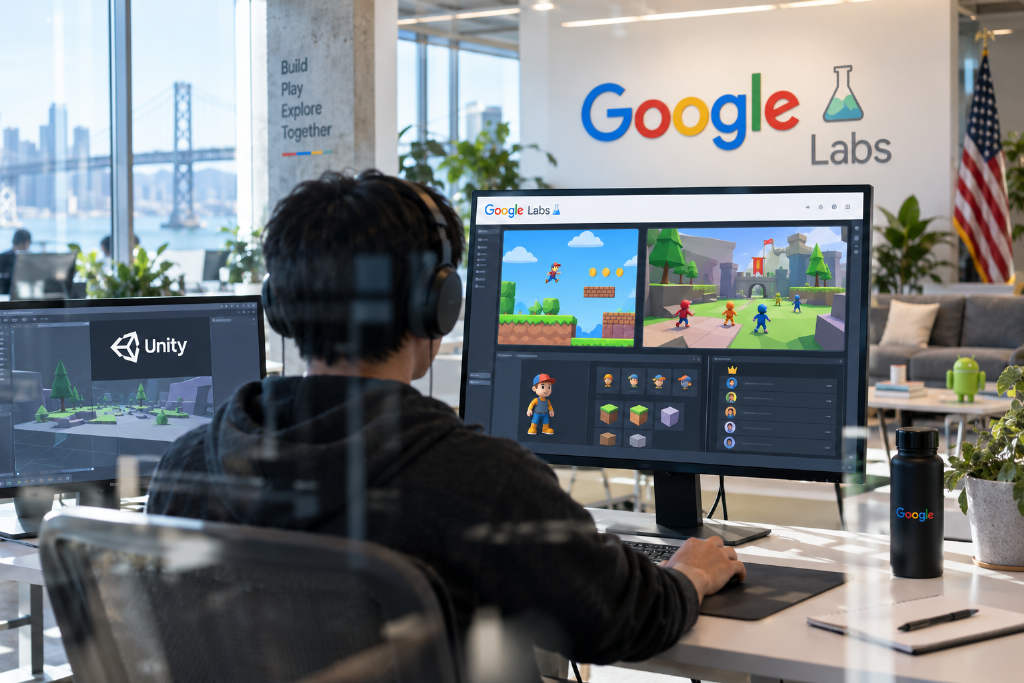
Google Labs has introduced Playground, an experimental AI game creation platform built to generate 2D and 3D web games from text prompts. The product is aimed at lowering the technical barrier to game development, letting users build playable projects without programming experience. Through a conversational interface, users can describe a game idea and quickly produce a prototype, then adjust modes, rules, characters, and environments before publishing the result. The platform also includes profile and community features such as player nicknames, live leaderboards, and sharing options through community posting or private links. Playground runs across browsers, laptops, and mobile devices, and Google has shown test examples spanning different styles, including a purple sweet potato latte-themed droplet-catching game and a yarn car collision game. Google also plans to integrate Playground with Unity Spark. Unity CEO Matthew Bromberg said the browser-based creation model, combined with direct access to thousands of assets from the Unity Asset Store, is designed to help people without coding skills make and share games more easily. For now, Playground is available only to users in the United States who are 18 or older.

1090
Google launches Playground, an AI tool that turns prompts into web games
AI
Aug 13, 2026

Rising AI token costs push companies to demand tighter prompts from staff

Companies adopting artificial intelligence are running into a basic operational problem: they can measure AI usage in tokens, but they still struggle to predict what those tokens will ultimately cost. Because large language models are non-deterministic, the same prompt does not always produce the same response, and small changes to instructions or model choice can materially alter token consumption. That makes long-term budgeting difficult, especially as firms move from single-model deployments to systems built around multiple AI agents working together. ABMedia reports that this pressure is spreading across the technology sector. Goldman Sachs has forecast that global token consumption will rise 24-fold between 2026 and 2030, reaching 120 quadrillion tokens per month as enterprise adoption of AI agents expands. Some businesses only realize they have exceeded budget limits when monthly bills arrive; Uber, for example, was cited as having exhausted its annual token budget within a few months. To respond, companies are tightening controls. Measures now in use include restricting expensive external AI tools, training employees to write more precise prompts, choosing models based on fit and cost rather than novelty, and budgeting for security testing and safeguards that also consume tokens. Small firms using personal accounts to avoid higher enterprise pricing were also warned not to treat that workaround as a durable solution.

1880
Rising AI token costs push companies to demand tighter prompts from staff
Higgsfield
Aug 9, 2026

Higgsfield Open-Sources the Full Prompt and Asset Pack Behind Its 95-Minute AI Film ‘Hell Grind’

Higgsfield has released the full production package for its 95-minute AI film Hell Grind, making public the project’s prompts, character models, scene assets, iteration history, a 19-minute behind-the-scenes breakdown, and a Claude Skill built around its prompting workflow. The company said the film was produced by a 15-person team in Almaty, Kazakhstan, over 14 days at a cost of nearly $500,000, with roughly $400,000 spent on GPU cloud compute and the rest on labor. CEO Alex Mashrabov described the process as feeling like a slot machine, with 253 usable shots selected from 16,181 generations, or about 64 to 1. Higgsfield also tied the release to promotion for its Higgsfield Global Film Festival, which carries a $1 million prize pool and a $500,000 top award. The open package details how the team locked character identity, structured prompts with anchors, coordinates, timestamps, and hard rules, and why it stopped using negative instructions such as “don’t” or “not game-like” after repeated failures.

10210
Higgsfield Open-Sources the Full Prompt and Asset Pack Behind Its 95-Minute AI Film ‘Hell Grind’
Opus 5
Jul 29, 2026

Opus 5 ‘challenge loop’ prompt goes viral as developers use it to build browser games in 24 hours

A game-building prompt built around Opus 5 has spread quickly across X, drawing attention for how it pushes the model through repeated planning, execution and review cycles. The setup, named the “challenge loop” by Matt Shumer, uses a lead agent to break down the task, multiple specialist agents to produce assets and code, and a separate judging agent to compare results against real AAA references and send weak outputs back for another round. One of the most widely shared examples came from developer Anshu, who said he used the method to create a browser-based space exploration game called “The Long Silence” over a 24-hour run. Shumer also shared an Opus 5 version of a Call of Duty-style project, describing the textures, animation and sound as AI-generated and saying no external assets were used. As the prompt circulated, other users posted kart racers, cyberpunk-style prototypes and experiments on GPT-5.6 Sol. The wave of examples has been framed as a practical demonstration of the long-horizon planning and iterative refinement abilities highlighted when Opus 5 was introduced.

3960
Opus 5 ‘challenge loop’ prompt goes viral as developers use it to build browser games in 24 hours
Claude Code
Jul 17, 2026

Claude Code lays out four loop patterns as AI coding shifts from prompts to system design

Anthropic’s Claude Code team has published a detailed framework for “loops,” defining them as repeated agent actions that continue until a stopping condition is met. In the post, the team breaks loops into four types: turn-based loops controlled step by step by a human, goal loops checked by an evaluator model against measurable targets, time loops triggered on a schedule, and proactive loops that run unattended in response to events or time. The discussion lands as several high-profile figures in the AI tooling world, including Peter Steinberger, Boris Cherny, and Google engineer Addy Osmani, have publicly shifted attention from writing one-off prompts to building systems that can keep working after a user steps away. Claude Code’s documentation argues that the core engineering challenge is not perpetual execution, but deciding how an agent knows when to stop. The article also highlights the practical risks. Unbounded loops can drive token costs sharply higher and can trap agents in cycles that appear productive but fail to make measurable progress. Claude Code’s guidance and community discussions point to three safeguards: machine-checkable completion conditions, hard limits on attempts and spending, and mechanisms to detect lack of progress. The broader takeaway is that prompt writing is not disappearing, but it is being repositioned as one component inside a larger execution system built around verification, budget control, and stop rules.

3080
Claude Code lays out four loop patterns as AI coding shifts from prompts to system design