Name.com
11 hours agoNews Editor

Name.com-linked domain hijack hit DeFi front ends as root cause remains unresolved

A wave of malicious redirects tied to domains registered through Name.com hit several DeFi front ends late Friday, with the apparent goal of gaining access to visitors’ crypto wallets. Name.com said Saturday that a number of domains on its platform had been improperly redirected and were later restored, but it did not explain how the attackers gained control or identify the affected domains. Vercel, one of the companies pulled into the incident, described the episode as a takeover campaign targeting crypto firms and said 10 affected domains were associated with its platform. Several projects publicly confirmed impact, including Flap, Kintsu, and Origami Finance. Origami said its smart contracts and vault funds were unaffected, but paused its vaults and urged users who connected wallets or signed transactions on its site after midnight UTC on Oct. 31 to revoke unfamiliar approvals. Blockaid said nine additional sites were actively serving the Step Drainer. Public registry checks reviewed by Unchained showed 12 named domains were all registered at Name.com and all reflected changes dated Oct. 31. Responsibility remains disputed, with project teams, Vercel, and independent researcher punkquidity offering differing views on whether the issue originated at Name.com, a reseller, or Vercel-linked nameservers.


20
Name.com-linked domain hijack hit DeFi front ends as root cause remains unresolved
Echelon
1 days agoNews Editor

Echelon says website access restored after registrar-level nameserver change led to phishing redirect

Modular money market Echelon said access to its official website has been fully restored and domain resolution is now functioning normally. After investigating the incident, the team said the issue was caused by an unauthorized nameserver change at the domain registrar level. According to Echelon, the domain is managed through Vercel, while Name.com serves as the registrar. The nameservers were changed without authorization to the registrar’s DNS, which redirected visitors to a phishing clone site. Echelon said the problem was limited to the registrar and DNS configuration, and that its smart contracts were not affected. The team had warned a day earlier that its domain might have been redirecting users to an unauthorized website.

40
Echelon says website access restored after registrar-level nameserver change led to phishing redirect
DeFi
1 days agoNews Editor

More Than a Dozen DeFi Sites Hijacked in Domain Attack, All Registered With Name.com

More than a dozen DeFi websites were redirected to wallet-draining phishing pages on Oct. 31 after their domains were hijacked, according to alerts from Blockaid and reporting by The Block. The affected sites included Pickle Finance, Origami Finance, FluxBeam, Echelon, StonkFun, StakePoint, supswap.xyz, longbow.cash, shprd.finance, apexdefi.xyz, Flap and Kintsu. The common link identified by The Block was that all 12 domains named by Blockaid were registered through Name.com, even though their DNS setups differed across providers such as Cloudflare, Vercel and Name.com’s own nameservers. Blockaid said the compromised sites were loaded with the Step Drainer wallet-draining kit, which tricks users into signing transfer approvals after connecting their wallets. Citing an April report from LevelBlue SpiderLabs, The Block said the kit was sold as malware-as-a-service for about $750 for the full source code, or rented for $150 plus a 20% cut of each theft, with support for more than 20 blockchains. Name.com later said 15 customer domains were affected and that all had been restored. Vercel said 10 domains tied to its platform were impacted and had also been restored. The Block tracked about $138,000 in stolen funds across Ethereum-related networks, though losses on Solana and Aptos had not yet been counted.

110
More Than a Dozen DeFi Sites Hijacked in Domain Attack, All Registered With Name.com
Name.com
2 days agoNews Editor

Name.com says 15 hijacked customer domains have been restored, with 10 tied to Vercel

Name.com said the attack ultimately affected 15 customer domains, above the 12 that had been previously confirmed, and that all of those domains have now been restored. Vercel said 10 of the impacted domains were associated with its platform. Earlier in the incident, hackers compromised more than a dozen DeFi websites, including Flap, Kintsu, Pickle Finance and Origami Finance, and drained visitors’ crypto wallets through those sites. Of the 12 domains first confirmed as hijacked, all had been registered through Name.com, and 10 were suspended at the registrar level on Saturday morning. So far, about $138,000 in stolen funds has been traced to three wallets on EVM chains. That figure does not include losses on Solana or Aptos.

70
Name.com says 15 hijacked customer domains have been restored, with 10 tied to Vercel
Vercel
11 days agoNews Editor

Vercel open-sources durable-harness for crash recovery in AI coding agents

Vercel has released durable-harness as an open-source package designed to give AI coding agents recovery capabilities when crashes or timeouts interrupt execution. According to Techub News, the package works by wrapping existing coding frameworks, including Pi, OpenCode, Claude Code, and Codex, without requiring changes to those frameworks themselves. Each session is written to a persistent log so work already completed is not lost if a function fails. The tool is aimed at teams moving agents from local environments to the cloud. Its recovery flow records each step in a durable log, storing intent before a model or tool call and saving the result after the call completes. If a function crashes, a queue hands the task to a new function, which reads the log and resumes execution from where the previous run stopped. Results from completed calls can also be read back from the log, which helps avoid duplicate billing. Techub attributed the report to MarkTechPost.

490
Vercel open-sources durable-harness for crash recovery in AI coding agents
Vercel
17 days agoNews Editor

Vercel adds Daemons and Drives, giving AI agents persistent background work and file storage

Vercel used its Ship 2026 developer conference to roll out a set of product updates that broaden what developers can run on its platform. The headline launch is Daemons, a new way to deploy long-running background processes directly on Vercel. These processes can continuously pull jobs from a message queue or database, finish one task, then move to the next, with automatic restarts if a process crashes. The feature is now in public beta. The company also formally opened Drives, a persistent file storage layer for AI agents. Previously, files inside a temporary sandbox disappeared once that sandbox shut down. With Drives, agents can keep code, data, and work output in separate storage and reuse them when a new sandbox starts. Developers can also clone workspaces so multiple agents can begin from the same file set and work on different jobs in parallel without overwriting one another. Vercel also added MCP Events to Connect, allowing agents to subscribe to events from external systems. In examples provided by the company, a compatible MCP service can send a notification when a new GitHub issue appears or when a document receives a new comment, letting an application trigger an agent without constant polling. That feature is also in public beta and requires external services to support event subscriptions.

540
Vercel adds Daemons and Drives, giving AI agents persistent background work and file storage
Vercel
17 days agoNews Editor

Vercel says open-source models handled 71.5% of tokens as Chinese models drove business to U.S. inference providers

Vercel’s latest AI Gateway usage report shows a sharp shift in how model traffic and spending are distributed on its platform. In September, open-source models processed 71.5% of all tokens, yet based on public pricing they accounted for only 23% of estimated usage costs. A month earlier, their token share was about 56%, pointing to a fast change in workload mix. DeepSeek led by volume. Its models represented 58% of tokens on the platform while making up just 6.6% of estimated spend. DeepSeek-V4.1-Flash alone handled nearly half of all tokens and accounted for only 2.6% of costs. Moonshot AI’s Kimi showed the opposite pattern, taking 3.6% of tokens but 13.2% of estimated fees, with higher-priced models such as Kimi K3 contributing more revenue. The report also highlights a geographic and commercial shift. In September, nearly 70% of estimated call costs tied to Chinese models went to U.S. service providers, up from less than 10% in December 2025. Vercel said companies can deploy open weights such as DeepSeek, sell compute and API access, and capture part of the revenue without building their own foundation models.

700
Vercel says open-source models handled 71.5% of tokens as Chinese models drove business to U.S. inference providers
OpenAI
1 months agoNews Editor

OpenAI lets third-party apps tap ChatGPT subscription usage, with 16 launch partners onboard

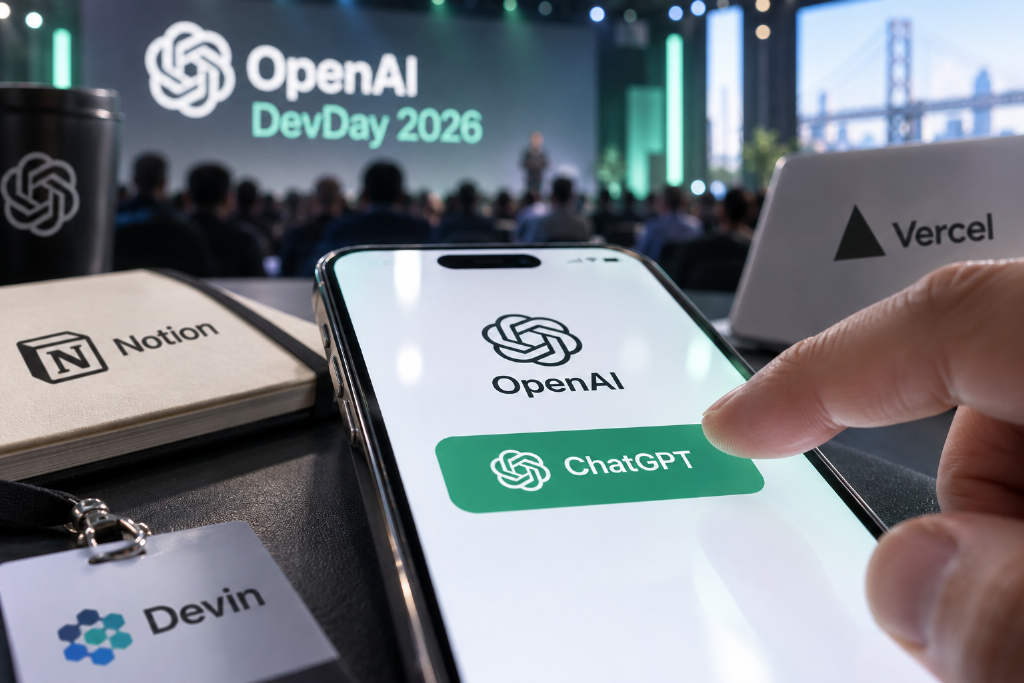
OpenAI has expanded "Sign in with ChatGPT" beyond identity login, turning it into a billing layer that lets participating third-party tools consume a user’s ChatGPT subscription usage. Announced at DevDay 2026, the feature means eligible AI requests inside supported apps can count against ChatGPT Work and Codex usage, without requiring users to create or share an OpenAI API key. The launch group includes 16 partners, with names such as Notion, Vercel, Devin, Dactyl, Warp, OpenClaw, and OpenCode. Lovable is marked as coming soon, while Airtable, Canva, GitLab, HubSpot, and Supabase currently support login only and do not draw from subscription usage. OpenAI told The New Stack it is starting with these 16 partners and plans to expand quickly. OpenAI also laid out several limits. Only Plus and Pro users can let supported apps consume plan usage, though open-source tools can be connected by all users. App-level weekly caps range from 10% to 100% of a user’s overall weekly ChatGPT usage, and those caps are ceilings rather than separate allocations. If users enable ChatGPT credits and auto-recharge, charges may be incurred once subscription usage is exhausted, and OpenAI said users may not always receive a notification when that happens.

1010
OpenAI lets third-party apps tap ChatGPT subscription usage, with 16 launch partners onboard
Total 24 items
Go topage