
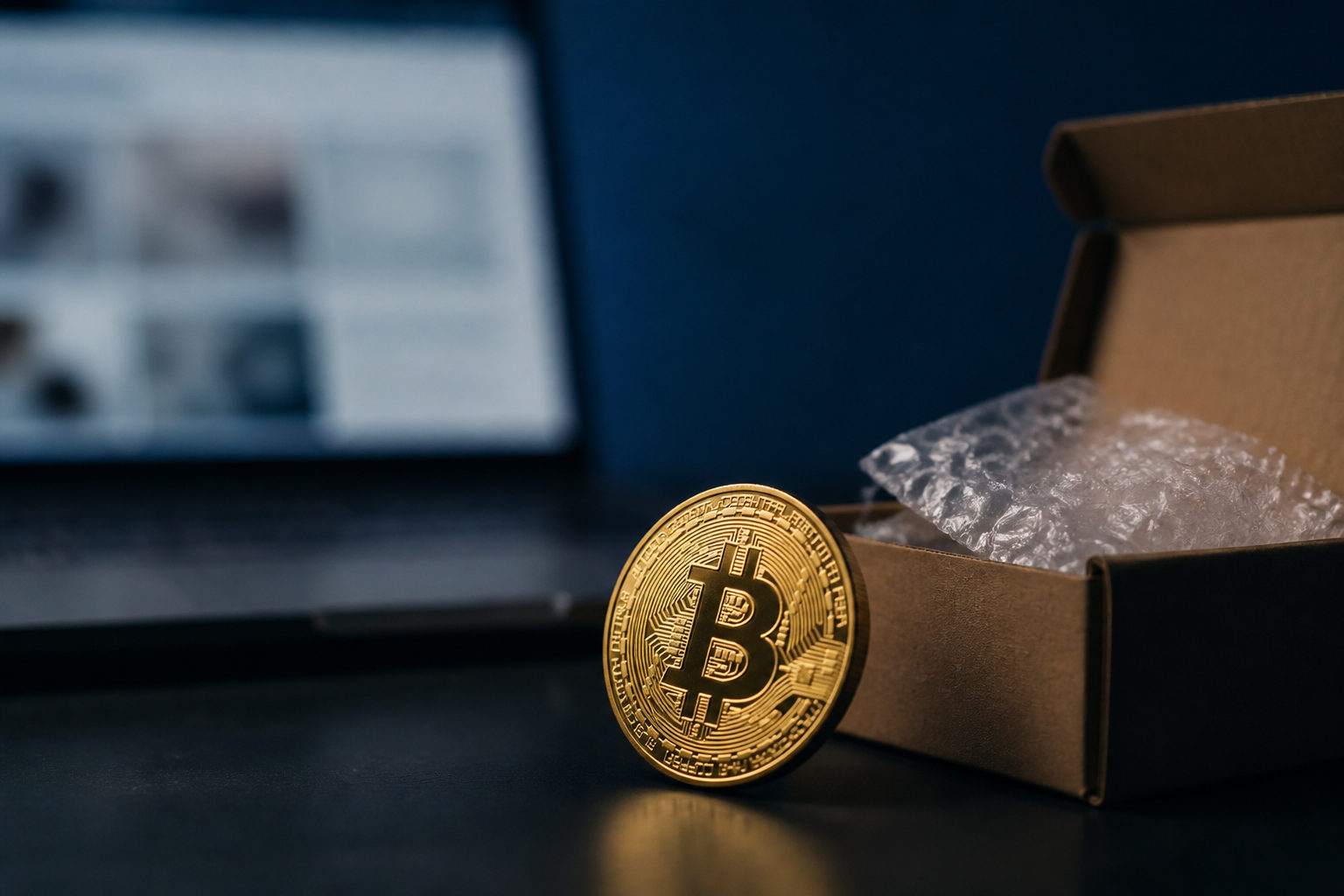
Most $5 “bitcoins” on eBay are not real BTC delivered to your wallet. In most cases, they are souvenir coins, decorative items, or listings that use Bitcoin wording to attract attention.
Start with the main distinction: Bitcoin is not a mailed metal coin
Real Bitcoin exists on the blockchain. What matters is control of private keys and the ability to move funds on-chain, not possession of a round object with a BTC logo on it. That sounds obvious once stated plainly, yet it is where many first-time buyers get confused.
Search results on large marketplaces often mix very different products under one keyword. A listing may include words like bitcoin, BTC, physical bitcoin, token, collectible, or commemorative coin in the title. That does not mean the item includes spendable Bitcoin. It may only mean the product is themed around Bitcoin.
The useful question is not whether the item looks convincing. The useful question is whether the listing gives you verifiable on-chain Bitcoin that you control yourself. If the answer is unclear, you should not treat it as real BTC.
What those eBay “bitcoins” usually are
Once you separate the common listing types, the confusion drops fast. Most disputes come from buyers assuming all “bitcoin” items mean the same thing.
Souvenir or commemorative coins
This is the most common category. These are physical coins made as collectibles, gifts, desk pieces, or novelty items. They may have a gold-colored finish, blockchain-style artwork, the BTC symbol, or references to Satoshi Nakamoto. None of that turns them into actual Bitcoin.
If the description talks about plating, finish, packaging, design, or display value, while saying nothing clear about on-chain transfer, it is almost certainly a themed collectible rather than a digital asset sale.
Props that imitate a “physical Bitcoin” concept
Some products go further and add a QR code, a hidden sticker, a serial-like string, or a peel-off layer to create the impression that the coin carries a private key. That still does not prove the item contains spendable BTC. The code may be decorative, copied, exposed to others, or disconnected from any balance at all.
This is where many buyers overestimate the product. A private key is only valuable if it is secret and under your sole control. If another person saw it during manufacturing, printing, packing, or shipping, then the key cannot be treated as securely yours.
Codes, redemption claims, or account-style offers
Some listings are not selling Bitcoin directly. They may promise a code, an account credit, a redemption process, or a later transfer. That introduces more risk because the buyer may receive only a promise instead of an asset that can be verified independently.
If a seller asks you to trust a later step on another platform, or to rely on vague instructions after purchase, you should slow down. Real Bitcoin ownership should not depend on a seller’s continued cooperation once payment is complete.
Listings that use Bitcoin as a search magnet
Sometimes the product is just a keychain, display case, sticker, card, or gift item, while the word bitcoin is placed early in the title because it helps visibility in search. Buyers who skim titles can easily think they found a cheap way to buy BTC when the item is only related to the subject.
That is why the title alone is a poor guide. The full description, item category, delivery method, and return terms tell you much more about what is actually being sold.
Why a low price does not prove you found cheap Bitcoin
People often ask this because they know Bitcoin can be bought in fractions. That part is true. You do not need to buy a full coin. The smallest unit is 1 satoshi, which is one hundred millionth of 1 BTC. A small amount of money can buy a small portion of Bitcoin.
But that fact leads some buyers to the wrong conclusion. It is possible to buy a small amount of real BTC. It is also common to see cheap physical items labeled with Bitcoin terms that are not BTC at all. Both statements can be true at the same time.
Real Bitcoin derives its meaning from the network, the supply model, and the private key system. The total supply cap is 21 million coins. The network began with the genesis block in January 2009, and the white paper, Bitcoin: A Peer-to-Peer Electronic Cash System, was released in 2008. Bitcoin was designed as a digital system from the start. A metal object can reference it, celebrate it, or mimic it, but it does not become Bitcoin just by looking official.
There is another practical point here. Even if a physical item truly claims to contain BTC, the average buyer has no easy way to know whether the private key was copied before sale. That makes these products a poor choice for anyone who cares about secure ownership rather than novelty.
How to judge whether an eBay “bitcoin” listing is fake, misleading, or just a collectible
You do not need advanced technical skills to avoid most bad listings. A simple checklist catches a lot.
- Read the description for plain language. Does it clearly say souvenir, collectible, replica, novelty, or decorative item? If so, it is not real BTC ownership.
- Check the delivery method. Real digital asset ownership is usually tied to a transfer to a wallet, not shipment of a metal token.
- Ask whether you must trust the seller’s honesty. If the value depends on the seller not having copied a private key, that is already a weak setup.
- Look for independent verification. A real on-chain balance should be verifiable through a blockchain explorer, not through screenshots alone.
- Check the category and fine print. If the item sits in collectibles, crafts, or gift sections, it probably should not be treated as a Bitcoin purchase.
- Look at how the listing handles disputes. Vague wording paired with narrow return conditions is a warning sign.
If any of those points remain fuzzy, the safest working assumption is that you are looking at a Bitcoin-themed product, not Bitcoin itself.
If you want actual Bitcoin, what should you look for instead?
Many people who search this topic are not really trying to collect novelty coins. They want to know how to avoid buying the wrong thing. The answer is simple: if you want real BTC, focus on verifiable control, not visual design.
- Use a real wallet setup. Learn what a receiving address is and how a transfer works.
- Check live prices on mainstream market data pages or established trading venues. Do not infer Bitcoin’s value from an auction listing.
- Confirm that the BTC can be withdrawn to a wallet you control. Withdrawal ability matters more than marketing language.
- Treat private key control as the core test. Whoever controls the key is closest to controlling the asset.
For beginners, this distinction solves most of the confusion. A souvenir coin can still be fun to own. It can be a gift, a desk piece, or a collectible tied to Bitcoin culture. It is only a problem when buyers mistake that object for spendable BTC.
FAQ
Can I really buy Bitcoin on eBay for five dollars?
You may be able to buy a Bitcoin-themed item for that amount, but that usually is not the same as receiving BTC in a wallet. If your goal is to own Bitcoin, you need an actual on-chain transfer or a balance you can verify and withdraw.
Are physical bitcoins always fake?
Not every item can be judged the same way, but ordinary buyers have a hard time proving that a private key was never copied. If ownership depends on trust in the seller, it is not a strong setup for secure holding.
Why does a listing say BTC if it only ships a metal coin?
Because some sellers use Bitcoin terms to describe the theme of the product rather than the thing being transferred. The title may help search visibility, while the detailed description reveals that it is only a collectible.
What is the single best way to tell if the listing includes real Bitcoin?
Ask whether you will receive verifiable BTC in a wallet you control. If the answer depends on vague claims, hidden codes, or steps that only the seller can explain, the risk is high.
Is a Bitcoin souvenir coin still worth buying?
It can be, if you want a collectible or a gift and understand what it is. The mistake is buying it as though it were the same thing as actual BTC.
Before paying, confirm two things: whether the item is only a Bitcoin-themed collectible, and whether you will receive Bitcoin that you can control yourself. If the listing centers on a physical object rather than a verifiable wallet transfer, do not treat it as real Bitcoin.