
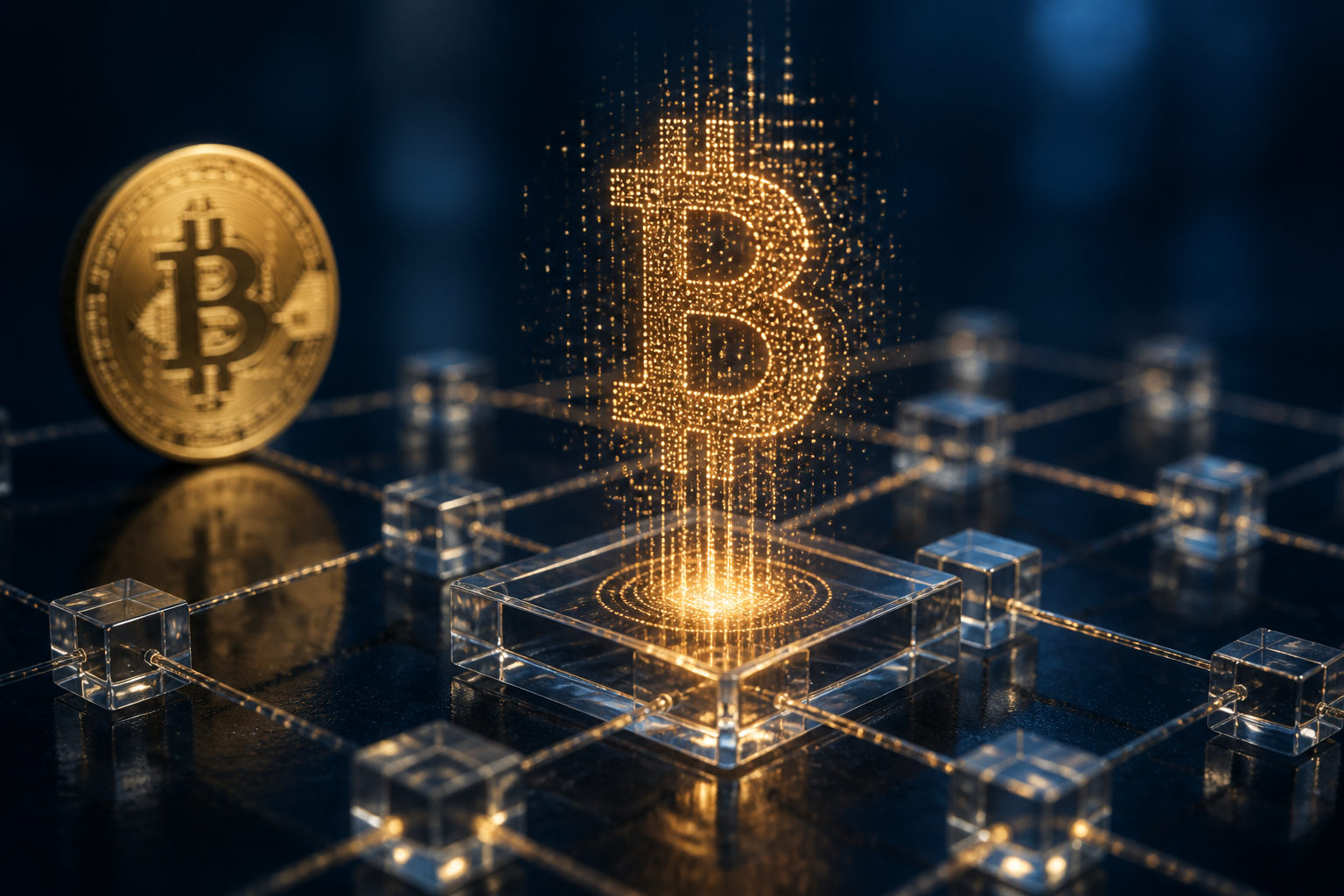
Bitcoin is not a physical coin. It is a digital asset and a peer-to-peer payment system that runs on a blockchain, and the word “coin” describes its monetary role rather than a metal form.
Why people think Bitcoin should be a coin
The confusion starts with the name. When people hear “Bitcoin,” they often imagine something that looks like a traditional coin: round, metallic, maybe gold-colored, with a logo stamped on the front. Search results, news graphics, and social posts reinforce that image with shiny token illustrations.
Those images are symbols, not the thing itself. When someone buys Bitcoin, they do not receive a physical object in the way they would receive cash, a commemorative medallion, or a collectible token. What they gain is control over a balance recorded on a public blockchain, usually through a wallet or a custodial account.
That distinction matters. If you keep thinking of Bitcoin as a literal coin, it becomes harder to understand what ownership, transfer, storage, and security really mean in practice.
What Bitcoin actually is
A better way to describe Bitcoin is to treat it as three things at once. It is a digital asset, a payment network, and a set of rules for verifying and recording transactions on a blockchain. You need all three parts to understand why it works.
The Bitcoin white paper was published in 2008 under the title Bitcoin: A Peer-to-Peer Electronic Cash System. The network began operating with the genesis block in January 2009. Its creator used the name Satoshi Nakamoto, though the real identity remains unknown.
Unlike money in a bank database, Bitcoin does not depend on a single institution to maintain the ledger. Transactions are checked by a distributed network, and the history of transfers is recorded on-chain. A wallet app may show you a balance, but that balance is a readable view of blockchain data, not a pile of digital coins sitting inside your phone.
This is why Bitcoin should not be reduced to “numbers on a screen.” Many systems show numbers on a screen. What makes Bitcoin different is that the ledger is public, the rules are transparent, and users can verify transfers without trusting one company to rewrite the records at will.
Why it is called a coin even though it is not physical
In everyday language, “coin” often means a unit used to store and transfer value. It does not have to mean a metal object. Bitcoin fits the monetary sense of the word, not the museum-piece sense. The label stayed because it is simple and familiar, even if it can mislead beginners.
Its issuance model also shows why the old image does not fit. New bitcoin units are introduced through mining and block rewards, not by minting pieces of metal. A new block is added about every 10 minutes. The issuance schedule changes roughly every 4 years, or every 210,000 blocks, through what is known as the halving. The total supply cap is 21 million.
Bitcoin is also divisible. The smallest unit is a satoshi, and 1 satoshi equals one hundred millionth of a BTC. That alone should make the physical-coin analogy look weak. Physical coins can be divided only by destroying them; Bitcoin can be used in tiny fractions by design.
Another subtle point gets missed here. People often imagine that owning bitcoin means holding a set of separate, numbered digital tokens in a wallet. In normal use, that is not how users experience it. Wallets present balances and transaction history, while the network tracks spendable outputs and validates whether a transaction can be made. The “coin” metaphor is convenient, but it is still a metaphor.
What physical Bitcoin items really are
If you have seen a metal “Bitcoin coin” online, in a shop, or in a video, it is usually a souvenir, a prop, or a collectible. It may look impressive and may even be made of metal, but that does not make it actual bitcoin on the blockchain.
Some products are nothing more than themed merchandise. Others may include access information, a private key, or some kind of claim to digital funds. In those cases, the important part is not the metal shell. The important part is whether the control information is genuine, secure, and known only to the intended owner.
That creates a practical risk for beginners. A physical object can give a false sense of certainty. You can touch it, photograph it, lock it in a drawer, and still have no safe claim to any bitcoin at all. If the private key has been exposed, copied, or generated in an unsafe way, the object may be little more than decoration.
So when people ask whether Bitcoin is “actually a coin,” the most useful answer is this: physical Bitcoin-themed objects exist, but Bitcoin itself does not require a physical form.
What it means to own Bitcoin
Ownership in Bitcoin is really about control. If you use a self-custody wallet, control usually comes from your private key or recovery phrase. Whoever has that information can usually authorize transactions. The wallet software is just a tool for viewing balances and signing transfers.
If you use an exchange or another custodian, the setup is different. You may see a bitcoin balance in your account, but the on-chain control is often held by the service, not directly by you. In that case, what you hold is a claim within that platform’s system, along with whatever withdrawal rights the platform offers.
Neither model is automatically right for everyone, but they are not the same thing. Thinking of Bitcoin as a physical coin hides this difference. Once you understand that Bitcoin is a system of digital control and verification, questions about custody, backup, access, and security become much clearer.
This also explains why security guidance in Bitcoin sounds so strict. There is no bank-style reversal process built into normal on-chain transfers. If a private key is exposed or a transfer is sent to the wrong address, recovery can be difficult or impossible. The form may be digital, but the consequences are very real.
Bitcoin does not have a printed face value
Many people asking whether Bitcoin is a real coin are also asking a hidden price question. If it is not physical, why does it have market value at all? The answer is that Bitcoin does not carry a printed face value like a metal coin. Its price is discovered in the market through buying and selling activity.
That price can be influenced by supply and demand, liquidity, market sentiment, macro conditions, and regulatory expectations. Without live market data, there is no honest way to state a current price. If you want to check it, look at established market data sites, exchange quote pages, or other mainstream price trackers, then compare the source, timestamp, and trading pair.
Understanding this keeps two ideas separate. A coin in your pocket may have a fixed denomination stamped onto it. Bitcoin does not. It is a digitally recorded unit whose market price changes as traders, investors, and users assign value to it in real time.
FAQ
Is Bitcoin the same as a virtual currency in a game?
No. A game currency is usually created and controlled by the game operator, which can change the rules, issue more units, or remove features at any time. Bitcoin runs on an open blockchain with rules that are publicly known and independently verified.
Both are digital, but they are not built on the same trust model. Treating Bitcoin like game points misses the role of self-custody, open validation, and network consensus.
Do I need to buy one whole bitcoin?
No. Bitcoin is divisible, and the smallest unit is a satoshi. Since 1 satoshi is one hundred millionth of a BTC, people can own a fraction rather than a whole coin.
That is one reason the “single coin” image can be misleading. Participation is not limited to buyers of full units.
Is Bitcoin stored inside my phone or laptop?
Not in the way files are stored on a device. Your wallet app mainly manages keys, displays blockchain information, and helps sign transactions. The actual state of ownership is recorded on the blockchain.
This is why people can recover access on a new device if they still have the right recovery information. The device is a tool, not the asset itself.
Are physical Bitcoin collectibles worth anything?
They can have value as collectibles, novelty items, or memorabilia, but that is separate from the value of bitcoin on-chain. A metal token with a Bitcoin logo is not automatically linked to blockchain ownership.
If a product claims to include access to real bitcoin, the key question is whether the control information is authentic and secure. The object alone proves very little.
How can I tell if I really own Bitcoin?
Ask whether you control the relevant access credentials or whether a custodian controls them for you. In self-custody, the focus is on your private key or recovery phrase. In custodial setups, the focus shifts to account rights, withdrawal access, and platform trust.
A screenshot, a souvenir coin, or a promise from someone else is not enough. Real ownership comes down to verifiable control.
Once you understand this, practical decisions get easier
If you stop thinking of Bitcoin as a literal coin, a lot of next steps become easier to judge. Before buying, check whether the service allows withdrawals. Before storing, decide between custody and self-custody. Before sending, verify the address and network carefully. The important thing is not the gold coin image used in marketing; it is whether you understand blockchain records, key control, and how ownership is actually enforced.