
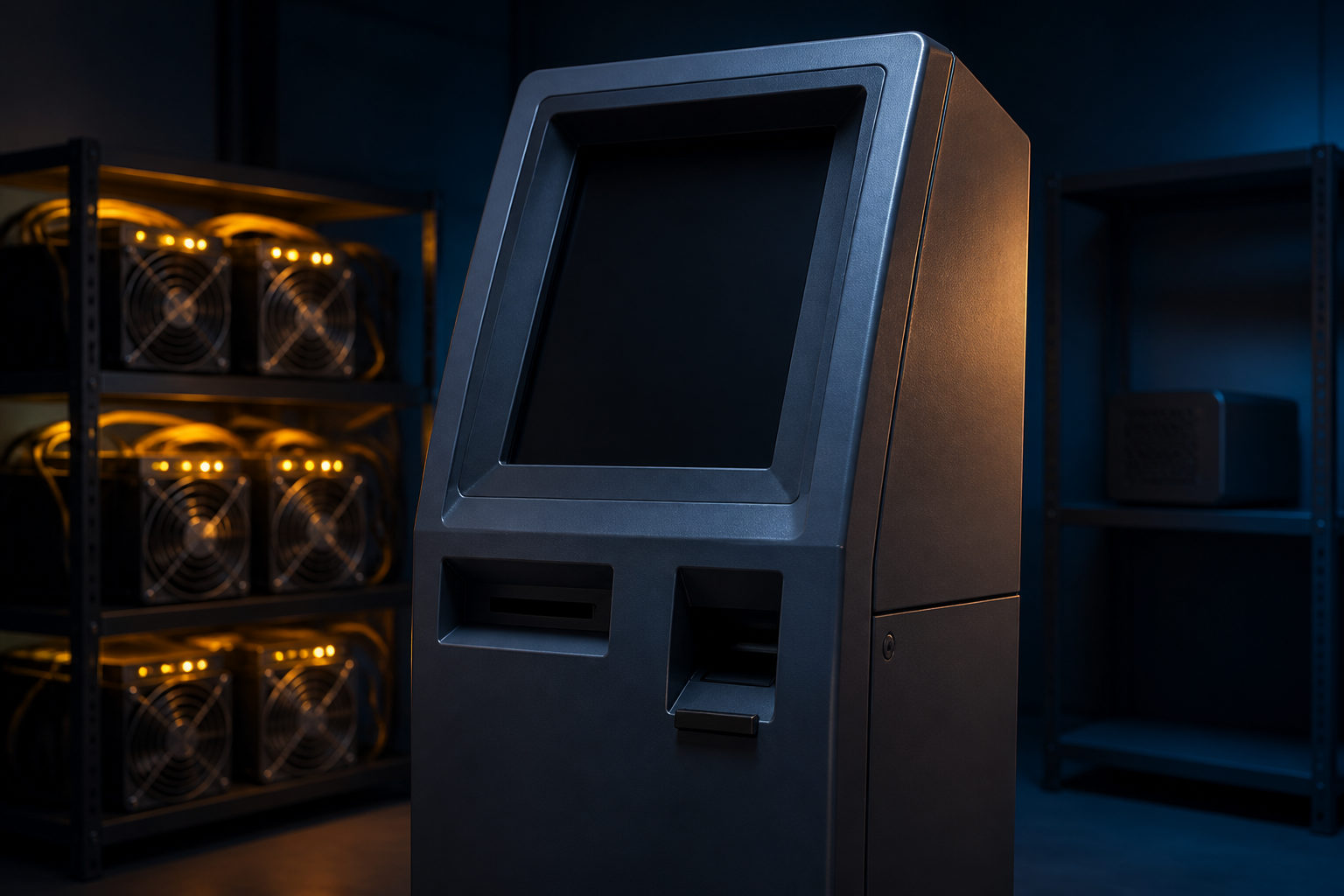
A bitcoin machine usually means a Bitcoin mining machine, though some people use the phrase for a Bitcoin ATM. Those are very different tools, so the first step is to separate mining, buying, and storage.
What people mean by “a bitcoin machine”
In most cases, the phrase refers to a mining machine built to participate in Bitcoin mining. Its job is to perform repeated computations as part of Bitcoin’s proof-of-work system, usually while connected to a mining pool.
Some users, though, mean a Bitcoin ATM. That type of machine is for buying or selling bitcoin in person, not for creating new coins. A few people also use the phrase for a hardware wallet or even a computer running wallet software, but that is loose language rather than standard industry usage.
| Type of machine | Main purpose | Used for mining | Typical user |
|---|---|---|---|
| Bitcoin mining machine | Provide hash power for mining | Yes | Miners and mining operations |
| Bitcoin ATM | Buy or sell bitcoin | No | Retail users |
| Wallet device | Store private keys and send or receive bitcoin | No | Holders and merchants |
If you mean a mining machine, here is what it does
Bitcoin targets a new block about every 10 minutes. Mining machines keep trying valid solutions under the network rules; when a miner or pool finds one first, that block can be added to the chain.
Bitcoin’s supply schedule is fixed. The total cap is 21,000,000 BTC, with issuance expected to continue until about 2140. The block subsidy is cut in half every 210,000 blocks, roughly every four years, and halvings have already happened on 2012-11-28, 2016-07-09, 2020-05-11, and 2024-04-19. The current block reward is 3.125 BTC, and the next halving is expected around 2028.
That does not mean one machine has a predictable payout. The network as a whole adds about 450 BTC per day at the current subsidy, but that is a network-wide figure, not a personal output target. What one operator earns depends on machine efficiency, electricity cost, downtime, pool terms, and how competitive the network is at the time.
Why a mining machine is not just a normal computer
Modern Bitcoin mining is done with specialized hardware designed for one narrow task. It is very different from a home PC used for office work, gaming, or video editing.
The machine itself is only part of the setup. Power delivery, heat management, network stability, dust control, and maintenance all matter. If any one of those pieces is weak, the machine may run poorly or stop running when it is needed most.
Before buying one, check whether you actually need it
People often focus on the idea of “getting bitcoin from a machine” and skip the operating reality. A mining machine is closer to equipment you manage than a passive product you switch on and forget.
| Question | Good sign | Warning sign |
|---|---|---|
| Power access | You have a stable and affordable power plan | You only know that a household outlet exists |
| Noise and heat | You have a separate place for loud, hot equipment | You plan to place it in a bedroom or living area |
| Maintenance | You can handle restarts, faults, and connection issues | You expect zero intervention after setup |
| Return expectations | You understand returns can change over time | You expect fixed daily income |
| Goal | You know whether you want exposure or equipment operations | You are mixing up mining with simply owning bitcoin |
If your goal is simply to hold bitcoin, buying bitcoin directly is often the more straightforward route. A mining machine makes more sense for someone who wants to run hardware, monitor costs, and accept operational risk.
If you mean a Bitcoin ATM, the decision framework changes
A Bitcoin ATM does not create bitcoin. It acts as a transaction point where a user can buy or sell, complete identity checks if required, and send funds to a wallet address.
With an ATM, performance metrics are not the issue. The practical questions are fees, whether the machine supports buying only or two-way transactions, what identity checks are required, how funds settle, and whether the wallet address is correct before confirming the transaction.
| Use case | Mining machine | Bitcoin ATM |
|---|---|---|
| Main function | Compete for block rewards through mining | Help users buy or sell bitcoin |
| Entry barrier | High, with hardware and operating demands | Lower, if you already know how to use a wallet |
| Main concerns | Power, cooling, upkeep, pool setup | Fees, compliance steps, address accuracy |
| Best for | Operators willing to manage equipment | Users who want transaction access |
Common mix-ups that cause bad decisions
One common mistake is treating a mining machine like an automatic income device. Bitcoin’s monetary rules are public and fixed, but a single machine’s outcome is variable, because it sits inside a competitive network rather than outside it.
Another mistake is confusing storage tools with mining tools. A wallet device protects private keys and helps you send or receive bitcoin; it does not mine. Bitcoin can also be divided very finely, with 1 satoshi equal to 0.00000001 BTC, which matters for payments and storage but says nothing about what a machine can produce.
A third mistake is assuming there is an official Bitcoin machine. Since Bitcoin began with the genesis block on 2009-01-03, there has never been a single official machine type. Different devices exist because users have different goals: mining, transacting, or custody.
FAQ
Does “a bitcoin machine” usually mean a miner?
Most of the time, yes. Still, some people mean a Bitcoin ATM, especially if they are asking where to buy or sell bitcoin in person rather than how mining works.
Can I run a Bitcoin mining machine at home?
It can be done in technical terms, but that does not make it practical. Heat, noise, electrical planning, and ongoing upkeep are usually the first real obstacles.
Is buying a mining machine better than buying bitcoin directly?
That depends on your goal. If you want price exposure, direct ownership is often simpler; if you want to operate hardware, a mining machine is a different kind of commitment with different risks.
What does a Bitcoin ATM actually do?
It provides a physical access point for buying or selling bitcoin. You still need to pay attention to wallet setup, fees, and any identity verification required by the operator.
Can anyone tell me exactly how much one machine will earn?
No honest answer can be universal. The network reward schedule is fixed, but individual results change with uptime, costs, machine performance, and network competition.
If you are evaluating a bitcoin machine, write down the exact job you want it to do: mine, help you trade in person, or secure private keys. Once that purpose is clear, the right machine type becomes obvious, and so do the costs and risks that actually matter.
Disclaimer: This article is for informational and educational purposes only and is not investment, financial, or legal advice. Crypto assets are highly volatile and you could lose your entire investment. Do your own research and decide carefully.