
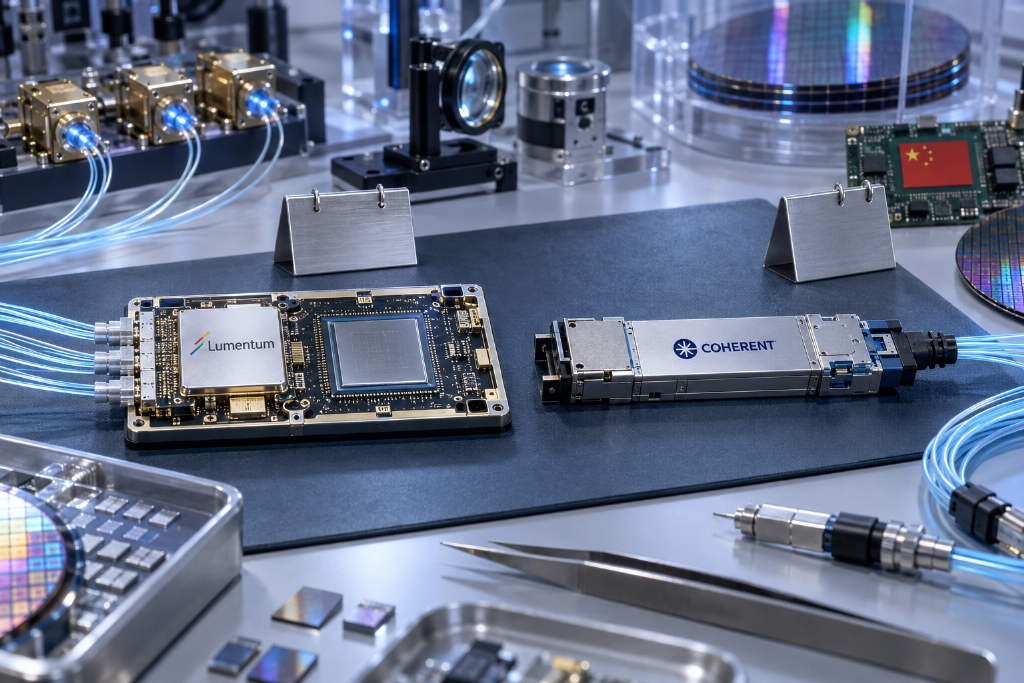
Bernstein said in a report dated Oct. 12, 2026 that the market is deeply divided over the rollout of co-packaged optics, or CPO, and near-packaged optics, or NPO. The firm said investors are not convinced CPO can reach volume production in 2028, while NPO could be ready in 2027. Even as competition in Asia picks up, Bernstein said the technology moat around Lumentum and Coherent remains in place.

Lumentum (LITE) trades at 49.3x expected 2027 earnings, while Coherent (COHR) trades at 32.9x, leaving a wider valuation gap between the two. Bernstein said the market may be overpricing the risk of CPO delays and kept Outperform ratings on both names.
Long-only investors are still largely waiting
According to the report, feedback from long-only investors was mostly basic investor education, suggesting many still have no position or only hold the stocks at index weight. In Bernstein's telling, that group has not formed a strong view in the Lumentum-versus-Coherent debate and has instead expressed frustration about the difficulty of building conviction.
Some investors also criticized how Lumentum communicates with the market. One investor said the company updated guidance at a bank conference rather than at a company event and called that approach inappropriate. Another said that style of communication could reward investors who trade more actively around bank conference calendars and could tilt the shareholder base toward faster money.
The market still questions a 2028 CPO ramp
Among hedge funds, the standing narrative is that scale-up optics is the next leg of growth and that the timing will be decided by CPO. Bernstein said investors lack confidence that CPO will achieve volume production in 2028.
The report cited Asia checks showing Foxconn is set to produce 10k CPO switches in the fourth quarter of 2026 and plans 30k in 2027. Assuming $500 per unit, Bernstein said CPO would account for roughly 2% of 2026 revenue, while the 2027 unit figure would still sit below the annualized run rate.
On the manufacturing side, Bernstein said the core problem in CPO is fiber alignment. Fiber has a low melting point and cannot withstand the high temperatures involved in soldering, so the connection has to be made later in the process. A single fiber alignment error can ruin the entire optical engine. NPO, by contrast, uses a socket-based fiber connection that addresses that issue. The fiber can be tested before insertion into the optical engine, and the process can be completed using a known-good engine.
NPO is gaining ground as a fallback option
Bernstein said investors are becoming more confident that NPO can serve as an alternative for scale-up optics. In the firm's view, NPO could be ready in 2027. If CPO keeps slipping, NPO may become a sufficient substitute.
That shift brings its own questions. Investors worry that vertical-cavity surface-emitting lasers, or VCSELs, and microLEDs could be used in scale-up NPO in ways that weaken the technology advantage now enjoyed by Lumentum and Coherent. The report said both companies are widely seen as having their deepest moat in high-power lasers. If low-power VCSELs or microLEDs prove good enough for scale-up NPO, the relevance of that high-power edge could diminish.
Bernstein also pointed to Asokan Seyedi's move from Nvidia to AMD-OSRAM, which some investors read as validation of AMD-OSRAM's microLED approach.
Asian competition adds another variable
Investors in Asia put more emphasis on intensifying competition, especially from China. The report said continuous-wave, or CW, lasers may face oversupply. Some U.S. investors argued there is still a regulatory moat because the U.S. government is unlikely to allow imports of Chinese-made lasers.
Others pushed back. Even if Chinese suppliers cannot ship into the U.S., they said, import substitution in China and potential exports into other non-U.S. markets could still hurt the industry's supply-demand balance.
OCS is drawing interest, but the growth path is unclear
Optical circuit switching, or OCS, has also attracted attention. Bernstein gave a rough estimate of a roughly $6 billion market but said it does not have confidence in the growth trajectory.
The firm said OCS is not a true replacement for traditional switching. Adopting OCS would require a redesign of rack architecture. Bernstein said there is clear interest and experimentation, but it is not sure whether other players are willing to invest in rack redesign at that level or whether OCS can build a dependable growth curve from here.
Bernstein keeps Outperform on both stocks
Bernstein said Lumentum is generally viewed as the stronger company relative to Coherent, with a clearer technology lead. Still, investors are sharply divided over Lumentum's 2028 earnings per share. Some see $40 as the revised upper bound, while others believe there is a path to $55.
As the valuation gap widened, some investors shifted toward being long Coherent instead of favoring Lumentum alone.
Bernstein updated its estimates for Lumentum for fiscal 2028 and beyond and maintained Outperform ratings on both companies. Its price target is $1,220 for Lumentum and $350 for Coherent. It forecasts 2027 EPS of $22.40 for Lumentum and $9.51 for Coherent, implying forward P/E multiples of 49.3x and 32.9x, respectively.
The firm said the risk-reward profile remains skewed to the upside for both names, with a high probability of upside surprises and estimate revisions over the next few quarters. It also said the technology debate is unlikely to shift much before OFC, which has historically acted as a positive catalyst for the subsector.
The ratings, price targets, earnings forecasts and related views cited here are from Bernstein's Oct. 12, 2026 report. The original article said those views represent the brokerage and its analysts, not TechFlowPost, and do not constitute investment advice.
